

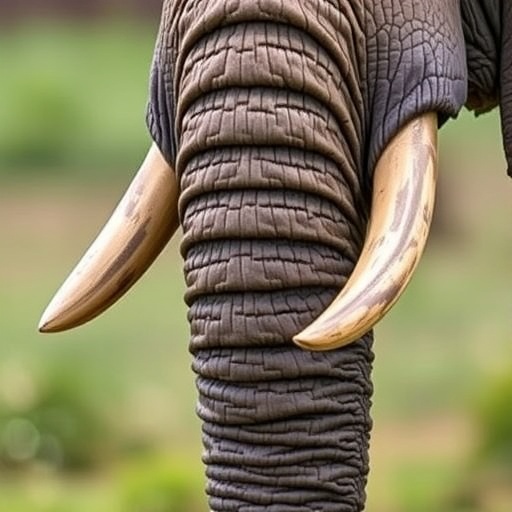
In a breakthrough that merges biology with robotics and materials science, researchers from the Max Planck Institute for Intelligent Systems (MPI-IS) in Germany have unraveled the extraordinary tactile abilities of the Asian elephant’s trunk. This discovery hinges on the unique properties of the approximately 1000 whiskers that adorn the elephant’s trunk, revealing a sophisticated mechanism that compensates for the animal’s thick skin and less acute vision. Published in the prestigious journal Science, the study illuminates how subtle material gradients in these whiskers enable elephants to perform delicate tasks with a gentle touch, challenging long-held assumptions about the sensory capabilities of their iconic trunks.
Elephant trunks, known for their strength and versatility, have mystified scientists for decades due to their remarkable dexterity. While the trunk’s muscular and neural architecture has been extensively studied, the role of its whiskers in tactile sensing had remained largely unexplored. The interdisciplinary team of scientists, led by Dr. Andrew K. Schulz and Professor Katherine J. Kuchenbecker at MPI-IS, took a novel approach combining biomechanics, haptics, neurobiology, and advanced materials characterization to delve into the microscopic structure and mechanical behavior of these whiskers.
Whiskers, or vibrissae, are specialized tactile hairs found in many mammals, but the structure and function of elephant whiskers are notably distinct from those of smaller animals such as rats and mice. Contrary to the uniform stiffness seen in rodent whiskers, the elephant’s trunk whiskers exhibit a remarkable functional gradient. Their bases are stiff and plastic-like, transitioning seamlessly to soft, highly resilient, rubber-like tips. This gradient allows an elephant to detect precisely where contact is occurring along each whisker, an ability that significantly enhances tactile feedback despite being shrouded beneath thick skin, making superficial touch sensors inadequate.
The research team employed micro-computed tomography (micro-CT) scans to map the intricate three-dimensional geometry of elephant whiskers. These scans disclosed a flattened, blade-like cross-section, with a hollow base housing internal channels similar to those seen in sheep horns and horse hooves. Such porosity and structural specialization reduce the whisker’s weight and increase its resilience against the enormous mechanical demands elephants face while foraging, which often involves handling massive quantities of food daily.
Delving further, the researchers used nanoindentation techniques to probe mechanical properties at the scale of micrometers. They found that the base of each whisker resists deformation rigidly, while the tip responds more flexibly and elastically to touch. These measurements revealed a continuous gradient in stiffness rather than abrupt changes, critical to ensuring tactile sensitivity without risking damage. Importantly, comparisons with the uniformly stiff body hair of elephants confirmed this functional gradient is unique to trunk whiskers, underscoring their specialized role in sensing.
To elucidate the functional advantages of this gradient, the team fabricated a life-sized 3D-printed model of an elephant whisker with analogous material properties— a stiff, dark base transitioning to a soft, transparent tip. Experiments with this “whisker wand” demonstrated that tactile interactions at different points along the whisker produce distinct sensations perceptible without visual cues. This validates the hypothesis that elephants can internally map where along each whisker a contact occurs, leveraging this to intuitively gauge the position and properties of objects they touch.
Computational modeling further corroborated these findings, simulating how the whisker’s unique geometry coupled with the stiffness gradient enhances the spatial resolution of tactile feedback. These simulations indicated that the gradient not only prevents breakage but also decodes contact location along the whisker’s length, effectively giving elephants a spatially nuanced sense of touch. This natural “embodied intelligence” may partly explain how elephants manage tasks requiring extraordinary delicacy, such as plucking a single peanut or lifting fragile objects like a tortilla chip without damage.
Intriguingly, the researchers observed that domestic cat whiskers share similar stiffness gradients despite their vastly different scales and ecological niches. This cross-species convergence suggests that stiffness gradients in vibrissae may be a widespread evolutionary adaptation optimized for tactile precision while maintaining structural durability, though each species leverages this trait in unique ways suited to their behavior and environment.
These insights not only deepen our understanding of elephant sensory biology but also pave the way for transformative innovations in robotics and sensor technology. By embedding analogous functional gradients in artificial tactile sensors, engineers could create robotic systems that ascertain contact location with unprecedented accuracy and low computational costs, simply by harnessing the mechanical properties of smart materials. This bio-inspired approach holds promise for developing more sensitive, robust prosthetics, and dexterous robotic manipulators capable of handling delicate tasks in unstructured environments.
The interdisciplinary nature of this study exemplifies the power of collaborative research spanning engineering, materials science, neurobiology, and biomechanics. “It was an exhilarating journey,” reflects Professor Kuchenbecker, “to discover how material gradients effectively encode tactile information. Working across five research groups and multiple disciplines was crucial in unveiling the science behind the elephant’s gentle yet powerful touch.” Lead author Dr. Schulz adds, “Our work bridges the gap between biological insight and technological application, showing that nature’s designs contain elegant solutions that robotics can learn from.”
Neuroscientist Dr. Lena V. Kaufmann of Humboldt University, a key contributor to the study, emphasizes the broader implications for neuroscience: “Unraveling how whisker material properties influence tactile perception in elephants opens fertile ground for exploring the neural computations underpinning touch. Understanding these principles could revolutionize our grasp of sensory coding in mammals.” As this research unfolds, it promises to inspire further investigations into how form and function converge in tactile sensing, both in nature and artificial systems.
This seminal work highlights that some of the most sophisticated engineering marvels exist in the natural world, hidden in plain sight. The elephant’s trunk, a marvel for its strength, flexibility, and now finely tuned tactile feedback driven by functional gradients in its whiskers, offers a blueprint for future haptic technologies. Through the synthesis of biology and materials science, the researchers have not only demystified an ancient sensory organ but also set a course toward smarter, more sensitive machines that can touch and feel the world in ways previously thought impossible.
Subject of Research: Not applicable
Article Title: Functional gradients facilitate tactile sensing in elephant whiskers
News Publication Date: 12-Feb-2026
Web References: DOI: 10.1126/science.adx8981
References: Schulz, A. K., Kaufmann, L. V., Smith, L. T., Philip, D. S., David, H., Lazovic, J., Brecht, M., Richter, G., Kuchenbecker, K. J. “Functional gradients facilitate tactile sensing in elephant whiskers,” Science, 2026.
Image Credits: MPI-IS/A. Posada and Heidelberg Zoo
Keywords: Elephant whiskers, tactile sensing, functional gradient, haptic intelligence, biomechanics, materials science, robotics, nanoindentation, micro-CT, embodied intelligence, bio-inspired sensors, neurobiology


