

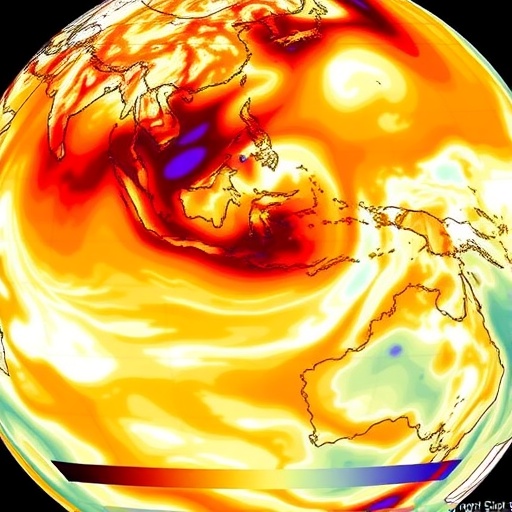
El Niño’s Lingering Shadow: Unraveling Its Persistent Toll on Life Expectancy and Economic Stability
The formidable climatic phenomenon known as El Niño has long been associated with immediate environmental disruptions—altered weather patterns, extreme heat events, and widespread ecological shifts. However, groundbreaking new research published in Nature Climate Change profoundly expands our understanding of El Niño, demonstrating that its impacts ripple far beyond these short-term shocks, exerting a persistent and pervasive drag on human mortality and economic productivity over several years. Contrary to prevailing assumptions that treat El Niño’s effects as transient, this study reveals a complex temporal dimension, whereby the mortal toll and economic burdens compound, undermining global public health resilience and economic stability, especially in regions with high El Niño teleconnection exposure.
The research meticulously quantifies the enduring mortality impacts associated with El Niño events, uncovering a sustained deceleration in mortality improvement rates spanning multiple years after each El Niño episode. This phenomenon means that populations do not simply experience a momentary health crisis but endure an elongated period of increased mortality risk, undoing decades of progress in life expectancy advancements. Intriguingly, the study highlights that younger demographics bear the greatest relative mortality burden. This finding aligns with biological and socio-environmental theories suggesting younger individuals’ heightened vulnerability due to disproportionately high exposure to climate-related stressors and comparatively limited adaptive capacity. These insights challenge policymakers and public health officials to reconsider age-specific vulnerabilities within climate adaptation frameworks.
While the young suffer the heaviest mortality toll, the largest economic costs attributable to El Niño manifest predominantly within the middle-aged cohort, identified as the prime productive segment of the workforce. This is a crucial distinction: although younger populations endure higher mortality rates, the economic repercussions accrue most significantly where productivity losses intersect with demographic structures—reflecting the larger workforce share and limited remaining lifespan within this group. By quantifying the differential economic burdens, the study illuminates how El Niño-induced mortality shifts translate into tangible labor productivity losses with far-reaching macroeconomic consequences. This carries implications for labor policy, insurance mechanisms, and social safety nets in affected regions.
Traditional mortality and economic forecast models, the authors argue, risk substantially underestimating the full human cost arising from climate variability, specifically El Niño cycles. Prevailing models often lack the longitudinal perspective necessary to capture extended lag effects on health and economic outcomes. By integrating distributed-lag analytical techniques, the study robustly demonstrates how mortality shocks propagate and persist, continuing to degrade population health profiles years after initial climatic disruptions. This paradigm shift emphasizes that the health repercussions of climate drivers unfold not just in immediate crisis windows but accumulate insidiously over time, calling for a profound recalibration of climate-health impact assessments.
Framing these findings within the broader context of El Niño-Southern Oscillation (ENSO) health literature reveals a compelling complementarity. Whereas prior investigations predominantly documented ephemeral spikes in mortality and morbidity coincident with immediate El Niño episodes, this work pioneers a longer-term vantage point. This broader temporal scope uncovers the latent nature of ENSO’s public health imprint—an imprint concealed beneath the surface of short-term event analysis. Such evidence bridges existing knowledge gaps and enriches multi-year epidemiological models, underscoring the necessity for sustained health surveillance post-el Niño events to capture delayed and compounding health crises generated by climate variability.
Methodologically, the study employs a parsimonious lag framework combined with established teleconnection indices, striking a balance between interpretability and statistical power. Sensitivity analyses reinforce the robustness of conclusions, incorporating generalized nonlinear distributed-lag models and varied teleconnection measurements across multiple regions and demographic groups. Nevertheless, data limitations persist most acutely in low-income settings, where health reporting infrastructure is often incomplete and causal pathways may diverge. This underlines that current estimates likely represent conservative lower-bound assessments of El Niño’s long-term mortality and economic burdens, signaling an urgent need to enhance data collection and analytic capacity in vulnerable locales.
Importantly, the authors articulate actionable policy recommendations grounded in their empirical findings. As climate mitigation strategies chiefly address greenhouse gas emissions and longer-term global temperature trajectories, they offer limited immediate respite against ENSO-related mortality headwinds that persist in near-future climates. Therefore, targeted climate adaptation must be prioritized, leveraging ENSO-sensitive early-warning systems and integrating climate-informed public health operations. Regions—particularly Latin America—with strong teleconnection exposure warrant focused adaptation strategies, including enhanced heat-health action plans and labor protections designed to buffer productivity and wellbeing losses. These interventions aspire to not only reduce mortality but also fortify economic resilience amid recurrent El Niño cycles.
Further, the research advocates the development of advanced, age-stratified, and cause-specific public health metrics tailored to the spatiotemporal dynamics of ENSO impacts. The creation of intra-annual, high-resolution monitoring frameworks could refine attribution capacities and facilitate precise targeting of adaptation resources. By expanding this infrastructure beyond affluent countries into diverse income contexts, global health systems can better confront ENSO-driven challenges. This comprehensive, data-driven adaptation apparatus emerges as essential for managing the evolving public health landscape shaped by intensifying climate variability.
The nuanced appreciation of El Niño’s effects elucidated here confronts previous underestimations inherent in climate-health forecasting. It emphasizes that the enduring repercussions on public health and economies are not mere ephemera but constitute substantive, prolonged burdens. This revelation carries profound implications for economic planning, healthcare provisioning, insurance and social safety schemes, and climate policy formulation. Understanding that ENSO’s impacts are temporally diffused underscores the necessity for longitudinal strategies, sustained resource allocation, and interdisciplinary approaches that synthesize climatology, epidemiology, and economics.
Moreover, by integrating distributed-lag models that capture delayed mortality effects, the research integrates methodological rigour with practical relevance. This modeling innovation positions the study at the forefront of climate impact assessment, fostering new avenues for capture and interpretation of complex temporal dynamics in population health. The approach offers a blueprint for further research exploring other climate variability phenomena, amplifying its significance beyond ENSO alone. By refining analytical frameworks, the study advances the fidelity and predictive power of climate-health impact studies, enriching scientific discourse.
Crucially, this research illuminates a latent public health hazard that demands urgent scholarly and policy attention. It reframes El Niño from a transient disruptor to an enduring stressor, reshaping risk assessments and adaptation planning. This redefinition invites renewed interdisciplinary collaboration, urging climatologists, public health experts, demographers, and economists to unite in tackling the manifold implications posed by ENSO’s persistence. It is a call to action backed by robust empirical evidence, signaling an inflection point in how society perceives and manages climate variability risks.
The comprehensive exploration of El Niño’s long-term effects also resonates with ongoing dialogues about climate justice and equity. The disproportionate impacts on less resilient populations and lower-income regions highlight critical inequities exacerbated by ENSO’s protracted toll. Recognizing these disparities informs equitable adaptation prioritization and resource distribution. This research thereby contributes to a more socially conscious narrative in climate-health discourse, ensuring that vulnerable populations are not overlooked amid global climate mitigation and adaptation efforts.
Finally, by delineating the multi-year accumulation of El Niño-induced mortality and economic impacts, the study empowers stakeholders with actionable intelligence. It lays the foundation for integrative health and economic policies adaptive to climate-induced volatility. These insights affirm that comprehensive climate resilience must account for both immediate and deferred consequences of complex ocean-atmosphere oscillations, necessitating renewed vigor in research, surveillance, and policy innovation. As El Niño events become increasingly frequent and intense under climate change scenarios, this work provides critical foresight to safeguard public health and economic vitality.
In sum, this landmark study reorients our understanding of El Niño’s impact from episodic disruptions to persistent, multi-year burdens on life expectancy and economic productivity. It calls for targeted adaptation strategies, enhanced data infrastructures, and a paradigm shift in climate variability risk assessment. These findings spotlight ENSO as a critical nexus in the climate-health-economic nexus, demanding intensified attention to protect both human lives and livelihoods in an increasingly volatile climate future.
Subject of Research: The study investigates the enduring impacts of El Niño events on mortality rates and economic productivity over multiple years, analyzing how climate variability affects life expectancy and economic burdens across different age groups and global regions.
Article Title: Enduring impacts of El Niño on life expectancy in past and future climates
Article References:
Xu, Y., Zhu, W., Samanta, D. et al. Enduring impacts of El Niño on life expectancy in past and future climates. Nat. Clim. Chang. (2026). https://doi.org/10.1038/s41558-025-02534-4
Image Credits: AI Generated


