

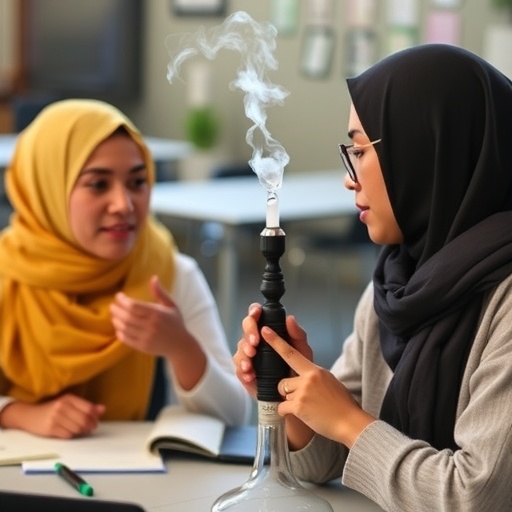
A recent study has shed light on a concerning trend among female university students: the growing prevalence of hookah smoking. With the allure of social interaction and a perception of reduced harm compared to traditional cigarettes, hookah smoking has become more than just a cultural practice; it is now a public health concern that demands attention. Researchers Khalilzadeh-Farsangi, Borzu, and Najafi have taken a comprehensive approach to understand and address this issue through an educational program grounded in behavioral theories.
The educational initiative was anchored in two influential behavioral frameworks: the Theory of Planned Behavior (TPB) and the Prototype Willingness Model (PWM). These theories provide a robust framework for analyzing how attitudes, perceived norms, and self-efficacy shape an individual’s likelihood of engaging in risky behaviors, such as smoking. By integrating these models, the researchers aimed to craft a nuanced strategy tailored to the unique challenges faced by female university students.
The research process began with thorough qualitative assessments to identify the specific motivations and barriers related to hookah smoking within this demographic. Surprisingly, many participants reported that they believed hookah smoking to be a less harmful alternative to cigarettes, an assumption that is often misleading. This perception is dangerous, as it can lead to increased consumption and adverse health effects over time. Armed with these insights, the educational program was designed with targeted content and activities that directly address these misconceptions.
To engage participants effectively, the program was structured around interactive sessions that combined theoretical knowledge with practical applications. Students participated in discussions about the health risks associated with hookah smoking, including the misconception of safety that often surrounds it. Interactive elements like role-playing scenarios helped participants confront social pressures and peer influences, common triggers that lead to smoking.
The team also highlighted the role of social media in shaping perceptions surrounding smoking. With platforms serving as a primary source of information and social validation, understanding the impact of online representations of smoking can help participants navigate their views. By providing accurate information, the program aimed to undermine the glamorization of hookah smoking often seen in social media narratives.
Evaluation of the program revealed significant shifts in knowledge and attitudes among participants. Pre- and post-program surveys indicated that many female students who initially viewed hookah smoking through a romanticized lens began to express concerns over its health implications post-intervention. The reframing of smoking from a benign social activity to a serious health risk was an essential outcome that showed the potential efficacy of the educational program.
In addition to knowledge changes, the program also addressed behavioral intentions. Through the lens of the TPB, participants were encouraged to reflect on how their beliefs could influence their future actions. The concept of behavioral intentions serves as a predictor of actual behavior, which means that positively altering perceptions can potentially lead to decreased smoking rates in the long term.
Furthermore, the Prototype Willingness Model underscored the importance of social norms among peers. Participants explored how their social circles shaped their willingness to engage in smoking and were encouraged to envision a future where they could redefine those norms within their communities. This empowerment aspect of the program was designed to cultivate a sense of agency, reinforcing that each participant has the capacity to influence both their own choices and those of their peers.
The study’s findings are critical not only for developing targeted interventions for female university students but also emphasize the need for broader awareness campaigns. The research highlighted the role of educational institutions in combatting the rising trend of hookah usage. Universities, as hubs of young adult socialization, are uniquely positioned to implement policies and support structures that discourage such behaviors and promote healthier lifestyle choices.
As public health officials continue to grapple with the nuanced landscape of smoking behaviors, this study offers valuable insights into the complexities of young adult tobacco use. The clear message resonating from Khalilzadeh-Farsangi and colleagues’ research is that education is a powerful tool. It can equip students with the knowledge and skills necessary to make informed choices, combat misinformation, and ultimately lead to healthier futures.
Moving forward, it is imperative for additional research to explore the long-term impacts of such educational programs. Establishing longitudinal studies will be essential to determine whether changes in knowledge, attitudes, and behaviors are sustained over time. Furthermore, expanding this research to include diverse demographics would provide insights into universal versus specific factors influencing smoking behaviors.
The fight against hookah smoking among young adults is far from over. As societal attitudes continue to evolve, integrating knowledge from empirical studies into public health initiatives will be crucial. Education and awareness programs hold promise as essential components of a broader strategy aimed at reducing tobacco-related harm, ensuring that future generations are more informed and less susceptible to the allure of smoking.
In conclusion, the investigation led by Khalilzadeh-Farsangi et al. serves as a clarion call to action. The rising trend of hookah smoking among female university students necessitates a robust response grounded in research, education, and community engagement. This study not only highlights the immediate need for informed interventions but also sets the stage for future explorations into how we can effectively tackle smoking behaviors in our society.
Subject of Research: The effect of an educational program on Hookah smoking among female university students.
Article Title: The effect of an educational program on Hookah smoking among female university students: applying the integrated model of theory of planned behavior and prototype willingness model.
Article References: Khalilzadeh-Farsangi, Z., Borzu, Z.A. & Najafi, F. The effect of an educational program on Hookah smoking among female university students: applying the integrated model of theory of planned behavior and prototype willingness model. BMC Med Educ 25, 1582 (2025). https://doi.org/10.1186/s12909-025-08170-y
Image Credits: AI Generated
DOI: https://doi.org/10.1186/s12909-025-08170-y
Keywords: Hookah smoking, female university students, health education, Theory of Planned Behavior, Prototype Willingness Model, public health.


