

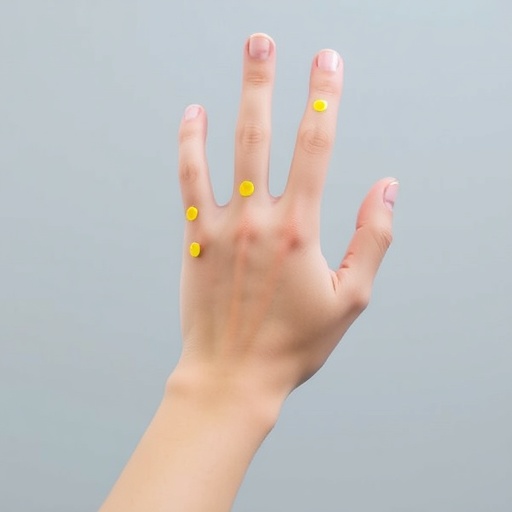
In an era where personalized medical solutions are rapidly evolving, the quest for effective, wearable therapy devices has taken a significant leap forward with the introduction of EdemaFlex. This groundbreaking development emerges from the collaborative efforts of researchers Youn, Choudhury, Ku, and colleagues who have crafted a novel textile-based soft-robotic platform engineered specifically for hand edema therapy. Their study, slated for publication in npj Flexible Electronics in 2026, promises to revolutionize how patients suffering from hand edema—a condition marked by painful swelling and restricted mobility—can manage their symptoms with greater precision, comfort, and efficacy.
The EdemaFlex platform exemplifies the convergence of advanced soft robotics and smart textiles, two fields that have individually transformed healthcare technologies but when combined, offer unprecedented therapeutic possibilities. Traditional edema treatments often rely on bulky compression garments and manual interventions that lack adaptive control and personalization. EdemaFlex disrupts this paradigm through integrating soft-actuated textile components capable of conforming intricately to the unique structure of the user’s hand. This provides dynamic pressure modulation aimed at promoting fluid drainage and reducing swelling in an intelligent, responsive manner.
At the core of EdemaFlex’s innovation is its meticulously engineered soft robotic actuators woven seamlessly into breathable textile substrates. These actuators utilize advanced pneumatic or electroactive materials that can expand and contract with precision under electronic command. The design enables localized compression cycles that mimic natural lymphatic movement, a key factor in managing edema pathophysiology. By embedding sensors within the textile, the system continuously monitors the hand’s swelling status, allowing real-time adjustments to the therapy regime. This level of feedback control heralds a significant advancement beyond static compression devices.
One of the most compelling technical achievements of EdemaFlex is its lightweight and flexible form factor. Unlike rigid exoskeletons or mechanical braces, this platform maintains complete user freedom and comfort, seamlessly integrating into daily activities. The textile is engineered to withstand repeated mechanical stress while preserving softness and breathability. Furthermore, the use of biocompatible materials ensures the device’s safety for prolonged skin contact—a critical consideration for wearable medical devices that require continuous or extended use.
From an engineering standpoint, integrating actuation, sensing, and control systems within such a compact form poses formidable challenges. The research team addressed these obstacles through meticulous material selection and microfabrication techniques. Employing conductive yarns and flexible circuit elements, they achieved an embedded wiring network capable of transmitting power and data without compromising the fabric’s stretchability. This allows EdemaFlex to perform complex pressure modulation sequences, adapting not just to the wearer’s current edema condition but also to varying environmental factors such as temperature and humidity.
Clinically, EdemaFlex offers a customizable therapeutic experience that aligns with the growing trend of personalized medicine. By harnessing patient-specific data, either collected through integrated sensors or external clinical input, the system can fine-tune compression intensity, timing, and spatial distribution to optimize lymphatic drainage. Such personalized protocols hold promise for improving patient outcomes, minimizing adverse effects, and enhancing adherence compared to one-size-fits-all treatments. Moreover, the platform paves the way for at-home therapy devices that reduce dependency on frequent clinical visits, alleviating strain on healthcare infrastructure.
The multifunctionality of EdemaFlex extends beyond edema management. The platform’s modular design allows potential future enhancements, such as incorporating electrical stimulation modules to further enhance lymphatic pumping or integrating wireless communication for seamless connectivity with other health monitoring systems. Additionally, machine learning algorithms can be layered atop the control architecture to predict edema flare-ups and proactively adjust therapy parameters, pushing the boundaries of preventive care in chronic conditions.
From a societal perspective, the implications of such a wearable, intelligent device are far-reaching. Hand edema is a debilitating condition commonly associated with post-stroke recovery, rheumatoid arthritis, lymphatic disorders, and trauma. By providing an accessible and effective therapeutic tool, EdemaFlex can significantly improve quality of life for millions worldwide. Its discreet, textile-based form factor also reduces the stigma often associated with bulky medical devices, encouraging sustained use and better health outcomes.
The research team’s approach also reflects a broader shift toward sustainable and patient-centric healthcare technologies. The use of soft robotics embedded within textiles offers a blueprint for designing future therapeutic platforms that balance efficacy with comfort and aesthetics. Additionally, the modular nature of EdemaFlex’s design could support scalable manufacturing processes, driving down costs and expanding accessibility, which is pivotal in democratizing advanced healthcare technologies globally.
In developing EdemaFlex, the interdisciplinary expertise spanning materials science, robotics, biomedical engineering, and clinical research was crucial. Such collaborative innovation underscores the necessity of bridging fundamental science and translational medicine to create next-generation medical devices. The device’s successful prototyping and testing reflect a milestone achievement, but the journey toward widespread clinical adoption requires regulatory approval pathways, extensive clinical trials, and iterative user feedback to refine the platform further.
The timing of this breakthrough aligns serendipitously with increasing healthcare demands triggered by aging populations and rising incidence of chronic diseases. Wearable technologies like EdemaFlex represent a critical intervention point for enhancing autonomous patient care, reducing hospitalization rates, and ultimately lowering healthcare costs. Integrating these systems with telemedicine networks can further embed them within the digital health ecosystem, enabling remote monitoring by clinicians and personalized adjustments to therapy protocols.
Looking forward, the researchers envision extending the EdemaFlex concept to other anatomical regions affected by edema or circulatory impairments. Legs, ankles, and other extremities could benefit from tailored soft-robotic compression garments, potentially creating a comprehensive suite of textile-based soft robotic devices that provide holistic management of vascular and lymphatic conditions. Moreover, integrating complementary sensing modalities, such as thermography or bioimpedance analysis, could enrich diagnostic capabilities embedded within wearable therapeutic platforms.
The success of EdemaFlex also invites exciting questions around the co-evolution of textiles and robotics. Could future clothing not only serve fashion and protection roles but also dynamically augment physiological function and therapeutic intervention? As the boundaries between wearable electronics, robotics, and medical devices blur, innovations like EdemaFlex illuminate the path toward seamless integration of health-promoting technologies into daily life fabrics themselves.
In summary, EdemaFlex represents a seminal advancement in personalized hand edema therapy, combining the subtlety of textile engineering with the intelligence of soft robotics. This novel hybrid device demonstrates how next-generation wearable medical platforms can deliver adaptive, patient-specific care while maintaining comfort and usability. As it moves closer to clinical implementation, EdemaFlex exemplifies the transformative potential of marrying emerging technologies to address long-standing healthcare challenges. The impact of such innovations promises not only to ease the burden of chronic diseases but to fundamentally redefine patient experience in medical treatment.
Subject of Research:
Soft robotics applied to personalized hand edema therapy through textile-based wearable devices.
Article Title:
EdemaFlex: textile-based soft-robotic platform toward personalized hand edema therapy.
Article References:
Youn, S., Choudhury, A., Ku, PS. et al. EdemaFlex: textile-based soft-robotic platform toward personalized hand edema therapy. npj Flex Electron (2026). https://doi.org/10.1038/s41528-025-00504-6
Image Credits:
AI Generated


