

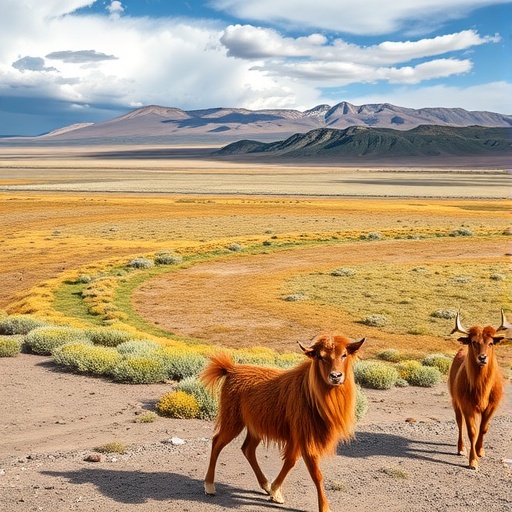
In a groundbreaking study published in Commun Earth Environ, researchers, led by Chen et al., delve into the intricate relationship between aridity gradients and ecosystem stability on the Mongolian Plateau. This compelling research marks a significant advancement in our understanding of how ecosystems respond to changes in climate conditions, particularly in arid regions that are becoming increasingly vulnerable due to global climate change. The Mongolian Plateau, a vast stretch of land defined by its harsh climate and diverse ecological zones, serves as a model for this critical analysis.
At the heart of this study is an exploration of the concept known as threshold-dependent shifts, which refers to sudden changes in ecosystem characteristics that can occur once an environmental variable, such as moisture availability, crosses a critical threshold. This phenomenon can lead to cascading effects on biodiversity, ecosystem function, and overall stability—a topic of rising importance as global temperatures continue to rise and weather patterns become more unpredictable.
Using a combination of field data collection, remote sensing technologies, and advanced statistical modeling, Chen and colleagues meticulously analyzed how varying levels of aridity impact both the resilience and vulnerability of ecosystems across the Mongolian Plateau. The research team uncovered that as aridity intensified, ecosystems exhibited a pronounced shift in stability. These shifts have significant implications for plant communities, animal habitats, and the services ecosystems provide, such as carbon storage and water regulation.
One key finding of this research is the threshold effect itself. The authors discovered that certain ecosystems can withstand lower levels of aridity without major disturbances; however, once moisture availability dips below a certain point, systems may rapidly transition to an alternate state. This change can result in a loss of biodiversity and shifts from one ecological community to another, which could potentially jeopardize the survival of native species that are ill-equipped for the new, harsher conditions.
Moreover, the study adeptly illustrates the differences in resilience among various plant community types across the plateau, highlighting that not all ecosystems respond uniformly to increasing aridity. For instance, certain grasslands demonstrated remarkable resilience, maintaining stability at lower moisture levels, while forested areas faltered. Such findings emphasize the delicate balance existing within these environments and the urgency for conservation strategies that account for these nuanced differences.
The implications of these ecosystem shifts extend beyond ecological borders. As human activity continues to exacerbate environmental stressors, understanding the consequences of climate change-induced shifts in ecosystem stability is vital to mitigating the impacts on agriculture, freshwater resources, and local communities that depend on these ecosystems for their livelihoods. This study acts as a clarion call for policymakers and conservationists alike to prioritize strategies that enhance ecosystem resilience and promote sustainable land-use practices.
Furthermore, the research team developed a comprehensive model predicting potential future scenarios based on current trends in climate change. They argue that if current aridity increases continue unabated, the threshold beyond which significant structural changes in ecosystems occur may be reached sooner than anticipated. This predictive modeling serves as a crucial tool for managing biodiversity and planning for future conservation efforts.
As an extension of their findings, the authors advocate for long-term ecological monitoring to better capture the dynamics of these ecosystems under various climate scenarios. They emphasize the importance of interdisciplinary approaches in ecological research, involving climatologists, ecologists, and land management experts to develop more holistic solutions to the challenges posed by climate change.
This research is groundbreaking not only for its revelations about ecosystem dynamics in the context of aridity but also for the methodologies employed. The integration of remote sensing technology with on-the-ground observations exemplifies how modern science can harness technology to provide clearer insights into ecological phenomena. This melding of various research techniques opens new avenues for understanding the effects of climate change on ecosystems across the globe.
The study also considers the potential economic ramifications of ecosystem shifts due to changing aridity levels. As ecosystems destabilize, the services they provide, such as food security, flood regulation, and carbon sequestration, may diminish. This study urges stakeholders in agriculture and resource management to reconsider practices that may further exacerbate ecological instability and explore more sustainable alternatives that align with the predictions outlined in the research.
In summary, the work of Chen et al. sheds light on a critical and timely issue facing not only the Mongolian Plateau but ecosystems worldwide. By articulating the complex interplay between aridity and ecosystem stability, the authors provide a valuable framework for understanding the ecological consequences of climate change. Their findings underscore the urgency of immediate action in conservation policies and ecological management strategies.
In conclusion, as populations grow and climate challenges escalate, the need for effective ecosystem stewardship becomes increasingly essential. The work demonstrated in this study offers essential insights into how ecosystems can adapt or fail in the face of changing environmental conditions, ultimately influencing biodiversity and human well-being across various regions. The Mongolian Plateau serves as both a warning and an opportunity—a chance to study and protect vital ecosystems before it is too late.
Subject of Research: Ecosystem stability and responses to aridity gradients on the Mongolian Plateau.
Article Title: Threshold-dependent shifts in ecosystem stability across aridity gradients on the Mongolian Plateau.
Article References:
Chen, W., Wu, L., Wang, B. et al. Threshold-dependent shifts in ecosystem stability across aridity gradients on the Mongolian Plateau.
Commun Earth Environ (2026). https://doi.org/10.1038/s43247-025-03173-5
Image Credits: AI Generated
DOI:
Keywords: Ecosystem stability, aridity gradients, Mongolian Plateau, climate change, threshold-dependent shifts, biodiversity, remote sensing, resilience, carbon sequestration, sustainable land use.


