

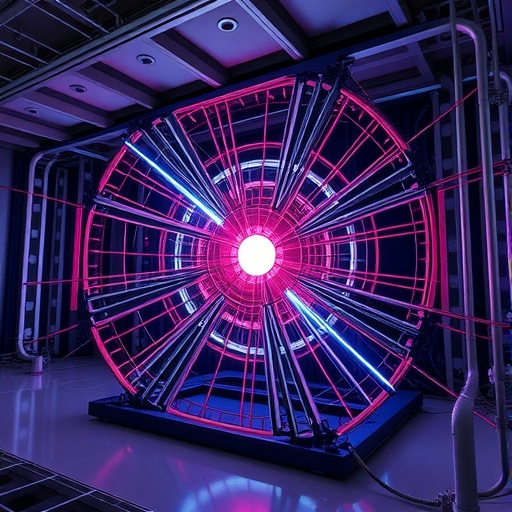
In the quest to unveil one of the most elusive properties of the subatomic world, a pioneering collaboration of physicists has delivered groundbreaking advancements in measuring the mass of neutrinos—particles so subtle they have earned the moniker “ghost particles.” This remarkable achievement stems from the Electron Capture in Ho-163 Experiment (ECHo), an international endeavor employing state-of-the-art detection technology to refine the upper bounds on the neutrino mass. By harnessing the unique decay characteristics of the isotope Holmium-163, researchers are navigating uncharted territory that could recalibrate our understanding of particle physics and cosmology.
Neutrinos, elementary constituents of matter, are electrically neutral and possess minuscule mass, rendering them notoriously difficult to detect. Despite their abundance throughout the universe, their weak interaction with other matter means that traditional experimental approaches often fall short. The precise determination of neutrino mass remains a critical unknown in physics, and securing it would unlock new theoretical frameworks, potentially extending beyond the current Standard Model and offering deeper insight into cosmic evolution.
Until recently, the Karlsruhe Tritium Neutrino Experiment (KATRIN) held the record for the lowest upper limit on neutrino mass. Yet, as KATRIN nears the limits of its sensitivity, ECHo positions itself as a complementary initiative with the potential to eclipse previous benchmarks. Anchored by researchers from Heidelberg, Mainz, Darmstadt, Tübingen, Karlsruhe, as well as collaborating teams from Geneva and Grenoble, ECHo represents a formidable fusion of expertise and innovation.
Central to the ECHo experiment’s methodology is the exploitation of the radioactive decay of Holmium-163. This isotope undergoes electron capture, wherein an atomic proton absorbs an orbiting electron, transforming into a neutron and emitting a neutrino. The neutrino’s mass subtly influences the energy distribution of residual atomic excitations—microscopic variations that, with sufficiently sensitive detection, can be quantified. As Professor Loredana Gastaldo, the spokesperson for ECHo, elucidates, “the subtle changes in the energy spectrum of Holmium-163 decay serve as a gateway to infer the neutrino’s mass.”
Unlocking this spectral information demands exceptional detection technology. ECHo employs metallic magnetic calorimeters, meticulously engineered at the Kirchhoff Institute for Physics under Professor Gastaldo’s leadership. These micro-fabricated detectors, measuring near 200 micrometers, operate at ultracold temperatures near 20 millikelvins—a realm colder than deep space—enabling them to detect minuscule thermal fluctuations corresponding to minute energy releases from decay events. This extreme sensitivity is essential to discern the delicate spectral shifts imparted by the neutrino mass.
Moreover, the experimental design embeds Holmium-163 directly into the detector matrix, an innovation realized at the RISIKO facility at Johannes Gutenberg University Mainz, enhancing measurement fidelity. The latest campaign, conducted at Heidelberg University, registered approximately 200 million Holmium-163 decay events—an unprecedented volume that empowers statistically robust conclusions.
The results of this massive data harvest are significant: the researchers have tightened the upper limit on the neutrino mass by nearly an order of magnitude compared to earlier ECHo results. Impressively, this new bound is roughly twice as stringent as the limits reported by the HOLMES collaboration, which also investigates neutrino mass via Holmium-163. These findings underscore ECHo’s potential to drive neutrino physics into a new era of precision.
Looking ahead, the ECHo team aims to scale their endeavor dramatically. Plans are underway to increase the array of detectors from the current hundred to an ambitious twenty thousand units in a project dubbed ECHo-LE (Electron Capture in Ho-163 – Large Experiment). This massive expansion will not only amplify detection capabilities but also enables probing neutrino mass with an unprecedented resolution. Securing an ERC Advanced Grant from the European Research Council has been instrumental in propelling this vision forward.
The collaborative nature of ECHo spans multiple premier institutions: Heidelberg University, the Max-Planck Institute for Nuclear Physics, Johannes Gutenberg University Mainz, the Helmholtz Institute Mainz, GSI Helmholtz Centre for Heavy Ion Research, the University of Tübingen, Karlsruhe Institute of Technology, CERN, and Institut Laue-Langevin. Their combined expertise synthesizes detector development, isotope embedding, experimental physics, and theoretical interpretation—a testament to the cooperative spirit propelling modern scientific discovery.
Published in the renowned journal Physical Review Letters, this work represents a milestone in neutrino research. By constraining the neutrino mass scale more tightly than ever before, ECHo not only enriches the particle physics canon but also opens avenues for refined cosmological modeling, given neutrinos’ role in the fabric of the universe. This achievement exemplifies how cutting-edge technology and international collaboration can push the boundaries of fundamental understanding.
In essence, ECHo’s breakthroughs signal a promising trajectory toward finally pinning down the neutrino mass—a parameter pivotal to unlocking mysteries of life’s origin, matter-antimatter asymmetry, and the grand dynamics of the cosmos. As experiments scale upward in sensitivity and precision, each Neutrino captured through the lens of Holmium-163 decay brings science closer to apprehending the ghostly particles that permeate existence yet remain tantalizingly out of reach.
Subject of Research: Determination of the Neutrino Mass Using Holmium-163 Electron Capture Decay
Article Title: Improved Limit on the Effective Electron Neutrino Mass with the ECHo-1k Experiment
News Publication Date: 25-Mar-2026
Web References:
DOI: 10.1103/lqkb-hylx
Image Credits:
© ECHo Collaboration
Keywords
Neutrino mass, Electron capture, Holmium-163, ECHo experiment, Metallic magnetic calorimeters, Particle physics, Quantum interference, Low-temperature detectors, Neutrino detection, Standard Model, Subatomic particles, Spectral analysis


