

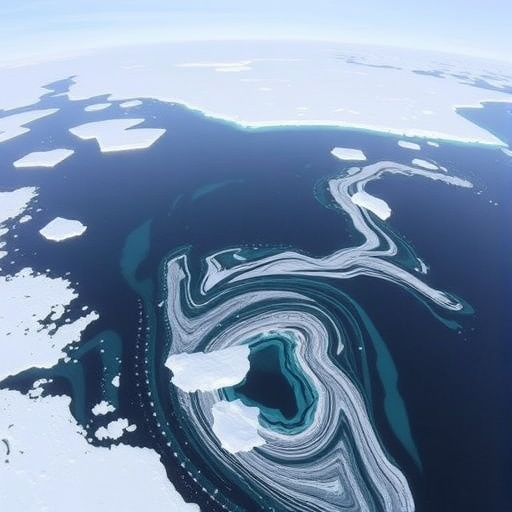
In the enigmatic and ever-changing realm of Earth’s polar climates, a groundbreaking study has emerged, revealing the intricacies of oceanic processes in the context of East Antarctica’s unique geographical features. Researchers, led by the pioneering scientist K. Yamazaki, have delved into a fascinating phenomenon occurring within an East Antarctic polynya—a region characterized by its sea ice melt and resultant cold seawater dynamics. This study not only sheds light on the complexities of shelf water outflows but also poses significant implications for our understanding of climate change and polar oceanography.
The research, published in the journal Commun Earth Environ, presents an innovative investigation into what the authors describe as the “emerging outflow of not-so-dense shelf water” from the East Antarctic region. This finding is particularly noteworthy given the historical context of understanding Antarctic shelf waters, which have predominantly been observed as denser, more saline entities. The new insights brought forth by Yamazaki and the team challenge pre-existing notions about the nature of these water bodies and their behavior under varying climatic conditions.
Through a series of meticulous observations and advanced modeling, the research team has identified that this less dense shelf water is being released into the surrounding ocean, a process which raises vital questions about marine ecosystems and their adaptability as ocean temperatures rise. Given the critical role that the Southern Ocean plays in global climate regulation, understanding the mechanisms behind this outflow becomes paramount not only for climate scientists but also for marine biologists and environmental policymakers.
One of the thematic pillars of this study is its emphasis on the interconnectedness of oceanic processes. The authors point out that the not-so-dense shelf water emerging from the polynya is not merely an isolated phenomenon. Instead, it interacts dynamically with both the overlying sea ice and the underlying currents, creating a complex network of energy and nutrient transfers. The implications of such interactions are manifold: from influencing local fish populations to altering phytoplankton growth dynamics essential for carbon fixation.
Furthermore, this research takes a closer look at the physical drivers behind this intriguing outflow. Variability in wind patterns and changes in sea ice coverage have been identified as significant factors contributing to the emergence of this anomalous shelf water. The study carefully quantifies these variables, using state-of-the-art oceanographic tools to map out the spatial and temporal changes associated with these environmental shifts. The resultant data not only provide a clearer picture of the current state of Antarctic waters but also serve as a basis for predictive modeling under future climate scenarios.
Moreover, the study raises alarms about the potential feedback mechanisms that could be initiated as a result of this outflow. The introduction of less dense water into the Southern Ocean may lead to stratification of the water column, potentially inhibiting the vertical mixing critical for nutrient cycling. This stratification could have cascading effects on marine biodiversity and the overall productivity of these vital waters, which already face stresses from anthropogenic activities and global warming.
The findings of Yamazaki et al. add a crucial piece to the puzzle of climate change, illustrating the need for continuous monitoring of polar regions. With climate models often underestimating the complexity of ocean interactions, their research urges for a re-evaluation of predictive frameworks that might otherwise miscalculate future scenarios. This underscores the urgency for a global concerted effort to bolster climate monitoring initiatives, providing scientists the necessary tools to collect real-time data on these crucial polar systems.
While the immediate focus of the study rests on the East Antarctic polynya, its implications extend globally. The Southern Ocean, when examined as a whole, serves as a critical component of the Earth’s climate engine. By understanding localized phenomena, such as the not-so-dense shelf water outflow, we gain insights into larger trends affecting ocean circulation patterns worldwide. This interconnectedness highlights the importance of comprehensive climate studies that transcend geographical and disciplinary boundaries.
Furthermore, the social implications of this research cannot be ignored. As global temperatures continue to rise, the socio-economic impacts of these environmental changes could be profound. Fisheries that rely on a delicate balance of marine life, coastal communities positioned at the forefront of climate change, and global food security are intricately tied to the health of northern ocean systems. This presents a clear call to action for policy frameworks that not only address immediate concerns but also prioritize long-term sustainability.
In conclusion, the study led by K. Yamazaki and his colleagues marks a significant milestone in our understanding of Antarctic marine dynamics. The emerging outflow of not-so-dense shelf water from the East Antarctic polynya represents a critical intersection of oceanography and climate science, reminding us of the urgency to heed the signals sent from such remote regions. As the world grapples with climate change, studies like this illuminate the pathways toward a more sustainable future, urging scientists, policymakers, and the global community to take decisive action in safeguarding our planet’s climate.
As we stand at this crossroads of scientific discovery, the time is ripe for increased collaboration, innovative research methodologies, and an unwavering commitment to protecting our oceans. The waters of the East Antarctic are not merely a distant concern; they are a vital thread in the fabric of Earth’s complex climate system, demanding our immediate attention and respect.
Subject of Research: Emerging outflow of not-so-dense shelf water from an East Antarctic polynya
Article Title: Emerging outflow of not-so-dense shelf water from an East Antarctic polynya
Article References:
Yamazaki, K., Foppert, A., Gunn, K.L. et al. Emerging outflow of not-so-dense shelf water from an East Antarctic polynya.
Commun Earth Environ 7, 38 (2026). https://doi.org/10.1038/s43247-025-03006-5
Image Credits: AI Generated
DOI: https://doi.org/10.1038/s43247-025-03006-5
Keywords: Climate change, Antarctic research, oceanography, marine ecosystems, sea ice dynamics


