

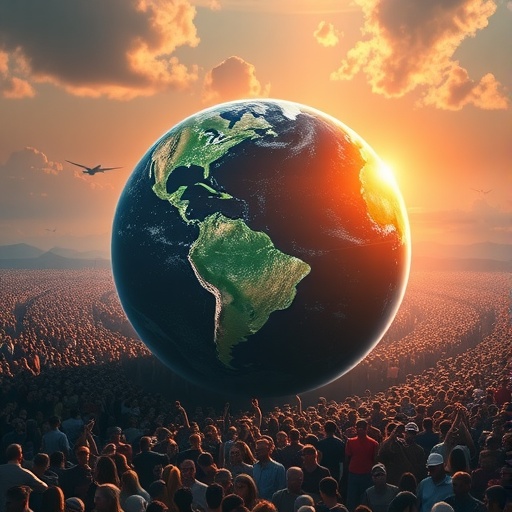
In a groundbreaking study published in Environmental Research Letters, scientists have revealed that the global human population has surpassed Earth’s sustainable carrying capacity, signaling a critical tipping point for the planet’s ecosystems and humanity’s future wellbeing. This research, led by Professor Corey Bradshaw of Flinders University, provides a sobering analysis of two centuries of population data, uncovering the profound ecological consequences of unchecked demographic growth combined with current consumption patterns. The findings emphasize the urgent need for transformative changes in global resource management and population policies to mitigate escalating environmental crises.
The study meticulously analyzed historical population growth trends and found a decisive shift occurring in the mid-twentieth century. Prior to the 1950s, the human population experienced accelerating growth rates, fueled by technological advances, increased energy availability, and expanding agricultural productivity. This phase reflected a positive feedback loop where rising population density spurred innovation and economic development, which in turn supported larger numbers of people. However, around the early 1960s, this trajectory reversed, marking the onset of a “negative demographic phase.” In this new paradigm, although total population continued to rise, the global rate of growth began to decelerate markedly.
Professor Bradshaw highlights that this negative demographic phase indicates a fundamental biological and ecological constraint: Earth is becoming increasingly unable to sustain continuous human expansion under existing consumption paradigms. According to their projections, global population is expected to peak between 11.7 billion and 12.4 billion by the late 2060s to 2070s, assuming current trends persist. While this projection may appear daunting, it also underscores the finite nature of ecological resources and the critical limits imposed by planetary biocapacity.
The research further clarifies that the upper bound of population growth has only been possible due to an extraordinary reliance on fossil fuels and the consequent depletion of natural resources at rates far exceeding nature’s regenerative capacities. This overshoot phenomenon, the team argues, has masked the severity of ecological strain by artificially boosting food production, energy supply, and industrial output. However, such dependence on non-renewable resources accelerates climate change, biodiversity loss, and environmental degradation, thereby exacerbating systemic vulnerabilities.
Crucially, the authors estimate a sustainable global population to be approximately 2.5 billion people, assuming equitable distribution and adherence to ecological limits while maintaining comfortable living standards. This figure is dramatically lower than today’s population of over 8.3 billion and starkly illuminates the scale of overconsumption and resource mismanagement. The disparity exposes the urgency of addressing both population stabilization and dramatic shifts in consumption behavior to safeguard long-term global resilience.
Another notable contribution of this research is its focus on the intertwined relationship between population size and environmental impact indicators such as climate warming, ecological footprint, and carbon emissions. The analysis revealed that total population size correlates more strongly with rising environmental stresses than per capita consumption alone. This finding suggests that demographic pressures, when combined with consumption patterns, amplify planetary stress multipliers, necessitating integrated approaches that address both aspects simultaneously.
The study’s implications extend beyond environmental projections and encompass socio-economic stability and human wellbeing. The overshoot of Earth’s carrying capacity threatens food and water security, intensifies inequality, and jeopardizes public health, particularly in vulnerable communities. These cascading effects raise fundamental ethical and policy questions about sustainability, resource allocation, and intergenerational equity, demanding urgent multinational cooperation and informed public discourse.
While the researchers caution against predictions of abrupt societal collapse, their assessment paints a realistic portrait of protracted stress on global systems. They argue that the trajectory of continued overshoot is likely to deepen crises rather than resolve them, potentially precipitating increased conflict, displacement, and environmental volatility. Hence, it is imperative that policymakers adopt long-term planning frameworks that explicitly consider planetary boundaries and integrate ecological economics into development strategies.
Professor Bradshaw and his colleagues advocate a paradigm shift that reconsiders humanity’s relationship with the Earth’s natural systems. This includes radical reforms in energy consumption, land use, agricultural practices, and material resource efficiencies. Policies aimed at stabilizing population growth through education, healthcare, and equitable economic opportunities are equally vital. The research underscores that smaller populations combined with lower per capita consumption present the most viable pathway toward sustainable coexistence with the biosphere.
The urgency of the findings is accentuated by the narrowing window for effective action. The authors emphasize that meaningful environmental recovery and resilience are still achievable but require unprecedented global collaboration and commitment. Future sustainability hinges on rebalancing human demands within Earth’s limits and fostering systemic transformations that prioritize ecological health alongside economic development.
This study, supported by the Kids Research Institute Australia and Population Matters, represents a critical contribution to the discourse on planetary sustainability. It serves as a clarion call to scientists, policymakers, and global citizens alike to recognize the entwined challenges of human population dynamics and environmental stewardship, and to act decisively in shaping a viable future for generations to come.
Finally, the comprehensive methodology, involving ecological growth models and expansive historical datasets, grounds the study in robust scientific analysis. By quantifying the mismatch between population size and biocapacity at a planetary scale, the research sets a new benchmark for understanding human impacts and guides evidence-based strategies to mitigate looming crises. The choices made in the coming decades will indelibly influence the trajectory of humanity and the resilience of Earth’s life support systems.
Subject of Research: People
Article Title: Global human population has surpassed Earth’s sustainable carrying capacity
News Publication Date: 27-Mar-2026
Web References:
- Environmental Research Letters DOI
- Professor Corey Bradshaw Flinders University
- Global Ecology Laboratory Flinders University
References:
Bradshaw, C. J. A., Judge, M. A., Blumstein, D. T., Ehrlich, P. R., Dasgupta, A. N., Wackernagel, M., Weeda, L. J. Z., & Le Souëf, P. N. (2026). Global human population has surpassed Earth’s sustainable carrying capacity. Environmental Research Letters. DOI: 10.1088/1748-9326/ae51aa
Image Credits: Flinders University
Keywords: global population growth, sustainable carrying capacity, ecological footprint, climate change, resource consumption, demographic shift, biocapacity, environmental sustainability, population overshoot, fossil fuel dependence, planetary boundaries, global ecology


