

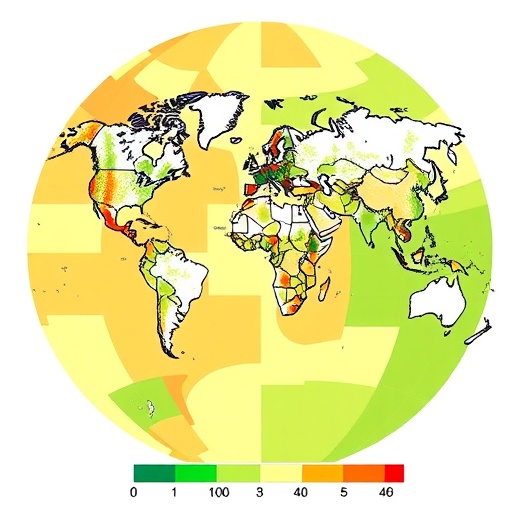
In a groundbreaking study published in Nature Geoscience, researchers have unveiled a striking disparity in how global vegetation is responding to contemporary climate changes, revealing a significant slowdown in the carbon uptake of dryland ecosystems compared to humid regions. This finding challenges prevailing assumptions about the uniformity of terrestrial carbon sinks and has profound implications for our understanding of the global carbon cycle and climate change mitigation.
Over the past several decades, rising atmospheric concentrations of carbon dioxide (CO₂), alongside increasing global temperatures and the escalating vapour pressure deficit (VPD), have been recognized as critical drivers influencing plant photosynthesis and terrestrial gross primary production (GPP). GPP is the total amount of carbon dioxide that vegetation captures through photosynthesis, serving as a crucial component of the global carbon cycle. However, the complex interplay between these environmental factors and their spatial variability across different climate regimes has remained elusive—until now.
Using a comprehensive dataset amalgamating globally distributed FLUXNET measurements with satellite-derived machine learning estimates of GPP spanning four decades from 1982 to 2022, the research team conducted a meticulous analysis to decipher temporal and spatial patterns in vegetation productivity. FLUXNET—a global network of eddy covariance towers—provides precise, ground-based measurements of carbon and water fluxes between ecosystems and the atmosphere, while satellite data extends this insight to a planetary scale with high temporal resolution.
Their analysis uncovered an asymmetric evolution of terrestrial carbon uptake marked by two contrasting trends. While humid regions continue to register a persistent increase in GPP, attributable largely to enhanced CO₂ fertilization effects and warming temperatures that lengthen growing seasons, dryland ecosystems show a pronounced slowdown in productivity gains. This divergence is primarily driven by a sharp increase in atmospheric aridity, reflected by surging VPD values which place severe water limitations on photosynthetic processes in these typically water-scarce environments.
The vapour pressure deficit, representing the difference between the amount of moisture in the air and the amount the air can hold when saturated, acts as a proxy for atmospheric dryness. Elevated VPD exacerbates plant water stress, causing stomatal closure to reduce water loss, but consequently restricting CO₂ uptake essential for photosynthesis. The study convincingly demonstrates that rising VPD in drylands overrides the positive influences of CO₂ and temperature, fundamentally constraining photosynthetic capacity and curtailing carbon uptake in these regions.
Interestingly, despite the mounting evidence from observational data, state-of-the-art dynamic global vegetation models (DGVMs) and Earth system models (ESMs) fail to replicate this contrasting vegetation response in both historical simulations and future projections. These models have traditionally overestimated carbon gains in drylands by underrepresenting water stress impacts and VPD dynamics, thus painting an incomplete and overly optimistic picture of the terrestrial carbon sink’s resilience to climate change.
The implications of this research are profound and multifaceted. As global atmospheric aridity continues to intensify and drylands expand—driven by climate change and land use alterations—the limitation of photosynthetic productivity in these ecosystems signals a potential cap on the land carbon sink. This cap could diminish the biosphere’s capacity to mitigate anthropogenic CO₂ emissions, thereby accelerating the rate of global warming.
Moreover, drylands, which already cover about 40% of the Earth’s terrestrial surface and support nearly 38% of the global population, are crucial for biodiversity, agriculture, and livelihoods. The study’s findings highlight the urgent need to prioritize adaptive management strategies aimed at enhancing water-use efficiency, soil conservation, and drought resistance in dryland ecosystems to sustain their ecological and socio-economic functions.
Conversely, humid regions, characterized by abundant water availability, stand to benefit substantially from the continuing increase in atmospheric CO₂ and moderate warming, which together stimulate photosynthetic activity and carbon sequestration. In these areas, nature-based solutions such as reforestation, wetland restoration, and conservation of primary forests can amplify the natural carbon sink, contributing significantly to climate mitigation efforts.
The divergence elucidated in this study underscores the necessity of region-specific approaches in climate policy and ecosystem management, eschewing one-size-fits-all strategies. Tailored interventions recognizing the water-limited constraints of drylands, alongside leveraging the growth potential of humid zones, could enhance the efficacy of global climate action.
Further research is imperative to refine Earth system models by integrating more sophisticated representations of plant physiological responses to VPD and water stress, along with incorporating fine-scale hydrological feedbacks. Augmented observational networks and high-resolution remote sensing can provide indispensable data to improve model accuracy and predictive capability at regional and global scales.
This study also prompts reconsideration of carbon budget estimates and future climate scenarios, as the diminished carbon uptake capacity in expansive drylands may necessitate recalibration of emission reduction targets and the assessment of negative emission technologies. The pronounced sensitivity of drylands to atmospheric moisture deficits exemplifies the complex interdependencies among biosphere-climate interactions, which must be comprehensively addressed to safeguard Earth’s climate stability.
In summation, the revelation that drylands dominate the recent global slowdown in vegetation carbon uptake represents a paradigm shift in our understanding of terrestrial ecosystem responses to concurrent environmental drivers. The asymmetric shift in GPP trajectories—marked by persistent growth in humid regions and deceleration in drylands—underscores the critical influence of atmospheric moisture stress, rather than temperature or CO₂ alone.
As humanity confronts escalating climate crises, this nuanced comprehension of ecosystem dynamics offers a clarion call for adaptive, scientifically informed stewardship of the planet’s diverse biomes. Recognizing drylands as both vulnerable and pivotal components of the global carbon cycle is essential to formulating effective mitigation and adaptation policies that embrace ecological heterogeneity while striving for a sustainable future.
Subject of Research: Terrestrial carbon uptake dynamics and the interaction of atmospheric CO₂, temperature, and vapour pressure deficit on global vegetation productivity.
Article Title: Dryland dominance in the slowdown of global vegetation carbon uptake.
Article References:
Li, F., Xiao, J., Chen, J. et al. Dryland dominance in the slowdown of global vegetation carbon uptake. Nat. Geosci. (2026). https://doi.org/10.1038/s41561-026-01957-8
Image Credits: AI Generated


