

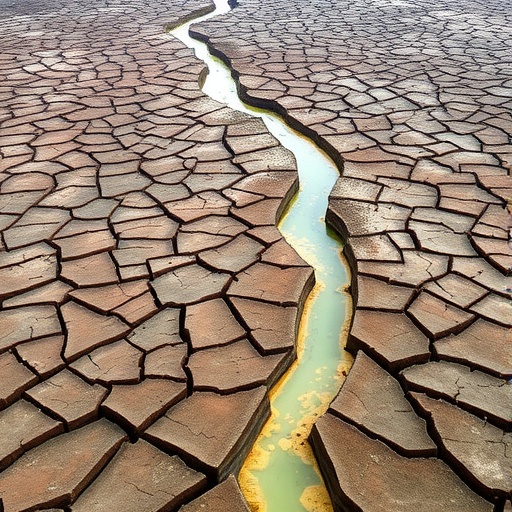
In recent years, droughts have emerged as some of the most devastating natural hazards impacting ecosystems and societies on a global scale. A groundbreaking study published in Communications Earth & Environment by Qu, Li, Peñuelas, and colleagues in 2026 throws new light on the complex dynamics governing drought propagation and its far-reaching ecohydrological consequences. Their research uncovers a crucial nonlinear mechanism by which droughts amplify environmental damage, offering critical insights into how prolonged water scarcity cascades through ecological and hydrological systems.
At the heart of this investigation lies the concept of drought propagation—not simply the occurrence of drought in isolated regions, but the way it spreads and intensifies through interconnected landscapes. The authors describe this phenomenon as a nonlinear amplifier, meaning that the impacts do not scale linearly with water deficits. Instead, small perturbations in precipitation and soil moisture can trigger disproportionate declines in ecosystem function and hydrological stability, feeding back to worsen drought effects.
Traditional drought models often treat environmental and hydrological components as separate entities responding linearly to precipitation deficits. However, Qu et al. challenge this framework through a sophisticated integration of ecohydrological processes. By coupling vegetation dynamics, soil moisture variability, and atmospheric drivers into a unified nonlinear model, their work reveals how drought-induced stress on plants can alter transpiration rates, surface energy balances, and soil infiltration capacity. These feedbacks then propagate through watershed networks, accelerating the transition from mild water stress to severe ecological damage.
One of the study’s striking revelations is how vegetation responses to drought conditions serve as critical nodes in this propagation mechanism. When drought stress reduces leaf area and photosynthetic activity, it not only diminishes carbon uptake but also decreases canopy transpiration, disrupting local humidity and precipitation recycling. This sets off a domino effect by lowering soil moisture recharge potential and weakening plant resilience, creating regions more vulnerable to prolonged drought. The result is a self-reinforcing loop that can rapidly intensify drought severity over expansive spatial scales.
Hydrological consequences are equally profound. The nonlinear interactions among soil, vegetation, and atmosphere alter runoff patterns, groundwater recharge, and streamflow in unpredictable ways. Areas previously buffered against water shortages experience more frequent dry spells, and the timing of drought onset shifts toward extended periods of water stress. Importantly, these changes are not uniform, but vary according to biome type, soil texture, and topographic complexity, underscoring the heterogeneous nature of drought impacts across terrestrial landscapes.
Crucially, the study employs extensive observational data sets from diverse climate zones—ranging from Mediterranean to boreal forests—to validate the proposed nonlinear amplification mechanism. Coupled with state-of-the-art remote sensing and in situ soil moisture measurements, this multidisciplinary approach enables the authors to precisely capture ecohydrological feedbacks at regional and continental scales. Such robust empirical support lends unprecedented credibility to the thesis that drought propagation operates fundamentally differently than previously understood.
An important implication of this research is the heightened vulnerability of ecosystems under future climate scenarios characterized by increased drought frequency and intensity. Ecosystem degradation triggered by nonlinear drought dynamics threatens biodiversity, carbon storage capacities, and water resource availability. These effects converge to exacerbate food and water insecurity, jeopardize livelihoods, and challenge conservation efforts worldwide.
Addressing this new paradigm requires rethinking current drought risk assessment frameworks. Traditional linear models underestimate the potential extent and severity of drought-induced damage by failing to account for cascading ecohydrological feedbacks. Qu et al. advocate for the development of predictive tools that integrate nonlinear processes to improve early warning systems and inform adaptive management strategies. This approach will enable policymakers and land managers to better prepare for drought extremes and mitigate long-term ecological harm.
On a broader scale, the research underscores the interconnectedness of climate systems, ecosystems, and human societies. As drought propagation amplifies ecohydrological damage beyond isolated events, it stresses the urgent need for holistic climate resilience planning. Interventions must incorporate vegetation management, soil conservation, and water use efficiency in tandem with greenhouse gas mitigation efforts to break the cycle of amplification.
The study also opens promising avenues for future research. Investigating how different species adapt to nonlinear drought stress, understanding soil microbial community shifts under prolonged water scarcity, and refining ecohydrological models with improved spatial resolution will enrich our comprehension of drought complexity. Moreover, interdisciplinary collaboration combining ecology, hydrology, atmospheric science, and socioeconomics will be vital in translating these scientific advances into actionable solutions.
In essence, Qu and colleagues’ 2026 landmark article unveils a paradigm shift in drought science, illuminating the nonlinear pathways through which droughts wreak exponentially greater ecohydrological damage than previously recognized. By revealing these hidden dynamics, the research catalyzes a transformative perspective on predicting, mitigating, and adapting to one of the planet’s most pressing climate hazards. Their findings serve as a clarion call for urgent innovation in monitoring and managing the intricate interplay between drought, ecosystems, and water resources.
As drought events become more recurrent and severe in the Anthropocene epoch, understanding propagation as a nonlinear amplifier equips scientists and policymakers alike with critical knowledge needed to safeguard both natural and human systems. It emphasizes that addressing drought risks requires nuance beyond simplistic drought duration or intensity metrics, centering instead on the systemic interactions that govern ecosystem health and hydrological functioning. This comprehensive framework for drought propagation lays foundational groundwork that will inspire groundbreaking research and policy transformations for decades to come.
In conclusion, the comprehensive work by Qu, Li, Peñuelas, and collaborators marks a pivotal advancement in unraveling the complex feedback mechanisms activated by drought conditions. By challenging linear drought paradigms and highlighting nonlinear ecohydrological amplifiers, the study charts a path toward enhanced resilience in the face of intensifying environmental challenges. The integration of cutting-edge data collection, multidisciplinary modeling, and insightful interpretations makes this research a seminal reference point for the scientific community and stakeholders striving to navigate the multifaceted threats posed by global drought phenomena.
Subject of Research: Nonlinear mechanisms of drought propagation and their amplifying effects on ecohydrological damage across diverse terrestrial ecosystems.
Article Title: Drought propagation as a nonlinear amplifier of ecohydrological damage
Article References:
Qu, Z., Li, X., Peñuelas, J. et al. Drought propagation as a nonlinear amplifier of ecohydrological damage.
Commun Earth Environ (2026). https://doi.org/10.1038/s43247-026-03330-4
Image Credits: AI Generated


