

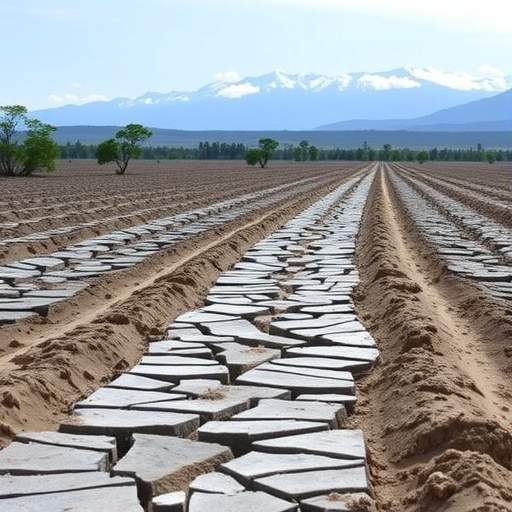
In recent years, droughts have emerged as one of the most pressing environmental challenges globally, with significant implications for water security, agriculture, and societal stability. A groundbreaking study conducted by a research team led by Professor Jong-Hoon Kam from the Department of Environmental Engineering at Pohang University of Science and Technology (POSTECH) offers new insights into how the South Korean public engages with drought crises. By leveraging advanced artificial intelligence (AI) tools to analyze news media, social media, and internet search activities, the team explored the dynamic interplay between public perception, media representation, and behavioral responses during the severe droughts of 2022 and 2023 in South Korea. This research, recently published in the prestigious journal Humanities and Social Sciences Communications, reveals nuanced variations in social reactions depending on whether a drought impacts the entire nation or is localized to specific regions.
Droughts are inherently complex phenomena that evolve gradually through multiple stages. Initially, a meteorological drought manifests as a deficiency in precipitation, setting off cascading environmental effects. This deficiency advances into an agricultural drought, characterized by drying soil that hampers crop growth. Eventually, the phenomenon escalates into a hydrological drought, marked by diminished water levels in rivers, reservoirs, and groundwater reserves. Prolonged persistence of these physical droughts culminates in a socioeconomic drought, profoundly disrupting industries, livelihoods, and daily routines. Understanding this sequence is crucial because human cognitive and emotional responses to droughts transform as the situation worsens, prompting shifts in information-seeking behaviors and public discourse. The POSTECH study pioneers an exploration into these evolving social dynamics by scrutinizing unstructured digital data through AI-driven natural language processing techniques.
The research zeroed in on two contrasting drought scenarios: the expansive nationwide drought of 2022 and the subsequent localized drought confined primarily to the Gwangju and Jeonnam regions in 2023. The team curated extensive datasets, including thousands of news reports, millions of social media posts, and voluminous internet search queries occurring throughout the drought timelines. Through machine learning algorithms, the researchers could detect patterns in public attention, emotional tone, and behavioral tendencies associated with these environmental stressors. The fusion of these digital traces provided a multifaceted lens to understand how societal engagement fluctuates as droughts transition from widespread crises to regional hardships.
Notably, during the peak of the nationwide drought in June 2022, all measures of public attention—news frequency, social media discussions, and online search volumes—surged dramatically. This convergence reflected heightened collective awareness and an active public discourse fostering shared concern. Contrarily, in March 2023, when drought severity concentrated in southwestern Korea, there was a distinct divergence: regional news coverage and localized search activity intensified, but social media engagement diminished comparatively. Such findings suggest that while citizens actively seek information when confronted with regional crises, their propensity to publicly discuss these issues wanes. This behavior underscores the differential psychological and communicative responses elicited by the scope and proximity of environmental threats.
Delving deeper into media content, the team performed sentiment and emotion analysis on news headlines during the drought period. A recurring emotional triad—expectation, anxiety, and disappointment—dominated the narrative arc. Public optimism often swelled upon forecasts predicting rainfall, juxtaposed sharply against subsequent disappointments when precipitation failed to materialize. This emotional ebb and flow illustrates the profound interconnection between media framing and public sentiment, highlighting the media’s role as both informer and emotional cue giver during environmental hardships. Such insights are critical for refining communications strategies aimed at maintaining public engagement without inciting undue alarm or complacency.
Beyond descriptive findings, this study advocates a transformative approach to drought management that transcends conventional engineering and hydrological solutions. It emphasizes the imperative of integrating social dimensions—public perception, emotional states, and communication dynamics—into technical drought responses. By harnessing big data analytics and AI, policymakers and disaster managers can anticipate shifts in social behavior and tailor interventions accordingly. For instance, targeted information campaigns can be more effectively designed to resonate with public moods and media consumption patterns, enhancing risk communication precision and efficacy.
Professor Kam articulates the novelty of this interdisciplinary research, remarking that the utilization of AI to decode unstructured, narrative-rich data sources ushers in a paradigm shift in disaster mitigation science. This approach enables real-time extraction of social emotions and behavioral signals otherwise inaccessible through traditional surveys or interviews. The research findings imply that incorporating such AI-driven social insights into drought preparedness frameworks can catalyze more adaptive, empathetic, and proactive policymaking, ultimately fortifying societal resilience against climate-induced stresses.
Moreover, this investigation underscores the spatial dimension of environmental risk perception. The public’s engagement wanes when crises localize, signifying a potential gap in regional disaster awareness and responsiveness. This phenomenon stresses the need for region-specific outreach initiatives to sustain vigilance and encourage adaptive behaviors even when environmental challenges appear geographically confined. The strategic deployment of localized messaging and community-based communication platforms could invigorate civic involvement and resource stewardship in vulnerable areas.
From a methodological standpoint, the study exemplifies the power of integrating heterogenous datasets—traditional news media, ephemeral social media content, and anonymized search engine queries—within a cohesive analytical framework. This fusion offers unparalleled granularity and temporal resolution in monitoring societal responses to environmental phenomena. It also paves the way for predictive analytics capable of forecasting social dynamics, guiding resource allocation, and optimizing public engagement throughout the drought lifecycle.
This research received valuable support from the Disaster and Safety Joint Research and Development Program under the Ministry of the Interior and Safety of Korea, highlighting institutional recognition of the critical nexus between environmental hazards and societal well-being. The interdisciplinary collaboration between environmental engineers, data scientists, and social communicators represents an innovative model for addressing complex global challenges in the Anthropocene era.
In conclusion, the insights from the 2022–2023 South Korea drought offer a compelling blueprint for global drought management under climate change uncertainty. As droughts intensify worldwide, integrating AI-based social analytics with hydrometeorological monitoring will be vital for crafting comprehensive, socially informed responses. This study exemplifies how marrying environmental engineering expertise with cutting-edge data science unlocks new dimensions of understanding and equips societies to better navigate the anxieties, expectations, and realities of water scarcity crises.
Subject of Research: Social dynamics and public response to droughts analyzed through AI-based natural language processing during the 2022-2023 South Korea drought
Article Title: The interplay of news media, social media, and public search behavior during the 2022–2023 South Korea drought
News Publication Date: 13-Dec-2025
Web References: http://dx.doi.org/10.1057/s41599-025-06398-z
Image Credits: POSTECH
Keywords: Applied sciences and engineering; Environmental engineering; Pollution; Environmental methods; Environmental sciences; Earth sciences; Biogeography; Geography; Cultural anthropology; Cultural studies; Mass media


