

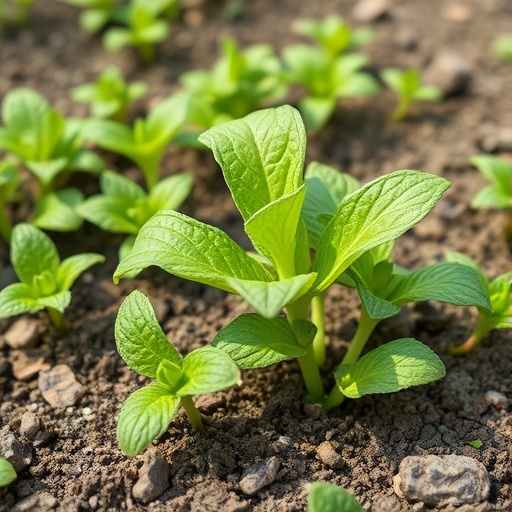
Recent research has unveiled groundbreaking insights into drought tolerance mechanisms across different photosynthetic types, primarily focusing on C3 and C3–C4 intermediate plants. This study highlights the physiological adaptations and gene expression changes that enable these plants to survive in arid environments. The work conducted by Mohamed, R.H.M., Badr, R., and Abdel-Latif, A. has significant implications for agricultural practices, especially in the face of increasing climate variability. As drought conditions become more frequent and severe due to climate change, understanding how plants cope with limited water availability is crucial for developing resilient crops.
Drought stress poses a severe threat to global agriculture, leading to substantial declines in crop yields. The need for developing plants with enhanced drought resistance has never been more pressing. Researchers have turned their attention toward the photosynthetic mechanisms employed by various plant types, particularly C3 and C3–C4 intermediates, which exhibit different adaptations to water scarcity. Understanding these differences at the physiological and molecular levels is essential for breeding programs aimed at improving drought tolerance.
C3 plants are characterized by their reliance on the Calvin cycle for carbon fixation, which can be inefficient under high temperatures and low moisture conditions. In contrast, C4 plants utilize a more complex pathway that allows them to minimize photorespiration, thus increasing their efficiency, especially in hot and dry climates. C3–C4 intermediates display traits of both types, providing a unique opportunity to explore how these plants can bridge the gap between the two pathways. By dissecting the mechanisms behind their drought resilience, researchers hope to unlock new avenues for crop improvement.
In their extensive study, the researchers carried out physiological profiling, which revealed that C3–C4 intermediates possess superior water-use efficiency compared to their C3 counterparts. The examination of leaf gas exchange parameters, such as stomatal conductance and photosynthetic rates, illustrated that these intermediate species can perform photosynthesis more efficiently under drought conditions. This enhanced performance is tightly linked to their ability to regulate water loss through transpiration, making them potential candidates for developing drought-resistant cultivars.
Gene expression profiling provided further insights into the molecular adaptations that facilitate drought tolerance. The researchers identified key genes involved in stress response pathways that are significantly upregulated in C3–C4 intermediate plants under drought conditions. These genes play a crucial role in maintaining cellular integrity and modulating metabolic processes to adapt to water scarcity. Specifically, genes associated with osmotic adjustment, reactive oxygen species (ROS) scavenging, and stomatal regulation showed differential expression patterns, underscoring the complexity of the drought response mechanisms in these plants.
Another exciting aspect of this research is the comparative analysis between C3 and C3–C4 photosynthetic types. By using advanced molecular techniques, the scientists were able to discern distinct transcriptional profiles that underpin the physiological adaptations observed. This comparative approach revealed that while both C3 and C3–C4 plants activate similar stress response pathways, C3–C4 intermediates employ additional regulatory mechanisms that enhance their resilience to drought. Such findings are pivotal, as they suggest that manipulating specific pathways may lead to the development of crops that can thrive in harsh climates.
Furthermore, the study highlights the importance of integrating genomic insights with traditional breeding practices. Given the urgency of climate change, breeders can utilize the identified gene markers related to drought tolerance to accelerate the development of resilient crop varieties. This intersection of molecular biology and agriculture could pave the way for innovative strategies that prioritize crop sustainability and food security in the face of dwindling water resources.
As the global population continues to rise, the demand for food will inevitably increase, putting additional pressure on agricultural production systems. The insights gained from this research are timely, as they offer a glimpse into how we can engineer crops that not only survive but also flourish in the face of environmental stressors. By harnessing the inherent adaptability of C3–C4 intermediates, agronomists and geneticists can work collaboratively to devise solutions that empower our agricultural systems.
Moreover, the findings conclude that enhancing drought tolerance will not only benefit food production but will also contribute to the preservation of natural ecosystems. With the capacity to adapt to arid conditions, these intermediate plants could play a vital role in maintaining biodiversity and ecosystem health as climatic shifts occur. This approach aligns with broader conservation goals and emphasizes the role of agriculture in environmental stewardship.
In light of these advancements, it is essential for policymakers to recognize and support research initiatives that focus on drought resilience in crops. By investing in science and technology, governments can facilitate the transition to sustainable agricultural practices that protect food resources while also mitigating the impacts of climate change. The collaboration between researchers, economists, and agriculturalists is pivotal to ensure the implementation of these findings into workable solutions.
Ultimately, this study serves as a reminder of the intricate relationship between plants, climate, and human needs. The revelations on drought tolerance mechanisms in C3 and C3–C4 plants represent a crucial step toward understanding and addressing the challenges posed by climate variability. As we navigate an uncertain future, it is these scientific insights that will empower humanity to adapt and thrive in harmony with our changing environment.
Advances in understanding physiological and molecular responses to drought in plants herald a new era of agricultural innovation. The road ahead is filled with potential, driven by scientific inquiry and a commitment to sustainability. The quest for drought-tolerant crops is not just an agricultural challenge; it is a vital pursuit for humanity’s resilience in the face of climatic adversity.
As we delve deeper into plant biology, the promise of more resilient agricultural systems becomes increasingly tangible. This research marks not only an academic achievement but a hopeful beacon for future agricultural practices. With each study, we approach a world where scarcity may no longer dictate our ability to feed the population, but rather, innovation and resilience pave the way for future generations.
Subject of Research: Drought tolerance mechanisms across C3 and C3–C4 intermediate photosynthetic types
Article Title: Drought tolerance mechanisms across C3 and C3–C4 intermediate photosynthetic types revealed by physiological and gene expression profiling.
Article References:
Mohamed, R.H.M., Badr, R., Abdel-Latif, A. et al. Drought tolerance mechanisms across C3 and C3–C4 intermediate photosynthetic types revealed by physiological and gene expression profiling.
Sci Rep (2026). https://doi.org/10.1038/s41598-025-33094-4
Image Credits: AI Generated
DOI: 10.1038/s41598-025-33094-4
Keywords: Drought tolerance, photosynthesis, C3 plants, C4 plants, gene expression, physiological profiling, climate change, agriculture, resilience, crop improvement.


