

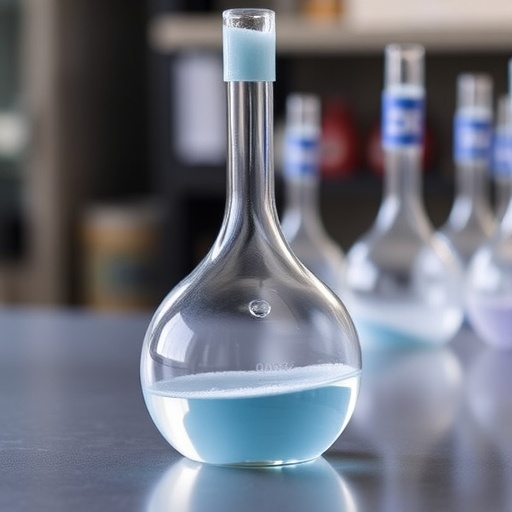
In a groundbreaking revelation that challenges the very foundations of fluid mechanics, researchers from Drexel University have uncovered a phenomenon whereby simple liquids—substances traditionally characterized by their ability to freely flow and conform to the shape of their container—can actually fracture in a manner akin to solid materials under specific conditions of applied stress. This astonishing behavior, detailed in a recent publication in the journal Physical Review Letters, demonstrates that viscous liquids subjected to critical tensile stress do not just thin and elongate indefinitely as once believed, but can abruptly snap, exhibiting a brittle fracture previously thought impossible for such fluids.
This discovery fundamentally redefines how scientists understand the mechanical response of liquids. While viscosity has long been acknowledged as a measure of a fluid’s resistance to flow, its role in governing the structural robustness of liquids under extreme deformation had not been fully appreciated until now. The implications span far beyond academic curiosity, offering potential insights for diverse applications ranging from advanced hydrodynamic systems and additive manufacturing technologies like 3D printing, to biomedical engineering disciplines concerned with fluid behavior in physiological contexts such as blood vessels.
Dr. Thamires Lima, an assistant research professor at Drexel’s College of Engineering and a lead author on the study, explained, “Our experiments reveal that when a simple liquid is pulled apart with sufficiently high force per unit area, it reaches a critical stress threshold at which it fractures much like a solid. Contrary to longstanding assumptions, this solidlike fracture is not limited to complex or elastic fluids but appears to be a fundamental property of all simple liquids—including common ones like water and oil.”
This unexpected fracture phenomenon was first noticed during extensional rheology tests involving viscous, tar-like hydrocarbon blends in collaboration with ExxonMobil Technology & Engineering Company. Extensional rheology, which explores how fluids deform under stretching rather than shear, typically reveals a gradual thinning and eventual breakup in fluids such as honey or syrup. However, instead of this continuous deformation, the hydrocarbon mixtures suddenly snapped with an audible crack, much like a brittle solid. The research team initially doubted their observation and conducted multiple repetitions to validate the authenticity of the fracture event.
By deploying high-speed imaging, the researchers captured the fracturing dynamics, observing the fluid elongating until reaching a critical stress point, then rapidly snapping apart in an instantaneous event. Such brittle fracture is a hallmark of solids under tensile stress but was previously unknown for simple viscous liquids. The magnitude of the critical stress measured was approximately 2 megaPascals, comparable to the force experienced if a laundry bag full of bricks were suddenly tugged to its breaking point.
Intriguingly, subsequent experiments using a chemically distinct simple liquid, styrene oligomer—carefully matched in viscosity to the hydrocarbon blends—yielded similar results, cracking under identical stretching rates. This consistency strongly suggests that the breaking point is governed by viscosity-dependent stress rather than specific chemical composition. The team further reinforced this conclusion by varying the temperature of the liquids, thereby modulating their viscosity. Across these conditions, each fluid exhibited fracturing behavior only at specific stretching rates corresponding to the same critical stress value.
This paradigm shift calls into question the traditional notion that fracture is a mechanical response exclusively linked to elasticity—the ability of materials to store and release energy under deformation. Simple liquids, lacking intrinsic elastic storage mechanisms above their glass transition temperatures, were long believed incapable of such abrupt failure. Yet, this research decisively demonstrates that viscous effects alone can induce fracture, indicating a previously unrecognized solidlike behavior in fluids traditionally categorized as purely flowing substances.
Comparative testing between the simple fluid oligomer styrene and its polymeric counterpart further revealed that both materials fractured at closely matching critical stress values. This outcome is particularly telling, as it underscores that elasticity, which is more pronounced in polymeric fluids, may not be a determining factor in the fracture phenomenon. Instead, the results point towards a universal mechanism based primarily on the viscous and stress-dependent nature of the liquids.
The researchers hypothesize that the fracturing process might be linked to cavitation—a phenomenon involving the nucleation, growth, and collapse of vapor cavities or bubbles under tensile stress within the fluid. Such rapid implosions can produce shock waves that propagate through the liquid, potentially triggering brittle fracture-like failure. However, this mechanism remains speculative and invites further experimental and theoretical scrutiny.
Looking ahead, Dr. Lima and her colleagues intend to deepen their investigation into the microscopic and molecular origins of this solidlike fracture. Understanding the physics that govern the transition from continuous fluid deformation to sudden rupture will be key to exploiting these effects in practical applications. From improving the control of viscous liquid fibers in industrial spinning processes to enhancing the durability of fluidic systems in manufacturing and medicine, this newfound knowledge opens a rich frontier for engineering innovation.
The significance of this discovery resonates throughout the scientific community, as it challenges fundamental concepts taught in fluid dynamics and materials science. It beckons a reconsideration of long-held models and heralds a new era where the mechanical behavior of fluids can no longer be dichotomously classified as either solid or liquid, but rather understood on a spectrum where viscous fluids can behave like solids under critical conditions.
By shedding light on the intrinsic capacity of simple liquids to withstand and succumb to mechanical stresses akin to solids, this study forges a bridge between two classical states of matter, enriching our comprehension of the natural world and inspiring future technological advancements grounded in this novel insight.
Subject of Research: Not applicable
Article Title: Unexpected solidlike fracture in simple liquids
News Publication Date: 26-Mar-2026
Web References:
10.1103/t2vy-32wr
Image Credits: Drexel University
Keywords
Fluid dynamics, Viscous liquids, Brittle fracture, Extensional rheology, Critical stress, Cavitation, Physical Review Letters, Material science, Mechanical properties, Simple liquids, Viscosity, Liquid fracture


