

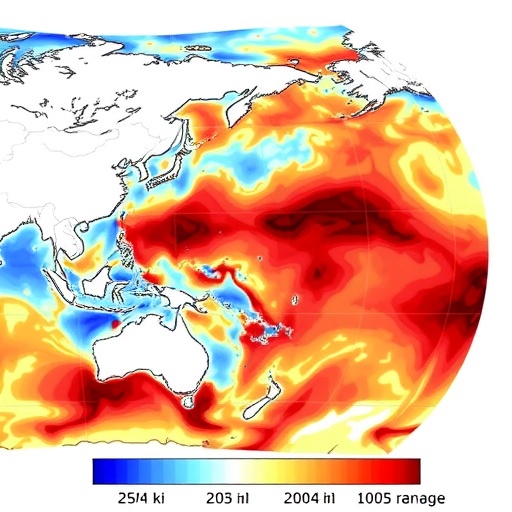
Researchers at Duke University’s Nicholas School of the Environment have uncovered a new and critical factor influencing the formation and intensity of the El Niño climate phenomenon: ocean salinity. Their groundbreaking study, recently published in Geophysical Research Letters, reveals that the spatial distribution of salt in the ocean—not just temperature—can significantly modulate the strength of El Niño events, which have profound implications for global weather systems.
El Niño episodes, occurring irregularly every two to seven years, dramatically alter weather patterns around the world, bringing atypical rainfall and drought conditions across multiple continents. These events are traditionally understood to be driven by the interplay of trade winds and ocean temperatures—specifically, the weakening of the east-to-west blowing trade winds across the equator in the Pacific Ocean. Under normal conditions, these strong trade winds promote the upwelling of colder waters along the eastern Pacific, maintaining cooler sea surface temperatures. However, when trade winds slacken, the suppression of upwelling allows warm surface waters to spread eastward, reinforcing the cycle of atmospheric and oceanic changes that culminate in El Niño.
Until now, models primarily focused on ocean temperature and wind patterns, paying little attention to the role of ocean salinity in this process. The new Duke study, led by assistant professor Shineng Hu, challenges this temperature-centric paradigm. “Ocean salt is far from uniform,” Hu explains. Variability in salinity arises from complex interactions including precipitation patterns, evaporation rates, and ocean circulation. These factors conspire to create intricate salt distributions that can be carried by currents, which in turn influence oceanographic and atmospheric dynamics.
Using high-resolution, publicly available satellite and buoy datasets spanning over six decades, Hu and her team identified recurring salinity patterns that precede major El Niño episodes. This discovery prompted a critical question: do these salt anomalies play an active role in promoting El Niño, or are they mere bystanders? The researchers employed sophisticated coupled ocean-atmosphere climate models designed to simulate the full complexity of Earth’s climate system. By manipulating salinity fields in these models, they tested how different salt distributions affected the likelihood and severity of El Niño events.
The modeling experiments yielded striking results. Specific springtime salinity configurations in the western Pacific—a fresher equatorial band flanked by saltier waters farther north and south—enhanced eastward oceanic currents along the equator. This eastward push helps transport warm surface waters toward the eastern Pacific, accelerating the development of El Niño conditions. Importantly, these salinity-driven currents were shown to intensify El Niño events by roughly 20 percent. Furthermore, the probability of extreme El Niño occurrences—characterized by more severe and widespread climate disruptions—doubled when these salinity patterns were present.
This finding has wide-reaching implications. Extreme El Niño events can cause devastating impacts, including catastrophic flooding, severe droughts, and disruptions to agriculture and ecosystems worldwide. Yet, current El Niño forecasting models rarely integrate salinity as a dynamic variable, relying heavily on thermal and wind data alone. The Duke researchers argue that ignoring this salty dimension limits both the accuracy and predictive power of climate models.
The discovery that salinity variability can act as a feedback mechanism to strengthen El Niño highlights the multifaceted nature of climate interactions. It underscores how interconnected oceanographic factors—temperature, salinity, and circulation—combine to shape global weather patterns. Understanding this interplay could refine forecasts, allowing better preparation for the societal impacts of El Niño events.
Funding from NASA enabled the research team to leverage advanced computational infrastructure, including the Duke Compute Cluster, to run exhaustive simulations. This computational power was necessary to disentangle the subtle but decisive effects of salinity from other confounding variables in the climate system. First author Shizuo Liu, a postdoctoral researcher in Hu’s lab, emphasized the novelty of this approach: “Our ability to isolate the role of salinity in a controlled model setting allowed us to definitively show its amplifying effect on El Niño.”
These insights come at a pivotal time. As climate change progresses, the frequency and intensity of extreme weather events are projected to rise. Better understanding the mechanisms behind phenomena like El Niño becomes not only a scientific imperative but also a societal necessity. The study’s findings suggest that incorporating salinity data into global climate models could enhance early warning systems, agricultural planning, and disaster preparedness.
Moreover, the research opens pathways for further investigation into how salinity interacts with other climate oscillations and teleconnections. It also prompts reconsideration of oceanic salinity monitoring strategies. To date, global salinity observations have been limited, but expanding coverage and resolution could yield even more insights into climate dynamics.
In conclusion, the Duke University study fundamentally advances our comprehension of the complex drivers behind El Niño. By illuminating the hidden influence of ocean salinity, it challenges existing climate modeling frameworks and offers a promising avenue to improve forecasts for one of the planet’s most disruptive natural phenomena. This research exemplifies the cutting-edge convergence of observational data, advanced modeling, and theoretical science necessary to tackle pressing global environmental challenges.
Subject of Research: Ocean salinity influence on El Niño intensity and formation
Article Title: Salinity-Induced Eastward Flow in Boreal Spring Favors Extreme El Niño
News Publication Date: January 5, 2026
Web References:
References:
Liu S, Hu S, McPhaden MJ. Salinity-Induced Eastward Flow in Boreal Spring Favors Extreme El Niño. Geophysical Research Letters. Jan. 5, 2026.
Keywords: El Niño, ocean salinity, climate modeling, trade winds, ocean currents, Pacific Ocean, upwelling, climate dynamics, extreme weather, sea surface temperature, climate forecasting, NASA-funded climate research


