

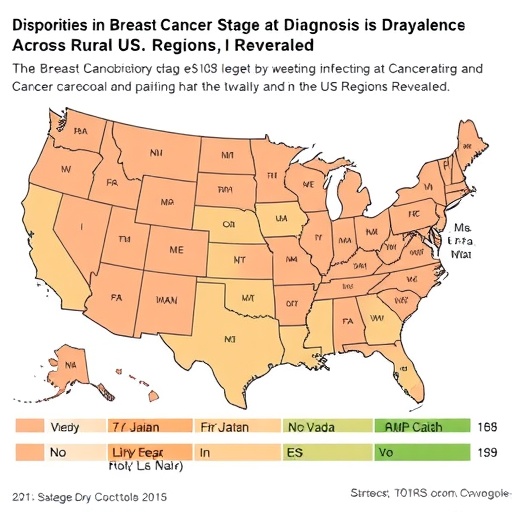
A groundbreaking national study which analyzes factors influencing the stage at which breast cancer is diagnosed among women living in rural America has revealed striking disparities rooted in geography, race, and insurance coverage. Published in the Journal of the American College of Surgeons, this research provides one of the most comprehensive assessments to date of how location within rural regions themselves impacts breast cancer outcomes. The findings underscore the urgent need for regionally tailored interventions and reinforce the complexity of cancer disparities in underserved populations.
Breast cancer remains a leading cause of cancer mortality among women worldwide, but its prognosis is heavily dependent on the stage at diagnosis. Early-stage detection offers a dramatically higher survival rate—often exceeding 90 percent five-year survival—whereas advanced stages, particularly stages three and four, reduce survival rates to nearly a third. This study specifically targets rural populations, historically known to be at higher risk for late-stage breast cancer due to barriers in healthcare access and socioeconomic factors. Leveraging the extensive dataset from the American College of Surgeons’ National Cancer Database, researchers analyzed records from over 52,000 rural women diagnosed between 2004 and 2021.
The study’s methodology involved categorizing counties as rural based on population thresholds—any area without cities or with towns fewer than 2,500 residents qualified as rural. Using established U.S. Census geographic divisions as a framework, the research examined incidence rates of advanced breast cancer diagnosis across these diverse rural regions. The analysis revealed that rural southern states, particularly the East South Central and West South Central regions, exhibited a significantly elevated proportion of women diagnosed with stage 4 breast cancer—up to 34 percent more likely compared to reference regions in the Midwest. These pronounced geographic disparities indicate that even within rural America, regional factors profoundly influence disease progression and stage at detection.
Racial disparities within rural breast cancer patients were also alarming. Black women showed a 58 percent higher likelihood of stage 3 diagnosis and a 28 percent higher likelihood of being diagnosed at stage 4 compared to their White counterparts. Hispanic women, though less represented in the cohort, demonstrated a 52 percent increased risk of stage 3 diagnosis. These findings align with longstanding evidence of racial inequities in cancer care but emphasize that such disparities persist and may be exacerbated in rural settings where resources and healthcare infrastructure are limited.
Insurance status emerged as a crucial determinant of breast cancer stage at diagnosis. Women without insurance were nearly twice as likely to receive a stage 3 diagnosis and were almost four times as likely to be diagnosed with stage 4 breast cancer relative to women with private insurance. Medicaid coverage, while somewhat protective, still correlated with an elevated risk of late-stage diagnosis—almost threefold compared to privately insured patients. This data suggests that insurance type, reflecting access to preventive screening and timely treatment, plays an instrumental role in early cancer detection.
Underlying these disparities are multifaceted challenges endemic to rural healthcare ecosystems. Notably, approximately 60 percent of rural counties lack active general surgeons, and fewer than 3 percent of oncologists primarily practice in rural areas, creating critical shortages in cancer diagnosis and treatment capabilities. Geographic remoteness compounds this shortage, as patients in rural regions often face significant travel distances to reach care facilities, a barrier that can delay screening and diagnosis. Additionally, lower health literacy and socioeconomic disadvantage further impede early detection efforts.
Addressing these entrenched challenges requires nuanced, region-specific strategies that extend beyond generic rural health initiatives. Experts advocate for expanded breast cancer screening programs designed to reach remote and underserved populations effectively. Another key intervention is bolstering the rural surgical workforce through dedicated training pipelines, such as fellowships offered by the American College of Surgeons’ Rural Surgery Program, which aim to prepare surgeons committed to long-term practice in these communities. By increasing local surgical and oncology capacity, access to timely diagnosis and comprehensive cancer care can be improved.
Moreover, health policy must be adaptive to the specific needs of rural residents in high-disparity regions. This may involve innovative care delivery models, such as mobile mammography units, telemedicine consultations with oncology specialists, and integrated community health education programs that enhance awareness of breast cancer symptoms and encourage prompt medical attention. Policies that expand insurance coverage and reduce out-of-pocket costs for diagnostic procedures also represent critical levers to alleviate financial barriers in these populations.
The study’s authors emphasize that while surgical training and workforce expansion are pillars of addressing rural cancer disparities, early detection and preventive care remain paramount. The interaction between systemic healthcare challenges and social determinants such as race and insurance highlights the complexity of rural cancer disparities. Therefore, interdisciplinary approaches involving public health, oncology, surgery, and community engagement are essential to design sustainable solutions.
While the National Cancer Database provides robust hospital-level data, the researchers acknowledge limitations including its inability to capture some patient-specific social and behavioral factors that contribute to delayed diagnoses. Future research integrating population-level datasets with granular individual and community-level characteristics may uncover additional barriers, such as cultural factors, stigma, or transportation issues. Such insight will be vital to create more precise interventions.
The significance of this research lies not only in documenting the severity of advanced breast cancer presentation in rural America but also in offering actionable insights. It demonstrates that rural health disparities are heterogeneous and that strategies to reduce late-stage breast cancer diagnoses must consider geographic variation, racial inequities, and socioeconomic status. By illuminating these complex layers, the study sets a foundation for more equitable breast cancer outcomes nationwide.
In summary, this landmark analysis paints a compelling picture of breast cancer disparities across rural America, revealing that where a woman lives—down to specific rural regions—substantially influences her likelihood of advanced breast cancer diagnosis. Alongside race and insurance status, geographic residence shapes cancer outcomes through a confluence of healthcare access, provider availability, and social determinants. Addressing these challenges demands a multifaceted, localized approach to improve screening access, strengthen rural surgical and oncology services, and address socioeconomic obstacles. As emerging rural surgery fellowship programs and policy initiatives gain traction, the hope is to transform cancer care and close these gaps in the near future.
Subject of Research: People
Article Title: Evaluating factors associated with advanced-stage breast cancer presentation in rural patients in the National Cancer Database
News Publication Date: 11-Mar-2026
Web References:
- Journal of the American College of Surgeons: https://journals.lww.com/journalacs/abstract/9900/evaluating_factors_associated_with_advanced_stage.1537.aspx
- American College of Surgeons National Cancer Database: https://www.facs.org/quality-programs/cancer-programs/national-cancer-database/
- U.S. Census regions and divisions: https://www2.census.gov/geo/pdfs/maps-data/maps/reference/us_regdiv.pdf
- ACS Rural Surgery Program: https://www.facs.org/for-medical-professionals/education/programs/so-you-want-to-be-a-surgeon/section-iii-surgical-specialties/rural-surgery-program/
- American Cancer Society Breast Cancer Survival Rates: https://www.cancer.org/cancer/types/breast-cancer/understanding-a-breast-cancer-diagnosis/breast-cancer-survival-rates.html
References:
Sogade O and Margenthaler J. Evaluating factors associated with advanced-stage breast cancer presentation in rural patients in the National Cancer Database. Journal of the American College of Surgeons, 2026. DOI: 10.1097/XCS.0000000000001759
Keywords: Breast cancer, Rural populations, Cancer disparities, Rural health, Advanced-stage cancer, Health insurance, Racial disparities, Surgical workforce, Cancer screening


