

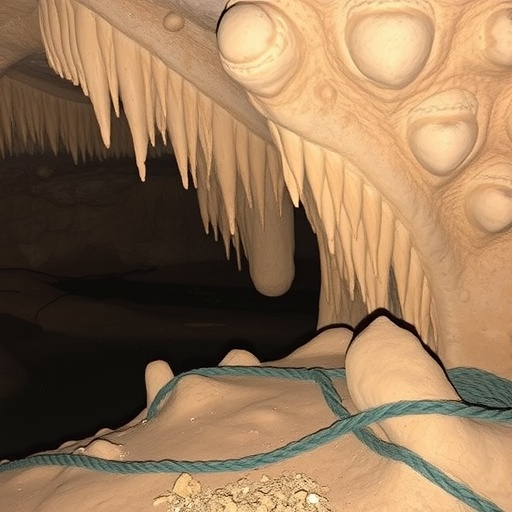
In a groundbreaking discovery that reshapes our understanding of Ice Age biodiversity in Central Texas, a paleontologist from The University of Texas at Austin uncovered fossilized remains of previously undocumented megafauna species while snorkeling in an underground water cave. This rare find includes remnants of a giant tortoise and a pampathere, an ancient armadillo relative comparable in size to a lion, marking a monumental addition to the paleontological record of the region.
John Moretti, who recently earned his doctoral degree from the UT Jackson School of Geosciences, spearheaded this research by conducting the first dedicated paleontological study of a water cave in Texas. Water caves, which act as conduits for subterranean streams and major channels for groundwater movement in Central Texas, have long been described by cavers as fossil-rich environments. Moretti’s systematic exploration of Bender’s Cave, located on private land in Comal County, confirmed these anecdotal impressions, revealing a trove of bones scattered abundantly along the cave’s streambed.
This extraordinary concentration of fossils in Bender’s Cave stemmed from erosion and flooding events thousands of years ago, which transported skeletal remains into the cavern through sinkholes. Once inside, these fossils remained preserved in the sediment, presenting a unique, largely untapped window into Ice Age ecosystems. Despite nearly a century of paleontological investigations in Central Texas, fossils from certain periods of the Pleistocene epoch had eluded detection—until now.
One of the most compelling aspects of Moretti’s findings is the potential interglacial age of the fossil assemblage. The last interglacial, occurring approximately 100,000 years ago, was a warm climate interval during the Ice Age. The presence of species such as the giant tortoise and pampathere—both dependent on warm habitats—and forest inhabitants like mastodons and giant ground sloths strongly suggests that Bender’s Cave preserves an interglacial fauna. This contrasts sharply with younger assemblages from the area that reflect colder glacial conditions dominated by grasslands.
The implications of these findings extend beyond mere species identification. They enrich the paleoecological narrative of Central Texas by revealing a diverse and previously undocumented megafaunal community adapted to a warmer, forested environment. This reshapes interpretations of how habitats shifted in response to climatic oscillations during the Pleistocene and highlights the interglacial period as a distinct ecological chapter.
Moretti’s research was meticulous and innovative in methodology. Over six field excursions spanning from March 2023 through November 2024, Moretti and John Young, a local caver and co-author, navigated the water-filled streambeds of the cave using snorkels and goggles. Their hands-on approach—plucking fossils directly from the sediment without the need for labor-intensive excavation—unveiled an array of megafaunal remains including bones from saber-toothed cats, camels, mastodons, and a giant ground sloth claw, alongside the hallmark tortoise and pampathere fragments.
Remarkably, all fossils displayed consistent mineralization patterns, with polished surfaces and rusty red staining indicative of simultaneous deposition and prolonged exposure to mineral-rich waters. However, the unique cave environment lacking associated geological material complicated radiometric dating efforts, presenting challenges to precisely establishing the fossils’ age. Consequently, researchers must rely on ecological context and comparative analyses with contemporaneous fossil sites.
Comparative statistical analysis conducted by Moretti underscored the link between Bender’s Cave fossils and other known interglacial fossil sites in Texas, particularly those in the Dallas area and the Gulf Coast. This clustering aligns with the hypothesis that the assemblage dates to the last interglacial, lending additional robustness to the interpretation of habitat and climatic conditions.
The discovery has generated excitement among experts in related fields. David Ledesma, an assistant professor at St. Edwards University specializing in vertebrate responses to Ice Age environmental changes, praised the work as evidence that even extensively studied regions like Central Texas continue to yield significant paleontological surprises. This underscores the dynamic nature of paleontology and the perpetual evolution of our understanding of prehistoric life.
Moretti stresses the importance of collaboration between scientific researchers and private landowners to facilitate future explorations. Since water caves often lie on privately held property, fostering partnerships is critical to accessing these natural archives. Such collaborations not only broaden the scope of scientific inquiry but also nurture stewardship of paleontological heritage.
Beyond expanding the fossil record, this research exemplifies how integrating multiple disciplines—paleontology, geology, ecology, and speleology—can yield insights into deep-time environmental change. The fossils of Bender’s Cave not only chronicle a snapshot of interglacial fauna but also invite reinterpretation of Central Texas paleoecology and Pleistocene biogeography, informing models of species survival and adaptation amid fluctuating climates.
The study’s publication in the journal Quaternary Research signals its significance within the scientific community, providing a detailed account of these novel megafaunal occurrences. It invites further inquiry and sets a precedent for employing innovative fieldwork techniques in challenging subterranean environments to uncover hidden chapters of Earth’s history.
By snorkeling through darkness and cold waters, Moretti’s expedition illuminates more than just fossil bones; it reveals a vivid narrative of life during a warm interval long before human history. These findings remind us that beneath familiar landscapes lie extraordinary stories shaped by the relentless forces of geology and evolution, waiting patiently for discovery.
Subject of Research: Late Pleistocene megafauna fossils from Bender’s Cave, Central Texas
Article Title: Novel occurrences of Late Pleistocene megafauna from Bender’s Cave on the Edwards Plateau of Texas may include evidence of the last interglacial
News Publication Date: 19-Mar-2026
Web References: Quaternary Research Article
References: DOI 10.1017/qua.2025.10071
Image Credits: John Moretti
Keywords: Paleontology, Megafauna, Paleoecology, Paleobiology, Fossils, Earth sciences, Caves


