

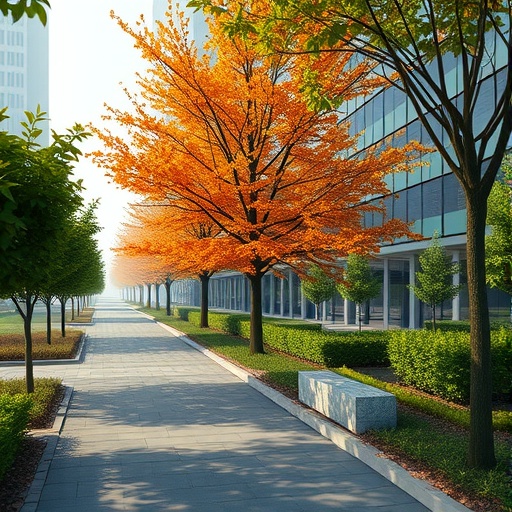
In a compelling study that merges environmental science with advanced technology, researchers have elucidated the intricate relationship between vegetation and land surface temperature (LST), particularly in urban settings. This groundbreaking research, conducted by a team led by scientists Hossain, Ferdous, and Suvo, leverages a digital twin framework to explore how urban greenery can mitigate the urban heat island (UHI) effect, a phenomenon where urban areas experience significantly warmer temperatures than their rural counterparts.
Understanding the UHI effect is pivotal in contemporary urban planning, especially as cities expand globally. The UHI phenomenon can lead to increased energy consumption, elevated emissions of air pollutants, and heat-related illnesses. The study underscores the importance of integrating vegetation into urban landscapes not just for aesthetic reasons, but as a critical strategy for climate adaptation. This is particularly urgent as cities continue to grapple with rising temperatures attributed to climate change and urbanization.
Utilizing a digital twin framework—an innovative technological model that replicates physical environments digitally—the researchers conducted a spatiotemporal analysis. This methodology allows for a high-resolution examination of vegetation and its impact on LST over various time periods. By employing this approach, the team was able to create a virtual representation of urban environments that could simulate different vegetation scenarios and predict their outcomes on temperature fluctuations.
One of the key findings of the research is that areas with ample tree coverage significantly experience lower surface temperatures compared to those dominated by concrete and asphalt. The data revealed that strategically placed vegetation can cool urban spaces by up to several degrees. This cooling effect is achieved through mechanisms such as shading and the process of evapotranspiration, where moisture from plants evaporates, leading to temperature reduction in the surrounding areas.
Moreover, the study highlights the varying impacts of different types of vegetation on temperature regulation. For instance, trees with dense canopies offer greater cooling effects than smaller plants. This suggests that urban planners should prioritize planting large trees in open spaces to maximize the benefits associated with urban greenery. Additionally, the research advocates for the enhancement of existing green spaces and the development of new parks as critical interventions for urban heat management.
The implications of this research extend beyond temperature regulation. Increased vegetation in urban settings has proven benefits for public health. Studies indicate that urban greenery contributes to improved air quality by filtering pollutants and capturing particulate matter. Furthermore, access to parks and green spaces has been linked to mental health benefits, promoting physical activity and social interaction, which are essential for community well-being.
In addressing the vulnerabilities associated with climate change, the research serves as a clarion call for cities worldwide to reassess their infrastructures and policies toward vegetation. Urban areas, which constitute a significant portion of the world’s population, must adapt to the warming climate, and incorporating green architecture and sustainable land use practices appears to be a fundamental step.
The digital twin framework employed by the researchers not only serves as a predictive tool but also as an educational resource for stakeholders involved in urban planning. Planners and policymakers can utilize the insights generated by this model to make informed decisions that foster greener urban environments. By visualizing the impact of different vegetation strategies in real-time, cities can better strategize the implementation of green initiatives.
As the study progresses, the researchers call for collaborative efforts between scientists, urban planners, and community organizations. The intermingling of ecological research with urban development is essential in creating resilient cities that can withstand rising temperatures. Engaging communities in the planning process ensures that planting initiatives are effective and culturally sensitive, reflecting the unique characteristics of each urban area.
Additionally, the findings advocate for enhanced policies that support urban greening initiatives. Financial incentives for developing green roofs, vertical gardens, and tree planting programs are essential to promote sustainability within urban settings. Such policies could also integrate education initiatives that inform residents about the benefits of urban greenery, empowering them to engage in community-led greening projects.
The research conducted by Hossain and colleagues is part of a broader narrative that recognizes the need for cities to evolve into greener, more sustainable habitats. As the effects of climate change become increasingly palpable, the lessons drawn from this study serve as a roadmap for future urban developments. The ability to simulate and visualize potential outcomes through advanced digital modeling provides a significant advantage in the pursuit of climate resilience.
In conclusion, the synergy between vegetation and urban temperature regulation is integral to the future of smart city planning. The study not only sheds light on the necessity of integrating natural elements into urban environments but also emphasizes the role of technology in shaping the sustainability of our cities. As we continue to navigate the challenges posed by climate change, embracing urban vegetation could be paramount in fostering cooler, healthier, and more resilient urban landscapes for generations to come.
Subject of Research: Vegetation’s influence on land surface temperature and urban heat island effect.
Article Title: Spatiotemporal analysis of vegetation influence on land surface temperature and urban heat Island using a digital twin framework.
Article References:
Hossain, M.I., Ferdous, M.N., Suvo, S.S. et al. Spatiotemporal analysis of vegetation influence on land surface temperature and urban heat Island using a digital twin framework. Discov Cities 2, 125 (2025). https://doi.org/10.1007/s44327-025-00175-y
Image Credits: AI Generated
DOI: https://doi.org/10.1007/s44327-025-00175-y
Keywords: urban heat island, land surface temperature, vegetation, digital twin framework, climate adaptation, urban planning, sustainable cities, greenery, resilience.


