
Tuesday, March 3, 2026
Science
No Result
View All Result
  • Login
  • HOME
  • SCIENCE NEWS
  • CONTACT US
  • HOME
  • SCIENCE NEWS
  • CONTACT US
No Result
View All Result
Scienmag
No Result
View All Result
Home Science News Science Education

Digital dog and cat skull database

July 16, 2024
in Science Education
Reading Time: 3 mins read
0
Skulls in the CT scanner
66
SHARES
601
VIEWS
Share on FacebookShare on Twitter
ADVERTISEMENT

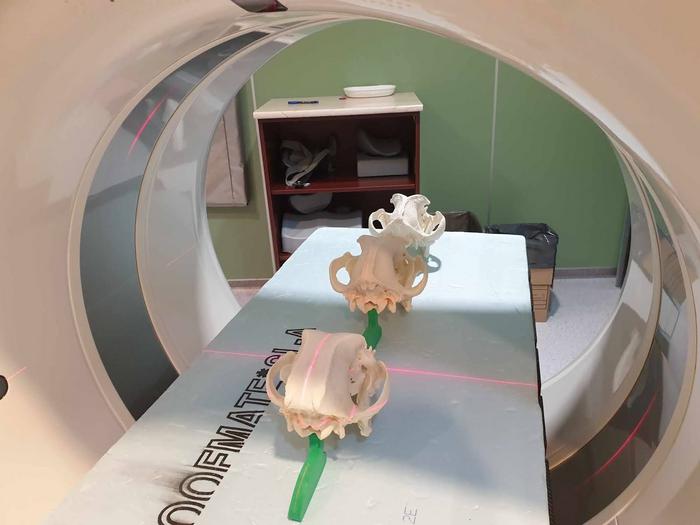
The ELTE Eötvös Loránd University is home to the skulls of more than 150 dog breeds and other animals. To make this unique collection accessible to all, researchers digitised the skulls of 431 dogs, cats and wild relatives. The database can be used for educational and research purposes.

Skulls in the CT scanner

Credit: Credit: Kálmán Czeibert

The ELTE Eötvös Loránd University is home to the skulls of more than 150 dog breeds and other animals. To make this unique collection accessible to all, researchers digitised the skulls of 431 dogs, cats and wild relatives. The database can be used for educational and research purposes.

Tibor Csörgő, a researcher at ELTE, has been collecting animal skulls for decades to teach anatomy to biologists. The shape of the skull varies considerably between species and breeds, especially in dogs, where, for example, greyhounds have long skulls and the now popular French bulldogs have rounded skulls.

A skull biobank could be a valuable resource for education, medicine and evolutionary research.

For example, Zsolt László Garamszegi, Director of the HUN-REN Institute of Ecological Research, together with ethologists from ELTE and Niclas Kolm from Stockholm University, have based their findings in part on this collection, which shows that modern dog breeds bred in the last 200 years have larger brains than those with ancient origin, due to altered selection effects. The researchers wanted to make this unique collection of skulls available to all.

VIDEOABSTRACT: 

Similar research previously required researchers to visit collections in person. Today, however, it is possible to digitise skulls so that anyone can conduct studies at their desk, even on another continent. The digitisation was carried out by Kálmán Czeibert, a veterinary neuroanatomist in collaboration with Ádám Csóka, Tamás Donkó and Örs Petneházy, imaging specialists from the Medicopus Nonprofit Ltd. research unit, using a medical high-resolution computed tomography (CT) scanner.

In total, 431 skulls were digitised, representing 152 dog breeds, 9 cat breeds and 12 of their wild relatives, including wolves, jackals, coyotes, a leopard and a serval.

The database was published in the journal Scientific Data. According to the study’s corresponding author, Enikő Kubinyi, head of the MTA-ELTE Lendület Companion Animal and ELTE NAP Canine Brain research groups, “the digital skull database can be used for comparative anatomical and evolutionary studies, in the education of veterinarians and biologists, and even for the development of machine learning algorithms for automated species identification and veterinary diagnostics”. The researchers have also produced a video to illustrate the database, which can be viewed here.


Original article:  Czeibert, K., Nagy, G., Csörgő, T., Donkó, T., Petneházy, Ö., Csóka, Á., Garamszegi, L. Z., Kolm, N., Kubinyi, E. (2024) High-resolution computed tomographic (HRCT) image series from 413 canid and 18 felid skulls. Scientific Data, 


Journal

Scientific Data

DOI

10.1038/s41597-024-03572-x

Article Title

High-resolution computed tomographic (HRCT) image series from 413 canid and 18 felid skulls. Scientific Data

Article Publication Date

16-Jul-2024

Share26Tweet17
Previous Post

Current international poverty line a ‘misleading shortcut method’, say experts

Next Post

Food aroma study may help explain why meals taste bad in space

Related Posts

blank
Science Education

Ranked in the World University Subject Rankings for the Second Year in a Row

March 2, 2026
blank
Science Education

New Study Traces 74 Years of China’s Medical Education Policy: From Segmentation to Integration

March 2, 2026
blank
Science Education

NUS Unveils Singapore’s Pioneering Dual Nursing-Informatics Degree to Cultivate a Digitally Skilled Nursing Workforce

February 27, 2026
blank
Science Education

New Study Uncovers Culturally-Rooted Pathways for Teacher Learning in China

February 26, 2026
blank
Science Education

Nationwide College Students Receive Lifesaving Education on Sudden Cardiac Death

February 26, 2026
blank
Science Education

NJIT Faculty Honored as Senior Members of the National Academy of Inventors

February 26, 2026
Next Post
Food aroma in a simulation of the International Space Station

Food aroma study may help explain why meals taste bad in space

  • Mothers who receive childcare support from maternal grandparents show more parental warmth, finds NTU Singapore study

    Mothers who receive childcare support from maternal grandparents show more parental warmth, finds NTU Singapore study

    27618 shares
    Share 11044 Tweet 6902
  • University of Seville Breaks 120-Year-Old Mystery, Revises a Key Einstein Concept

    1023 shares
    Share 409 Tweet 256
  • Bee body mass, pathogens and local climate influence heat tolerance

    665 shares
    Share 266 Tweet 166
  • Researchers record first-ever images and data of a shark experiencing a boat strike

    532 shares
    Share 213 Tweet 133
  • Groundbreaking Clinical Trial Reveals Lubiprostone Enhances Kidney Function

    518 shares
    Share 207 Tweet 130
Science

Embark on a thrilling journey of discovery with Scienmag.com—your ultimate source for cutting-edge breakthroughs. Immerse yourself in a world where curiosity knows no limits and tomorrow’s possibilities become today’s reality!

RECENT NEWS

  • Early Detection of Bloodstream Infections in Pediatric Leukemia Patients Using Cell-Free DNA
  • Physicists Unveil Long-Awaited ‘Clock Magnetism’ in Atomically Thin Crystal
  • NYU Langone Orthopedic Surgeons Showcase Breakthrough Clinical Findings and Research at AAOS 2026
  • Study Reveals Three Distinct Global AI Trajectories Influencing the Future of Technology and Governance

Categories

  • Agriculture
  • Anthropology
  • Archaeology
  • Athmospheric
  • Biology
  • Biotechnology
  • Blog
  • Bussines
  • Cancer
  • Chemistry
  • Climate
  • Earth Science
  • Editorial Policy
  • Marine
  • Mathematics
  • Medicine
  • Pediatry
  • Policy
  • Psychology & Psychiatry
  • Science Education
  • Social Science
  • Space
  • Technology and Engineering

Subscribe to Blog via Email

Enter your email address to subscribe to this blog and receive notifications of new posts by email.

Join 5,190 other subscribers

© 2025 Scienmag - Science Magazine

Welcome Back!

Login to your account below

Forgotten Password?

Retrieve your password

Please enter your username or email address to reset your password.

Log In
No Result
View All Result
  • HOME
  • SCIENCE NEWS
  • CONTACT US

© 2025 Scienmag - Science Magazine

Discover more from Science

Subscribe now to keep reading and get access to the full archive.

Continue reading