

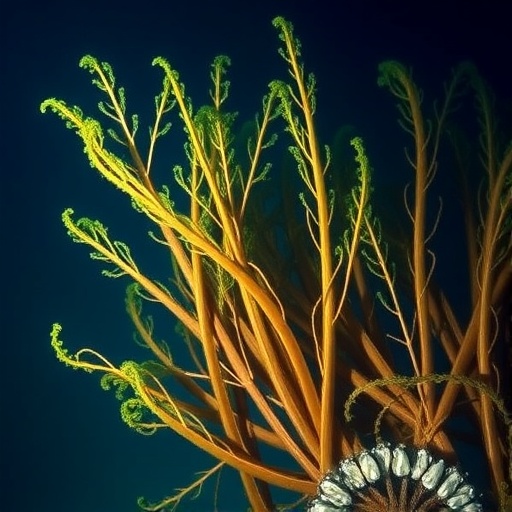
In a groundbreaking study poised to recalibrate our understanding of marine ecosystems and their role in carbon cycling, researchers have unveiled the rapid degradation of kelp in the deep ocean and its profound consequences on marine biomass-based carbon sequestration. Utilizing continuous in-situ deep ocean monitoring techniques, the research offers unprecedented insights into how the breakdown of kelp—one of the ocean’s most productive biological resources—curtails the capacity of marine environments to capture and store carbon effectively. This discovery not only redefines the limitations of kelp as a natural carbon sink but also highlights significant changes in benthic ecosystems that depend on these underwater forests.
Kelp forests are widely recognized as critical blue carbon reservoirs, ecosystems that biologically fix and store carbon dioxide (CO2) from the atmosphere. Prior models have often assumed that once kelp detritus sinks into the deep ocean, it constitutes a long-term carbon sink, contributing significantly to mitigating climate change. However, this novel study, leveraging in-situ sensors and autonomous underwater vehicles equipped with biochemical analyzers, paints a more nuanced and alarming picture. The kelp’s biomass, it turns out, is subject to rapid degradation processes, far faster than previously anticipated, thereby limiting the amount of organic carbon sequestered in the deep seafloor sediments.
By deploying cutting-edge deep-sea monitoring systems, the scientists gathered continuous data that reveal the kinetics of kelp decomposition in the ocean’s abyssal plains. Their findings emphasize that the biological, chemical, and physical factors down there—ranging from microbial activity to varying oxygen concentrations—accelerate the breakdown of kelp detritus before it can be effectively buried or integrated into sedimentary carbon pools. This acceleration drastically lowers the expected sequestration lifespan of kelp-derived biomass carbon, questioning the sustainability of kelp forests as long-term carbon sinks.
More than just a carbon cycle issue, the degradation of kelp biomass triggers cascading effects across benthic ecosystems. These underwater forests form habitats for a diverse array of species, and the unexpected rapid loss of kelp biomass has produced a domino effect on the structure and functioning of these communities. The researchers observed shifts in benthic organism populations, with species adapted to thrive on detrital kelp matter declining, and opportunistic organisms exploiting the changing nutrient cycles increasing. This ecological imbalance holds the potential to disrupt food webs and biogeochemical cycles critical for ocean health.
The methodology behind this study represents a leap forward in oceanographic research. Instead of relying on periodic sampling that risks missing transient yet influential processes, the in-situ monitoring approach captures real-time biochemical transformations. Autonomous deep-sea platforms, staffed with oxygen sensors, optical backscatter devices, and molecular probes, continuously assessed degradation markers such as lignin breakdown, carbon isotope ratios, and microbial respiration rates. Such detailed temporal resolution allows for parsing out the intricate interplay between physical oceanography and microbial ecology that drives kelp decomposition.
Interestingly, the study sheds light on the microbial consortium responsible for the accelerated kelp decay. The researchers identified specific bacterial taxa that thrive in the deep ocean’s low-oxygen microenvironments and produce enzymatic cocktails capable of rapidly dismantling kelp’s complex polysaccharides. These microbial processes, hitherto less understood, represent a crucial pathway through which organic carbon is recycled back into CO2, thus preventing long-term sequestration. This finding spotlights microbial communities as key regulators of blue carbon dynamics and targets for further research to manipulate or monitor in efforts to enhance carbon retention.
In terms of climate change mitigation strategies, the implications of this research are substantial. Policymakers and conservationists have increasingly viewed kelp restoration and protection as natural climate solutions to absorb atmospheric CO2. However, by demonstrating this limitation in carbon storage potential, the study argues for a reassessment of kelp-based blue carbon projects’ efficacy. While kelp forests undoubtedly provide numerous ecological benefits, including biodiversity conservation and coastal protection, their carbon sequestration role might be more transient and sensitive to environmental change than previously thought.
Moreover, this research adds urgency to understanding how ocean warming, acidification, and deoxygenation might alter the rates of kelp degradation. As deeper waters warm and oxygen availability shifts, microbial metabolisms and enzymatic functions influencing kelp breakdown are likely to fluctuate. The researchers urge that future studies incorporate such environmental stressors to model carbon sequestration trajectories accurately and predict how global change could exacerbate or mitigate degradation rates, ultimately influencing carbon budgets in marine systems.
Another crucial aspect addressed is the spatial variability of kelp degradation. The study found that degradation rates vary substantially across different deep ocean basins, influenced by local oceanographic conditions such as current patterns, sediment types, and biological community composition. These findings emphasize the importance of region-specific data when assessing blue carbon stocks and warn against overgeneralizing carbon sequestration potential at a global scale. Tailored conservation and carbon accounting measures will be necessary to reflect this heterogeneity accurately.
The research also challenges the standard assumptions of carbon transfer efficiency from surface kelp growth to deep-sea sequestration. Previous models often underestimated the metabolic activity occurring once kelp detritus settles on the seafloor. By integrating biochemical markers and microbial respiration rates collected in real time, the team highlighted higher remineralization rates than anticipated, demonstrating that microbial degradation converts a significant fraction of the carbon back to CO2 rather than enabling it to sink into long-term burial.
Crucially, the observed alterations in benthic ecosystem dynamics extend beyond carbon cycling. The decline in detritus-dependent fauna affects nutrient recycling and bioturbation — the mixing of sediments by organisms — processes that influence sediment oxygenation and nutrient availability. Depleted detritus inputs alter these functions, potentially creating feedback loops that further accelerate kelp degradation and decrease ecosystem resilience. This holistic perspective underscores the intertwined nature of carbon biogeochemistry and ecosystem health.
The study’s temporal scale, covering months of continuous measurements, contrasts starkly with earlier snapshot-based research approaches. Long-term monitoring elucidates episodic events such as sudden oxygen fluxes, temperature shifts, and detrital bloom decay stages that were previously undetectable but significantly affect degradation rates. This temporal depth unveils the complex, nonlinear nature of kelp degradation and carbon cycling dynamics, informing more robust models for forecasting future ocean carbon flux patterns.
From a technological standpoint, the deployment of autonomous deep ocean monitoring systems heralds a new era in marine carbon research. Combining high-resolution chemical sensing with genetic sequencing technologies onboard allows simultaneous tracking of carbon flux and microbial community dynamics. These integrative platforms can be adapted globally to various oceanic regions, enabling large-scale, comparative studies that enrich our understanding and management of blue carbon.
The team’s comprehensive analysis ultimately redefines kelp’s role in ocean carbon sinks. While kelp forests remain essential ecological and carbon-absorbing habitats, their potential for locking away carbon in deep sediments may have been substantially overestimated. This realization calls for recalibrated climate models, incorporating marine biomass degradation processes as dynamic and spatially variable factors rather than fixed assumptions. The study sets a new benchmark for marine ecological research aimed at unraveling the ocean’s complex contributions to Earth’s carbon budget.
As ocean conservation policies evolve, this research urges integrating microbial ecology and continuous environmental monitoring in evaluating carbon sequestration strategies. A more nuanced understanding will help strategize preservation and restoration efforts considering both ecological benefits and realistic carbon storage capabilities. Future research expansions into other macroalgal systems and interactions with marine sediment processes will further illuminate the global blue carbon potential and improve strategies against climate change.
In summary, this pioneering investigation reveals that rapid kelp degradation in the deep ocean significantly restricts the carbon sequestration potential of marine biomass, altering benthic ecosystems in profound ways. Through innovative in-situ monitoring and biochemical analyses, the study exposes microbial degradation as a pivotal control mechanism, urging a reassessment of kelp forests’ role in global carbon cycling. This paradigm shift will influence future climate mitigation policies, marine ecosystem management, and the scientific pursuit of leveraging natural systems to combat atmospheric CO2 rises.
Subject of Research: Rapid kelp degradation in the deep ocean, marine biomass-based carbon sequestration, and its impact on benthic ecosystems.
Article Title: In-situ deep ocean monitoring reveals rapid kelp degradation limits marine biomass-based carbon sequestration potential and alters benthic ecosystems.
Article References:
Bauer, K.W., Correa, P.V.F., Lupin, A. et al. In-situ deep ocean monitoring reveals rapid kelp degradation limits marine biomass-based carbon sequestration potential and alters benthic ecosystems. Commun Earth Environ (2026). https://doi.org/10.1038/s43247-026-03342-0
Image Credits: AI Generated


