

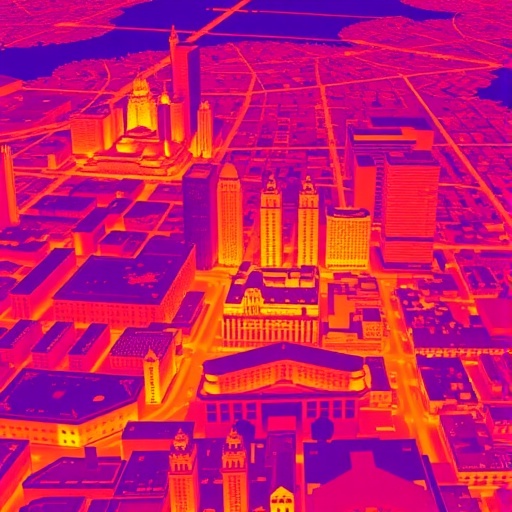
In recent years, urban heat islands (UHIs) have gained increasing attention as cities around the world continue to expand. The phenomenon, characterized by urban areas exhibiting higher temperatures than their rural surroundings, poses significant challenges for sustainability and public health. Understanding the intricate relationship between urbanization and UHI effects is paramount for urban planners, policymakers, and environmental scientists alike. The recent study conducted by Das, Mandal, and Das delves into this crucial subject, employing machine learning to unravel the complexities of spatial urbanization and UHI phenomena through a detailed landscape-based spatial framework.
Urbanization has fundamentally transformed landscapes across the globe. As cities expand, the increased concentration of buildings, roads, and other man-made surfaces results in heat retention, contributing to pronounced temperature disparities. As regions become more urbanized, it is critical to ask how these changes are influencing local climates and, specifically, UHI effects. The study’s authors sought to quantify these effects and identify contributing factors using advanced machine learning techniques, providing new insights that can inform future urban development.
One of the innovative aspects of the research is its emphasis on a landscape-based spatial framework. Unlike past studies that have approached UHI analysis through simplistic models, this research acknowledges the multifaceted nature of urban landscapes. By examining variables such as land cover, vegetation, and proximity to water bodies, researchers were able to create a more nuanced understanding of how these elements interact to influence warming phenomena in urban settings.
Machine learning algorithms offer unparalleled capabilities in processing vast amounts of data. The researchers utilized these advanced techniques to analyze spatial patterns and predict UHI effects based on urbanization metrics. By applying machine learning to a rich dataset, they could identify which variables most significantly correlated with temperature increases. This method transcended traditional statistical analysis, providing deeper insights into complex relationships that had previously gone unexamined.
Furthermore, the study identified several critical urban features that amplify UHI impacts. Dense concentrations of impervious surfaces, such as asphalt and concrete, were found to be particularly exacerbating factors in contributing to elevated temperatures. Additionally, the research shed light on the importance of vegetation within urban environments, suggesting that increases in greenery can effectively mitigate UHI effects. These findings underscore the importance of incorporating green spaces into urban planning to foster both environmental and public health outcomes.
Beyond individual findings, the implications of this research resonate throughout multiple sectors. Understanding the dynamics between spatial urbanization and UHI is crucial for urban planners aiming to create sustainable cities. The study provides critical data-driven insights that can guide policy interventions aimed at reducing heat retention in urban locations. For instance, promoting the integration of green roofs, urban forests, and parks might be effective strategies to help alleviate urban heat concerns and improve residents’ quality of life.
An important aspect of the research is its potential application on a global scale. While urban heat island effects are often studied within localized contexts, the methodology developed in this study can be adapted to evaluate UHI dynamics in various cities worldwide. The insights gained from this research could inspire a wave of similar studies, prompting global collaboration and knowledge sharing as cities seek to address the common challenges posed by rising urban temperatures.
Additionally, as climate change continues to evolve, understanding UHI effects becomes even more critical. The increasingly erratic weather patterns and rising average temperatures necessitate proactive measures to protect vulnerable urban populations from escalating heat-related risks. The methodologies and frameworks established in this research can serve as essential tools for cities striving to adapt to evolving climate dynamics through informed, data-driven policy making.
Looking ahead, the study’s authors advocate for interdisciplinary approaches that combine environmental science, urban planning, and data analytics. By bringing together experts from various fields, cities can create comprehensive strategies that account for the complexities of urbanization. This collaborative approach is essential for fostering resilience in urban environments susceptible to climate-induced challenges.
Moreover, the study highlights the role of community engagement in combating urban heat islands. By raising awareness and promoting public participation in urban greening initiatives, cities can empower residents to act positively in their neighborhoods. Community-led efforts can complement governmental strategies, reinforcing the collective responsibility to address climate risks and enhance urban livability.
In summary, the groundbreaking research by Das, Mandal, and Das illuminates the intricate relationship between spatial urbanization and urban heat islands through the lens of machine learning. This work not only advances our understanding of UHI but also opens pathways for innovative solutions to urban climate challenges. As cities continue to grow, adopting evidence-based practices derived from such studies will be critical in creating sustainable and resilient urban environments for generations to come.
Subject of Research: Urban Heat Islands and Spatial Urbanization
Article Title: Understanding the relationship between spatial urbanization and urban heat island using machine learning: a landscape-based spatial framework
Article References:
Das, M., Das, A., Mandal, A. et al. Understanding the relationship between spatial urbanization and urban heat island using machine learning: a landscape-based spatial framework.
Environ Sci Pollut Res (2025). https://doi.org/10.1007/s11356-025-37195-5
Image Credits: AI Generated
DOI: https://doi.org/10.1007/s11356-025-37195-5
Keywords: Urban Heat Islands, Machine Learning, Spatial Urbanization, Climate Change, Environmental Policy


