

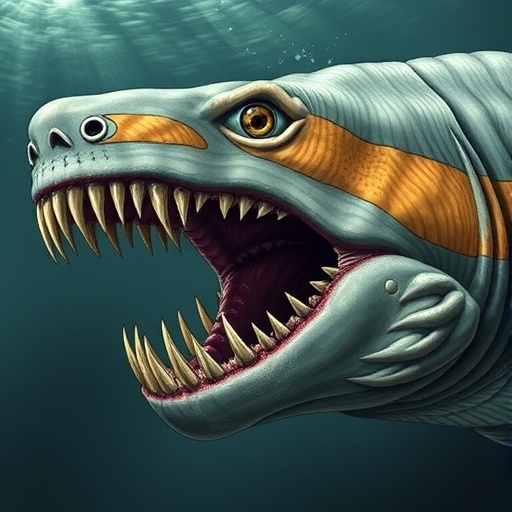
In a groundbreaking study led by the University of Liège, a team of international researchers has unlocked new insights into the predatory dynamics of extinct marine reptiles that thrived approximately 80 million years ago in the ancient seas covering North America. This research, published in the esteemed journal Palaeontology, employs an innovative interdisciplinary approach that melds palaeontology, biomechanics, and engineering to delve deeply into the feeding mechanics of formidable Cretaceous marine predators, namely mosasaurs and plesiosaurs. By resurrecting the bite forces these animals wielded, scientists are beginning to unravel how these large predators coexisted without direct competition, thereby illuminating the intricate ecological balances that once dominated prehistoric marine ecosystems.
The biodiversity of marine reptiles inhabiting the Western Interior Seaway during the Late Cretaceous period presents a complex web of predator-prey relationships. To infer the hunting strategies and ecological roles of these long-extinct creatures, the research team turned to cutting-edge 3D modeling technologies combined with engineering simulation techniques, notably finite element analysis (FEA). By reconstructing detailed, three-dimensional digital models of mosasaur and plesiosaur skulls and mandibles, the team was able to approximate the muscular structure and calculate the forces that these muscles generated during biting. This approach permits a precise quantification of stress distributions on each specimen’s cranial framework under bite loads, providing unprecedented insights into the mechanical constraints and capabilities of these marine reptiles.
Finite element analysis, a computational method typically used in mechanical engineering, allows for simulation of physical forces acting on structures by dividing them into a mesh of small elements. Applying this technique to fossilized skulls enabled the excavation of the biomechanical performance of jaws during prey capture and processing. In doing so, researchers gained a virtual window into the functional morphology of extinct species, which traditionally had to be inferred indirectly from fossil shapes alone. This ability to simulate real-world mechanical behavior equips scientists to test long-standing ecological hypotheses about predator niche partitioning quantitatively, transcending previous speculation based solely on comparative anatomy.
One of the key revelations from this study is the identification of distinct feeding adaptations across different species cohabiting the seaway. While some mosasaurs exhibited skulls capable of withstanding immense bite forces with optimal mechanical performance—characteristics indicative of apex predators capable of subduing large and robust prey—plesiosaurs, by contrast, showed signs of specializing in softer-bodied, more elusive prey such as small fish or cephalopods. This differentiation suggests that evolutionary pressures fostered unique biomechanical strategies allowing sympatric species to partition ecological niches effectively, thus minimizing direct competition and facilitating their prolonged coexistence within the same marine environment.
The importance of musculature reconstructions in this research cannot be overstated. By estimating the force output of jaw adductors, the investigators were able to calculate bite forces reflective of the true functional capacity of these animals. The method integrates anatomical landmarks to restore muscle orientations and lever mechanics, providing a foundational understanding of feeding behavior grounded in biomechanics rather than mere morphological assumptions. Such reconstructions enable nuanced interpretations of how these marine reptiles interacted with their environment, not just how they looked.
This multidisciplinary fusion of palaeontology and engineering also opens exciting avenues for exploring fossil records beyond feeding mechanics. For extinct organisms where behavior and ecology are otherwise lost to time, biomechanical modeling can serve as a proxy to infer how anatomical structures may have performed under ecological pressures. This virtual experimentation enables scientists to hypothesize behaviorally relevant functions with an unprecedented degree of confidence, thus bridging the temporal gulf between extinct and extant lifeforms.
The findings presented challenge previous notions that large marine predators engaged in heavy direct competition, instead painting a picture of intricate predator-prey dynamics marked by specialization and resource partitioning. This ecological mosaic likely played a crucial role in sustaining diverse predatory guilds in prehistoric seas. By illuminating these relationships, researchers contribute to a broader understanding of how ecosystems—both ancient and modern—balance predator populations and structure food webs in a sustainable, competitive environment.
The methodological framework established through this investigation lays groundwork not only for studies of Late Cretaceous fauna but also for future explorations into the functional anatomy of other extinct species whose lifestyles remain enigmatic. It exemplifies a new era in palaeontology where classical fossil analysis merges with computational technologies and mechanical principles to reveal life’s deep past with extraordinary clarity.
In sum, this study highlights that marine reptiles of the Cretaceous were biomechanically diverse predators adapted to various ecological roles. Their skull mechanics, bite forces, and potential prey types reflect a refined evolutionary balance within their ecosystems, elucidating how multiple large predators thrived simultaneously in the same ancient seaway. These revelations enhance our understanding of evolutionary biology, paleobiology, and ecosystem dynamics in prehistoric marine systems across deep time.
As technology advances, such integrative approaches to palaeontological research promise to reshape the narratives scientists can construct about extinct life, optimizing both the accuracy and depth of ecological reconstructions. This particular inquiry into mosasaur and plesiosaur feeding biomechanics stands as a compelling testament to the value of melding engineering principles with fossil study to unravel life’s ancient mysteries. It invites a future where extinct animals are not merely static relics of the past but dynamic subjects whose biology and ecology can be explored in astonishing detail.
For the scientific community and the public alike, this research provides an evocative glimpse into the highly specialized adaptations that enabled prehistoric marine reptiles to dominate their environments. It also underscores the power of collaborative, interdisciplinary methods in solving some of the most intriguing puzzles of natural history. Through the precise recreation of biting forces and ecological roles, this work transforms ancient fossils from inert remains into vivid chronicles of survival, predation, and evolution beneath the waves of a Cretaceous ocean.
Subject of Research: Feeding biomechanics and ecological roles of Late Cretaceous marine reptiles (mosasaurs and plesiosaurs) from the Western Interior Seaway.
Article Title: Distinct feeding biomechanics in Late Cretaceous marine reptiles from the Western Interior Seaway
News Publication Date: 25-Mar-2026
Web References:
https://mediasvc.eurekalert.org/Api/v1/Multimedia/13a0c987-292f-4842-bebe-110666b22220/Rendition/low-res/Content/Public
DOI: 10.1111/pala.70051
Image Credits: University of Liège / EddyLab / F.Della Giustina
Keywords: Mosasaurs, plesiosaurs, Late Cretaceous, feeding biomechanics, finite element analysis, bite force, marine reptiles, paleoecology, Western Interior Seaway, predator-prey interactions, evolutionary biology, fossil reconstruction


