

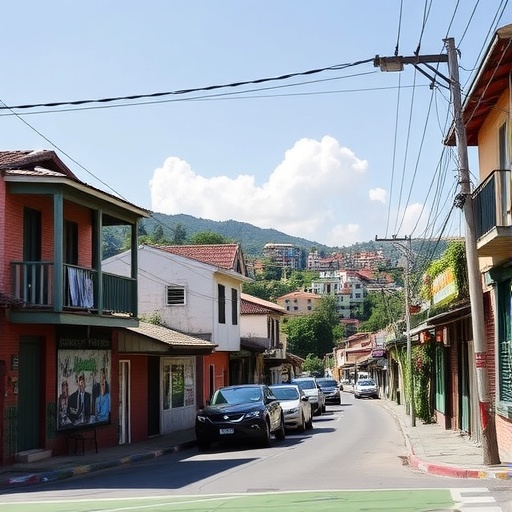
In the heart of Mexico City’s sprawling metropolitan expanse lies Lomas del Centinela, a neighborhood whose intricate urban fabric reflects the multifaceted realities of informal settlements worldwide. A groundbreaking study published in npj Urban Sustainability dismantles conventional paradigms, shedding new light on the challenges and methodological innovations essential for decoding the complexities inherent in informal urbanism. The research, led by Rico, Izquierdo, Delgado, and colleagues, ventures beyond simplistic models to unveil nuanced perspectives on how these dynamic environments function, thrive, and confront the pressures of rapid urban growth.
Informal urbanism, typified by self-organized, often unregulated settlements, comprises a significant portion of many cities globally. Yet, its informal nature poses substantial methodological hurdles for researchers and policymakers alike aiming to understand and improve living conditions. The Lomas del Centinela case study presents a pioneering approach that harnesses mixed-method frameworks integrating spatial analytics, participatory mapping, and ethnographic inquiry to provide a granular view of everyday life and spatial organization in informal contexts.
At the core of the investigation is the acknowledgment that traditional urban planning instruments fall short in capturing the fluid, adaptive characteristics of informal settlements. These areas defy rigid categorization; their morphologies and social networks continuously evolve, driven by economic precarity, legal ambiguities, and environmental constraints. Therefore, the study underscores the necessity of developing flexible, culturally attuned methodologies capable of engaging local residents as active knowledge producers.
One technical innovation detailed involves the application of high-resolution drone imagery combined with machine learning algorithms to delineate informal housing patterns with unprecedented precision. This geospatial technology enables researchers to identify micro-scale variations in building materials, structural integrity, and spatial connectivity. Such data enriches the understanding of urban resilience factors and informs targeted interventions to enhance infrastructure without displacing communities.
Moreover, participatory mapping initiatives emerged as a potent tool for democratizing urban knowledge production. Engaging residents in co-creating spatial narratives allowed the researchers to document subjective experiences related to safety, mobility, and access to services. This bottom-up knowledge complemented remote sensing data, providing a holistic depiction of the neighborhood’s socio-spatial dynamics that purely quantitative measures might obscure.
Ethnographic methods were intricately woven into the research design, illuminating the socio-economic undercurrents shaping informal urbanism. Detailed interviews and prolonged immersion unveiled residents’ strategies for navigating legal precarity, accessing informal economies, and fostering community solidarity. Such insights problematize mainstream policy fixations on formalization, arguing for more nuanced policies that valorize local agency and indigenous knowledge systems.
The study also tackles the critical issue of governance and the interplay between formal institutions and informal dynamics. Lomas del Centinela’s case highlights how multiple overlapping authorities and ambiguous legal frameworks generate both obstacles and opportunities for residents’ daily existence. Researchers contend that governance models must embrace hybridity and multi-scalar coordination to effectively address the realities on the ground.
Environmental considerations take center stage as well, given the susceptibility of informal settlements to climate hazards. The investigation reveals how residents employ informal adaptive measures—from makeshift drainage systems to vernacular architectural solutions—that exemplify resilience. Recognizing and integrating these adaptive capacities into urban sustainability agendas is imperative as cities confront unprecedented environmental challenges.
The granular data provided by this multidisciplinary approach offers a robust foundation for developing urban policies that balance the imperatives of sustainability, equity, and inclusion. It advocates for embracing informality not as deviation from normative urbanism but as an intrinsic, vibrant component deserving respect and strategic investment. Such a paradigm shift requires dismantling entrenched stigmas and adopting a pluralistic vision of urban futures.
Significantly, the researchers emphasize the replicability of their methods for other informal settlements globally. The blend of technological tools and participatory frameworks stands as a blueprint for comprehensive urban analysis, capable of being tailored to diverse cultural and geographic contexts. This scalability positions the study as a milestone in the democratization of urban knowledge and data sovereignty.
Nevertheless, the study candidly acknowledges limitations. The often transient and fluid population dynamics challenge longitudinal analysis, while ethical complexities arise when navigating residents’ privacy and consent in data collection. Addressing these concerns necessitates continuous refinement of methodological protocols, rooted in respect and reflexivity.
The implications stretch far beyond academic circles, signaling a clarion call for urban planners, policymakers, and civil society organizations. Effecting meaningful change in informal neighborhoods demands embracing complexity and rejecting one-size-fits-all solutions. Instead, fostering collaborative, context-specific interventions that center residents’ voices emerges as the pathway toward sustainable and just urban futures.
Through meticulous articulation of empirical findings and methodological rigor, this study broadens the horizons of urban sustainability discourse. It paints a compelling narrative of informal settlements not merely as sites of vulnerability but as crucibles of innovation, resilience, and social ingenuity. Understanding and supporting these communities constitutes an indispensable chapter of modern urbanism.
Ultimately, the Lomas del Centinela case study contributes decisively to the global endeavor of reimagining informality. By dissecting its layered challenges and charting new avenues for engagement, Rico and colleagues illuminate the transformative potential embedded in informal urbanism. Their work stands as a testament to the power of integrated research paradigms in crafting inclusive, adaptive cities of tomorrow.
Subject of Research: Challenges, methods, and opportunities in understanding informal urbanism through a detailed case study of Lomas del Centinela, Mexico.
Article Title: The challenges, methods, and opportunities of understanding informal urbanism: a case study in Lomas del Centinela, Mexico.
Article References:
Rico, A., Izquierdo, L., Delgado, E. et al. The challenges, methods, and opportunities of understanding informal urbanism: a case study in Lomas del Centinela, Mexico. npj Urban Sustain 6, 35 (2026). https://doi.org/10.1038/s42949-026-00360-x
Image Credits: AI Generated


