

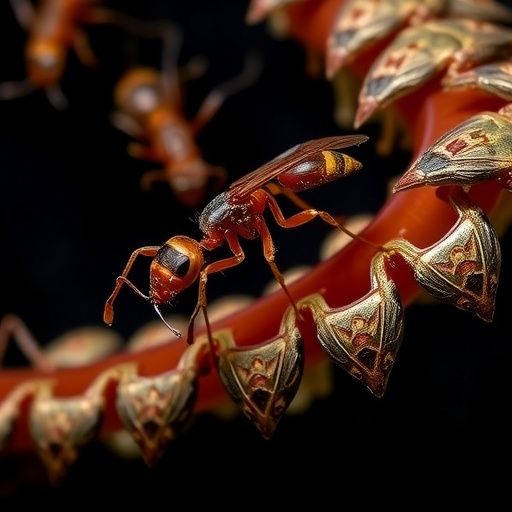
In the unprecedented realm of host-parasite interactions, recent revelations have emerged from a cutting-edge study led by Sistermans, Libbrecht, and Foitzik, which delves into the intricate dynamics of an ant-cestode system. Their pioneering work highlights the intricate co-expression analysis of transcriptomes from both the host (the ant) and the parasite (the cestode). This is not just a case of studying two different organisms; it’s a deep dive into the molecular dialogues that transpire between them, unveiling how the parasite modulates the behavior and physiology of its ant host.
The research exemplifies how advanced genomic techniques can unlock a Pandora’s box of biological mysteries. Transcriptome analysis, which studies the set of all RNA molecules in one or a population of cells, is critical here. By comparing the expression levels of genes in both the ants and the cestodes, the researchers were able to identify specific pathways that are hijacked by the parasite. This phenomenon is not merely one of infection but involves sophisticated manipulation mechanisms at the molecular level, which ultimately affect the host’s behavior.
One striking finding from the study is the identification of particular genes that are consistently upregulated in infected ants. This indicates that the cestodes have not only invaded the host but have also triggered a cascade of genetic responses that aid their own survival. This modulation often leads to altered foraging behavior, changes in immune responses, and even impacts the longevity of the ant, all aligned with the needs of the parasite for optimal transmission and survival.
The researchers employed an integrative co-expression analysis method, allowing them to synthesize data from both host and parasite, creating a comprehensive picture of their interaction. By utilizing this dual approach, they were able to not only view how the parasite affects the gene expression in its host but also offer insights into the evolutionary adaptations that may have occurred over millennia. Such interactions are a testament to the complex dating game of evolution, where winners and losers are constantly changing based on their ability to adapt to these intertwined lives.
Furthermore, the study’s authors assert that their findings extend beyond mere academic interest; they hold implications for understanding broader ecological dynamics. The ant-cestode interaction they studied can serve as a model for other host-parasite systems. The principles uncovered in this research could potentially be applied to understand human pathogens and their interactions with human hosts, thereby providing insights that may influence medical research and treatment strategies.
Examining the fine details of genetic expression changes caused by the parasite reveals potential targets for new treatments. If certain pathways can be disrupted without harming the host, it may be possible to mitigate the detrimental effects of the parasite. This opens avenues for employing specific inhibitors or therapies to counteract the manipulative strategies employed by parasites, not just in ants but across a wide spectrum of hosts.
Moreover, the researchers point out the importance of understanding these bi-directional interactions not just at a genetic level, but at a behavioral one as well. The behavioral changes observed in infected ants suggest a form of host manipulation that could be described as “mind control.” The infected ants exhibit altered social interactions, and this change can have ramifications for the entire colony, pushing the boundaries of our understanding of social organisms and the implications of such parasitic strategies.
This nuanced exploration of host-parasite genetics also sheds light on the potential arms race between hosts and their parasites. As parasites evolve to exploit their hosts’ systems more effectively, hosts too are under selection pressure to develop counter-strategies. This evolutionary back-and-forth may lead to a deeper understanding of biodiversity and the maintenance of ecosystems, underlining that hosts and parasites are often inextricably linked in a complex web.
In a world increasingly challenged by infectious diseases, the findings presented in this research could have significant ramifications for the field of infectious disease ecology. Understanding how different species negotiate these complex relationships can contribute to more effective management and conservation strategies. Insights gained from such studies are essential as they enhance our comprehension of biodiversity, ecosystem functioning, and the impact of invasive species.
The work by Sistermans and colleagues is a call to action emphasizing the need for multidisciplinary approaches in studying infectious diseases. Traditional methods often fall short in addressing the complexities of these interactions; thus, integrating genomics, ecology, and behavioral studies seems essential for advancing the field. Their study is exemplary of how scientific exploration can illuminate the hidden intricacies of life, showcasing the power of research to rewrite our understanding of the natural world.
As we dive deeper into this era of genomics and molecular biology, it becomes increasingly evident that the tiniest organisms can wield immense power over others, shaping evolutionary pathways and influencing ecosystem dynamics. This study serves as a reminder that the battle between hosts and parasites, while often overlooked, is a significant force in shaping the biological world around us.
In conclusion, this groundbreaking study enhances our understanding of host-parasite interactions. It illustrates that the hidden conversations occurring within the genome have far-reaching implications for ecology and evolution. As researchers continue to unveil these complex relationships, the implications for science, medicine, and our understanding of life on Earth will undoubtedly be profound.
Subject of Research: Host–Parasite Interactions in Ant–Cestode Systems
Article Title: Integrated Co-Expression Analysis of Host–Parasite Transcriptomes Reveals Mechanisms of Host Modulation in an Ant–Cestode System
Article References:
Sistermans, T., Libbrecht, R. & Foitzik, S. Integrated co-expression analysis of host–parasite transcriptomes reveals mechanisms of host modulation in an ant–cestode system.
BMC Genomics (2026). https://doi.org/10.1186/s12864-026-12581-6
Image Credits: AI Generated
DOI: 10.1186/s12864-026-12581-6
Keywords: Host-parasite interactions, transcriptome analysis, ant, cestode, gene expression, ecological dynamics, infectious diseases, evolutionary biology.


