

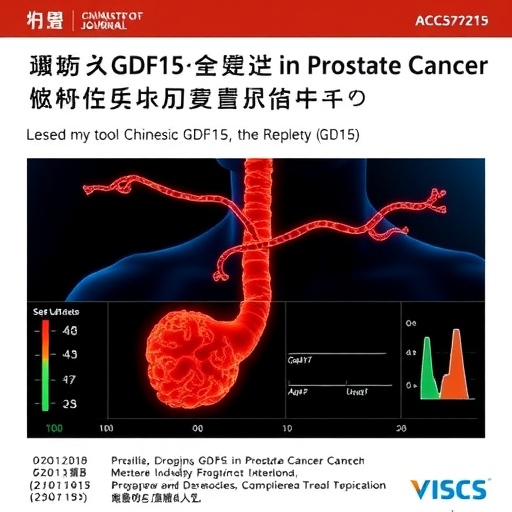
Prostate cancer continues to assert itself as a formidable health challenge worldwide, marked by its increasing incidence and the poor outlook associated with its advanced stages. Particularly troubling are the cases complicated by cachexia, a debilitating syndrome characterized by profound weight loss and muscle wasting that significantly compromises patient survival and quality of life. As conventional therapies reach the limits of their efficacy, the urgent need for novel, targeted approaches has become glaringly evident. Recent advances shed light on a pivotal molecular player: Growth Differentiation Factor 15 (GDF15), a cytokine belonging to the transforming growth factor-beta (TGF-β) superfamily, which has emerged as a multifaceted regulator within the prostate cancer microenvironment.
GDF15’s influence on prostate cancer biology is intricate and often paradoxical, reflecting its capacity to engage multiple cellular and molecular pathways. One of the core functions of GDF15 lies in its capacity to modulate the tumor microenvironment (TME), the complex ecosystem of cancer cells, immune infiltrates, and stromal components. By impairing T cell recruitment and adhesion through inhibition of LFA-1/β2-integrin–mediated interactions with activated endothelial cells, GDF15 effectively dampens anti-tumor immune responses, fostering an immunosuppressive “cold” milieu that enables tumor evasion from immune surveillance. This immunomodulatory effect extends further, as GDF15 hinders the infiltration of dendritic cells and granulocytes and activates M2 macrophages, which are known for their tumor-promoting activities.
Beyond immune escape, GDF15 actively shapes the stromal compartment, orchestrating the transformation of cancer-associated fibroblasts (CAFs) into myofibroblast phenotypes known for their enhanced collagen production. This remodeling contributes to increased tumor stiffness and facilitates invasive cancer cell behavior. Interestingly, fibroblasts themselves are a significant source of GDF15, perpetuating a feed-forward loop that exacerbates tumor progression. Such dual roles exemplify the contextual nature of GDF15 function, which, while generally pro-tumorigenic, can under certain conditions limit local tumor growth via mechanisms dependent on cytotoxic CD8⁺ T cells, even as it paradoxically promotes distant metastatic spread.
Metastatic dissemination to bone is a hallmark of advanced prostate cancer and a major contributor to morbidity and mortality. GDF15 is integral to establishing a metastatic niche within the rigid bone microenvironment. It enhances osteoblast activity and drives the secretion of chemokines like CCL2 and receptor activator of nuclear factor kappa-B ligand (RANKL), pivotal factors for osteoclast recruitment and activation. This cascade accelerates osteoclastogenesis, the bone-resorbing process that creates space for metastatic colonization and tumor growth. Through this bone stromal remodeling, GDF15 not only supports metastatic establishment but also fosters the vicious cycle of bone degradation and tumor expansion characteristic of skeletal metastases in prostate cancer.
The challenge of chemoresistance in advanced prostate cancer, particularly resistance to frontline agents such as docetaxel, remains a primary barrier to durable therapeutic responses. Emerging evidence identifies GDF15 as a salient mediator of this resistance. Elevated expression of GDF15 has been documented in docetaxel-resistant prostate cancer cell lines, where it functions as a cytoprotective factor enabling tumor cells to withstand chemotherapy-induced cytotoxicity. Functional studies reveal that knocking out GDF15 in resistant cells restores sensitivity to docetaxel, underscoring its central role in modulating drug response. These insights propel GDF15 to the forefront as a promising target to overcome chemoresistance and improve treatment outcomes.
Clinically, GDF15 holds significant promise beyond therapeutic targeting. Its role as a biomarker in prostate cancer diagnosis and prognosis is gaining traction. Unlike the prostate-specific antigen (PSA), which suffers from limited tumor specificity and frequent false-positive results, serum GDF15 levels exhibit distinct patterns reflecting disease status. Lower levels are typically observed in localized prostate cancer, whereas markedly elevated levels correlate with metastatic disease. Incorporating GDF15 measurements enhances diagnostic precision; for instance, the MIC-PSA algorithm, integrating GDF15 with PSA, improves cancer detection accuracy and holds the potential to reduce unnecessary biopsies by approximately 27%.
Further refining risk stratification, combinatorial biomarker panels including GDF15 offer superior predictive power for distinguishing aggressive low-risk prostate cancers. Additionally, elevated GDF15 independently predicts worse cancer-specific survival and discriminates lethal from indolent localized disease, positioning it as a clinically valuable prognostic tool. Such applications pave the way for more personalized patient management, guiding decisions on intervention intensity and surveillance.
Perhaps the most exciting frontier lies in therapeutically targeting the GDF15 pathway. Several monoclonal antibodies currently in clinical development aim to neutralize GDF15 signaling and its downstream effects. AV-380, an inhibitory antibody, has demonstrated promising preclinical efficacy in reversing cachexia-related phenotypes by restoring weight, muscle mass, and fat reserves. NGM120, an antagonist of the GDF15 receptor GFRAL, has shown encouraging anti-cancer activity in early-phase clinical trials involving advanced prostate cancer patients, with reported cases of partial tumor responses. Another agent, Visugromab, exhibits potential for synergistic enhancement of immunotherapy by neutralizing GDF15, thereby facilitating immune cell infiltration and improving the effectiveness of PD-1/PD-L1 checkpoint blockade therapies.
Other candidates, such as Ponsegromab and AZD8853, further expand the therapeutic arsenal targeting GDF15-related pathways, with ongoing trials evaluating their roles in treating cancer cachexia and potentially overcoming resistance to immunotherapy. Collectively, these advances highlight the therapeutic versatility of targeting GDF15, addressing both tumor intrinsic mechanisms and systemic effects that compromise patient health.
The multifactorial role of GDF15 in prostate cancer—from modulating the immune milieu and stromal dynamics to driving bone metastasis and mediating chemoresistance—affirms its status as a complex molecular node ripe for precision interventions. Its dualistic functions necessitate nuanced understandings of context-dependent effects but also present multiple therapeutic entry points. As research progresses, integrating GDF15-centered strategies promises to transform prostate cancer management, potentially improving survival rates and quality of life for millions affected by this devastating disease.
In conclusion, the evolving landscape of prostate cancer biology now recognizes GDF15 as a linchpin molecule orchestrating critical aspects of tumor progression, metastasis, cachexia, and resistance to therapy. The convergence of mechanistic insights and translational applications—from diagnostic biomarkers to monoclonal antibody therapies—portends a new era where precision targeting of GDF15 may redefine clinical paradigms in prostate cancer treatment. Ongoing and future trials will elucidate the full therapeutic potential of this compelling target, offering hope for enhanced efficacy and patient outcomes.
Subject of Research: Growth Differentiation Factor 15 (GDF15) in Prostate Cancer
Article Title: Decoding GDF15: Impact on prostate cancer metabolism, chemoresistance, and clinical applications
News Publication Date: 24-Nov-2025
Web References: http://dx.doi.org/10.1097/CM9.0000000000003876
References: DOI: 10.1097/CM9.0000000000003876
Image Credits: Chinese Medical Journal
Keywords: Prostate cancer, GDF15, tumor microenvironment, bone metastasis, chemoresistance, immunosuppression, cachexia, targeted therapy, biomarkers, monoclonal antibodies


