

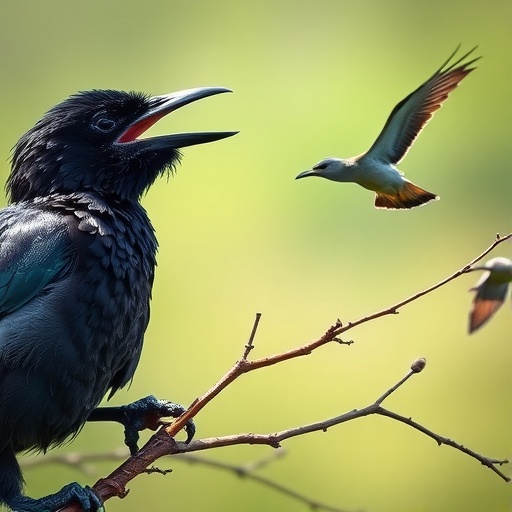
Corvids, a family of birds that includes crows, ravens, and magpies, have long captured the fascination of scientists and bird enthusiasts alike. These intelligent creatures exhibit complex behaviors and social structures that demonstrate a significant degree of cognitive sophistication. The latest research by Salis, Martin, and Girard-Buttoz, published in Animal Cognition, delves into the intricacies of corvid call sequences, illuminating the challenges and exciting opportunities in deciphering the meanings behind these vocalizations.
The research presents a fascinating overview of how corvids utilize a varied repertoire of calls, not merely for individual communication but as a complex language system that conveys rich information about their environment. The authors emphasize that understanding these call sequences could shed light on the cognitive capabilities of these birds, which have often been likened to primates in terms of problem-solving skills and social interactions.
One of the central points addressed in the paper is the variability of corvid calls. Unlike many bird species that communicate using relatively simple and fixed calls, corvids can produce a wide range of vocalizations that change in structure and meaning depending on context. This variability raises the question of whether corvid calls are symbolic in nature—signifying specific events or emotions—or if they are more reflexive, serving as immediate responses to environmental stimuli. This distinction is crucial in the ongoing debate about what constitutes a language and the thresholds of linguistic ability in non-human species.
Salis and colleagues further discuss the potential implications of deciphering corvid call sequences for understanding animal cognition more broadly. The intricate social lives of corvids, which often include cooperation, deception, and even punishment, mean that their vocalizations are likely part of a more extensive system of social communication. By studying these interactions and the associated call sequences, researchers can gain insights into the evolution of complex communication systems and their role in the development of intelligence across species.
In addition to the biological and behavioral aspects of corvid calls, the article addresses the technical challenges researchers face in decoding these vocalizations. Analyzing animal communication has always presented difficulties, from the need for precise recording technology to the complexities of contextual analysis. The authors highlight the advancements in machine learning and artificial intelligence that can assist in identifying patterns within the vast array of corvid calls. These technologies not only enable data analysis but also facilitate the exploration of the meaning behind sequences that might otherwise be dismissed as random noise.
The paper notes that despite the numerous studies on corvids, many of their vocalizations remain unexamined. One reason is that researchers often focus on specific contexts, such as alarm calls or mating calls, without assessing how these sounds function in the broader spectrum of corvid communication. This narrow focus can overlook the underlying cognitive processes that govern how these birds use calls in everyday interactions. By broadening their focus, researchers can develop a more holistic understanding of corvid communication and its implications for cognitive science.
Furthermore, the research outlines the significance of studying corvid vocalizations in a comparative context. Understanding how corvids communicate compared to other avian species or even mammals can provide critical insights into the evolution of intelligence and communication. For instance, the parallels drawn between corvid vocal patterns and those of primates and elephants highlight the potential for convergent evolution in complex signaling among different species. This cross-species comparison adds depth to the analysis and broadens the scope of potential findings.
Moreover, the need for long-term field studies is emphasized. Capturing the full range of corvid calls requires a deep understanding of their natural behaviors over extended periods. Short-term studies may yield incomplete or misleading data, emphasizing the importance of rigorous longitudinal research in animal communication. Long-term observation allows researchers to witness shifts in vocalization patterns over time, providing a dynamic view of corvid communication in response to environmental and social changes.
The authors advocate for interdisciplinary collaboration among researchers from fields such as ornithology, cognitive science, linguistics, and artificial intelligence. By fostering collaborations across these disciplines, scientists can develop more nuanced interpretations of corvid vocalizations. This multifaceted approach could lead to innovative methods in both the analysis of calls and the understanding of the cognitive processes behind them, ultimately enriching our knowledge of animal communication as a whole.
In conclusion, the work of Salis, Martin, and Girard-Buttoz underscores the potential of corvids as a valuable model for studying communication and cognition in non-human animals. As researchers continue to unravel the complexities of corvid call sequences, we are left with a greater appreciation of the intricate social lives of these remarkable birds and the cognitive abilities that underpin their communication. The challenges highlighted in this research are not merely obstacles but rather gateways to new opportunities for discovery, inviting the scientific community to explore the depths of avian intelligence and the evolutionary pathways that have led to the sophisticated communication systems we observe today.
The implications of this research extend beyond academia. As we learn more about the communication abilities of corvids, we also cultivate a deeper respect for the intelligence found in non-human species. The understanding that these birds may possess a form of language not only reshapes our relationship with them but also challenges us to reconsider our notions of intelligence and communication across the animal kingdom, echoing increasingly loud calls for conservation and respect for these incredible creatures.
In navigating the exciting frontiers of animal cognition, the ongoing studies of corvid call sequences will undoubtedly reveal more about the mental landscapes of these avian geniuses. As science continues to evolve and embrace new technologies, the future of understanding corvid communication appears bright, promising revelations that may alter the way we view language, intelligence, and the connections that bind all living beings.
Subject of Research: Corvid call sequences and their meanings
Article Title: Challenges and new opportunities in deciphering the meaning of corvid call sequences
Article References:
Salis, A., Martin, K. & Girard-Buttoz, C. Challenges and new opportunities in deciphering the meaning of corvid call sequences.
Anim Cogn 28, 95 (2025). https://doi.org/10.1007/s10071-025-02015-3
Image Credits: AI Generated
DOI: 10.1007/s10071-025-02015-3
Keywords: Corvids, animal communication, cognitive science, language evolution, call sequences, artificial intelligence.


