

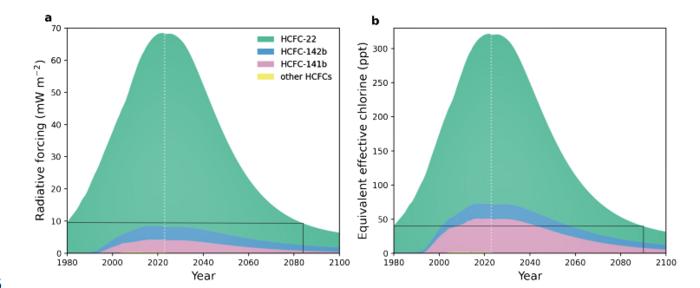
The study, led by researchers at the University of Bristol and published today in Nature Climate Change, show for the first time a notable decline in the atmospheric levels of potent ozone-depleting substances (ODS), called hydrochlorofluorocarbons (HCFCs). These HCFCs are also harmful greenhouse gases (GHGs), so their reduction should also lessen global warming.
The Montreal Protocol was agreed to internationally in 1987 to introduce controls on the production and use of ODS, which were once widely used in the manufacturing of hundreds of products, including refrigerators, aerosol sprays, foams and packaging. HCFCs were developed as replacements for chlorofluorocarbons (CFCs). While production of CFCs has been banned globally since 2010, HCFC production and use is currently still being phased out globally, with a completion date slated for 2040. They will be replaced by non-ozone-depleting hydrofluorocarbons (HFCs) and other compounds.
“The results are very encouraging. They underscore the great importance of establishing and sticking to international protocols”, says lead author Luke Western from the University of Bristol’s School of Chemistry. “Without the Montreal Protocol, this success would not have been possible. So it’s a resounding endorsement of multilateral commitments to combat stratospheric ozone depletion, with additional benefits in tackling human-induced climate change.”

Credit: Empa
The study, led by researchers at the University of Bristol and published today in Nature Climate Change, show for the first time a notable decline in the atmospheric levels of potent ozone-depleting substances (ODS), called hydrochlorofluorocarbons (HCFCs). These HCFCs are also harmful greenhouse gases (GHGs), so their reduction should also lessen global warming.
The Montreal Protocol was agreed to internationally in 1987 to introduce controls on the production and use of ODS, which were once widely used in the manufacturing of hundreds of products, including refrigerators, aerosol sprays, foams and packaging. HCFCs were developed as replacements for chlorofluorocarbons (CFCs). While production of CFCs has been banned globally since 2010, HCFC production and use is currently still being phased out globally, with a completion date slated for 2040. They will be replaced by non-ozone-depleting hydrofluorocarbons (HFCs) and other compounds.
“The results are very encouraging. They underscore the great importance of establishing and sticking to international protocols”, says lead author Luke Western from the University of Bristol’s School of Chemistry. “Without the Montreal Protocol, this success would not have been possible. So it’s a resounding endorsement of multilateral commitments to combat stratospheric ozone depletion, with additional benefits in tackling human-induced climate change.”
Decline faster than anticipated
The international study shows the total amount of ozone-depleting chlorine contained in all HCFCs combined peaked in 2021. Because these compounds are also potent GHGs, their contribution to climate change also peaked in that year. This maximum occurred five years earlier than predicted in the last ozone assessment report published in 2022. Although the drop between 2021 and 2023 was less than 1%, it still shows HCFC emissions are heading in the right direction. For Empa scientist and co-author Stefan Reimann, the study represents a “milestone in the history of measures to contain the ozone hole, in which we were able to show for the first time that even the replacement products for the even more ozone-depleting CFCs are now decreasing – and this even five years earlier than expected.” According to the Empa researcher, this was only possible thanks to the continuous tightening of international protocols and their verification with the help of atmospheric measurements, for instance on Jungfraujoch.
The results rely on high-precision measurements at globally distributed atmospheric observatories, using data from the Advanced Global Atmospheric Gases Experiment (AGAGE) and the National Atmospheric and Oceanic Administration (NOAA) in the US, including the high-alpine research station on Jungfraujoch, where Empa scientists carried out their atmospheric measurements. “We use highly sensitive measurement techniques and thorough protocols to ensure the reliability of these observations,” said co-author Martin Vollmer, an atmospheric scientist at Empa.
Co-author and NOAA scientist Isaac Vimont added: “This study highlights the critical need to be vigilant and proactive in our environmental monitoring, ensuring other controlled ozone-depleting and greenhouse gases follow a similar trend, which will help to protect the planet for future generations.”
Journal
Nature Climate Change
Method of Research
Observational study
Subject of Research
Not applicable
Article Title
Global Reduction in Harmful Greenhouse Gases and Ozone-Depleting Substances: Success of Montreal Protocol Confirmed
Article Publication Date
11-Jun-2024

