

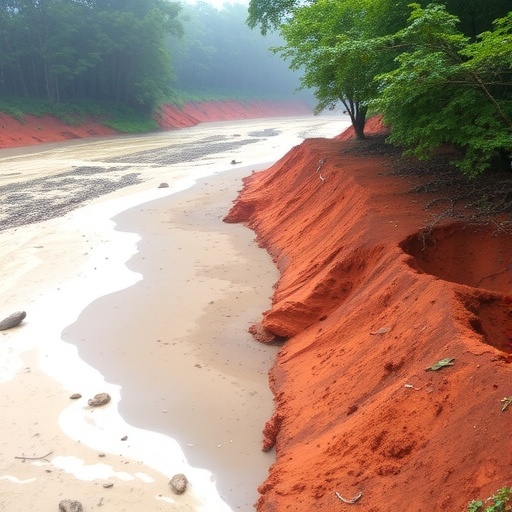
A groundbreaking study published in Environmental Earth Sciences has unveiled critical insights into the decadal dynamics of soil erosion and sediment yield in the ecologically sensitive mountain watershed of the Western Ghats, India. Employing advanced GIS-based methodologies, the research integrates the Revised Universal Soil Loss Equation (RUSLE) with sediment delivery ratio (SDR) techniques, offering a nuanced evaluation of soil degradation patterns that have profound implications for regional environmental management and sustainable land-use planning.
The Western Ghats, known for their rich biodiversity and vital role in regulating hydrological cycles, are increasingly vulnerable to erosional processes driven by climatic variability and anthropogenic pressures. This research team, led by Kaliraj, S., Abishek, S.R., and Preethy, P.S., embarked on a comprehensive multi-decadal assessment to quantify how soil erosion rates and sediment yield have evolved over time, utilizing state-of-the-art geographical information systems coupled with hydrological modeling tools. Their work represents a significant advancement in spatial-temporal soil erosion assessment, integral for devising mitigation strategies in fragile mountainous ecosystems.
At the core of their approach lies the integration of RUSLE, a widely recognized empirical model that estimates potential soil loss based on rainfall erosivity, soil erodibility, topography, cover management, and conservation practices, and the SDR, which estimates the proportion of eroded soil that is effectively delivered to stream channels. By combining these two techniques, the authors transcended conventional soil erosion estimation, enabling precise identification of sediment sources and transport pathways within the watershed. This methodological synergy underscores the growing utility of GIS in environmental earth sciences, transforming how researchers visualize and mitigate erosion hazards.
Over the study period, the researchers applied high-resolution spatial datasets including remote sensing imagery and detailed digital elevation models to delineate watershed characteristics with unprecedented accuracy. This spatial precision allowed for the disaggregation of erosion risk, capturing heterogeneity across diverse landforms ranging from steep slopes to plateau-like terrains. Notably, the study exposed substantial temporal fluctuations in soil loss and sediment transport, correlated with changes in rainfall intensity patterns and land cover alterations stemming from agricultural expansion and reforestation efforts.
One of the study’s pivotal revelations is the identification of hotspot areas within the Western Ghats that have consistently exhibited elevated soil erosion rates across the decades. These localized zones of intense degradation often coincide with regions experiencing deforestation, road construction, or shifting cultivation, emphasizing the crucial link between human interventions and landscape instability. The ability to map such critical source areas enables targeted conservation actions, optimizing resource allocation for soil and water conservation measures.
The multidisciplinary nature of this research is buoyed by its incorporation of both hydrological process understanding and geospatial analytics. By simulating sediment yield variations under varying land use and climate scenarios, the authors have set a precedent for dynamic erosion risk modeling. This forward-looking perspective is invaluable for policy-makers and land managers aiming to anticipate and alleviate erosion impacts in the face of ongoing environmental change. Moreover, the study’s decadal timeframe provides a rare longitudinal view, allowing for the assessment of long-term trends rather than relying solely on snapshot observations.
Intriguingly, the analysis reveals a nonlinear relationship between precipitation variability and soil erosion patterns. Whereas periods of high rainfall intensity evidently exacerbate erosion, the spatial distribution of sediment yield displays complexity influenced by watershed morphology and vegetation cover. This highlights the necessity of integrating multiple environmental factors in soil erosion prediction algorithms, an aspect that the GIS-based RUSLE-SDR hybrid modeling framework elegantly captures.
The researchers also discuss how their findings contribute to understanding sediment dynamics, which are crucial in shaping downstream fluvial ecosystems and reservoir sedimentation processes. Excessive sediment loads can impair aquatic habitats and reduce reservoir lifespans, thereby affecting water security and biodiversity. Consequently, the study’s sediment yield estimations provide actionable intelligence to water resource engineers and conservation biologists alike, bridging the gap between watershed-scale soil erosion research and ecosystem management.
Importantly, the study underscores the pressing need for sustainable land-use policies in the Western Ghats to curb ongoing soil degradation. By pinpointing the most erosion-prone landscapes and elucidating the drivers behind sediment mobilization, it arms local authorities with data-driven insights to implement soil conservation techniques such as contour terracing, afforestation, and controlled grazing. These interventions are vital not only for maintaining soil productivity but also for preserving the ecological integrity of the entire mountain range.
Technological advancements in GIS and remote sensing have revolutionized soil erosion studies, as exemplified by this investigation. The spatially explicit and temporally resolved maps of erosion risk generated by the researchers empower stakeholders at various levels, from local communities to national planners, to make informed decisions that balance development and environmental sustainability. This represents a paradigm shift from coarse erosion assessments towards high-fidelity environmental diagnostics.
The research further highlights the importance of regular monitoring and updating of soil erosion databases to track the effectiveness of implemented conservation measures over time. Future iterations of their model could incorporate climate change projections and socio-economic factors, enhancing predictive capabilities and resilience building. The methodological framework demonstrated here offers replicability potential across other mountainous watersheds globally, extending its impact beyond the Indian Western Ghats.
In conclusion, this pioneering work by Kaliraj and colleagues provides a thorough and sophisticated examination of soil erosion and sediment yield variability over several decades in one of the world’s critical biodiversity hotspots. Through innovative application of GIS-based RUSLE and SDR techniques, the study delivers a powerful toolset for tackling erosion-related challenges, underlining the intertwining of natural processes and human activities in landscape transformations. As environmental stewardship becomes imperative, such research is vital in guiding sustainable management and conservation of fragile mountain ecosystems.
This study’s rich combination of empirical models, geospatial technology, and long-term field data analyses presents an exemplary case of modern earth science research. By making visible the invisible forces sculpting our terrestrial habitats, it catalyzes a deeper appreciation for the delicate balance that underpins soil stability and watershed health. The implications for improving agricultural productivity, safeguarding biodiversity, and protecting water infrastructure are immense, positioning this work at the forefront of environmental sustainability science in the 21st century.
As global climate patterns continue to fluctuate unpredictably, the frameworks established in this study will be indispensable in combating soil erosion threats to mountainous landscapes worldwide. It sets a new standard for comprehensive soil erosion assessment that integrates scientific rigor with practical applicability, demonstrating how GIS-driven earth science research can shape resilient futures. The Western Ghats case study thus serves as a compelling example of how technology and environmental science converge to address pressing ecological challenges on a regional and global scale.
Subject of Research: Soil erosion and sediment yield variability in the Western Ghats mountain watershed, India, using GIS-based RUSLE and SDR modeling techniques.
Article Title: Unveiling decadal variability of soil erosion and sediment yield using GIS-based RUSLE and SDR techniques – a case study of mountain watershed of the Western Ghats, India.
Article References:
Kaliraj, S., Abishek, S.R., Preethy, P.S. et al. Unveiling decadal variability of soil erosion and sediment yield using GIS-based RUSLE and SDR techniques – a case study of mountain watershed of the Western Ghats, India. Environ Earth Sci 85, 38 (2026). https://doi.org/10.1007/s12665-025-12745-9
Image Credits: AI Generated


