

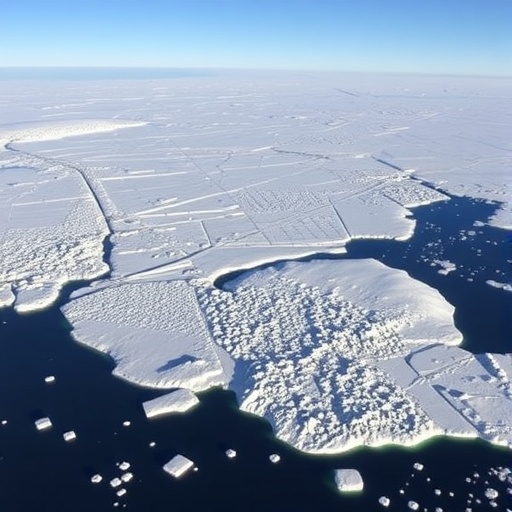
In a groundbreaking study published in Nature Geoscience, researchers have unveiled new insights into the radar backscattering mechanisms within the Greenland Ice Sheet, revealing how entrained debris significantly amplifies radar reflections. This advancement has profound implications for our understanding of ice sheet dynamics and their historical growth patterns, particularly in the context of post-last interglacial regrowth. Employing innovative direction-of-arrival synthesis techniques—combining along-track imaging and the sophisticated Multiple Signal Classification (MUSIC) algorithm for across-track imaging—the study differentiates distinct radar scattering types embedded deep within the ice. This methodological leap enables scientists to precisely characterize both specular and incoherent scattering phenomena, thereby opening new windows into ice sheet structure and composition.
Ice-penetrating radar systems have long been pivotal in uncovering subsurface features of ice sheets, but interpreting their signals requires disentangling complex scattering signatures originating from various internal layers. The research team identified three unique scattering behaviors based on their backscattering amplitude and directional attributes: specular reflections arising from relatively smooth meteoric ice layers, weak incoherent scattering confined to narrow angles, and stronger incoherent scattering dispersed over wider angular intervals. The latter category is particularly significant as it correlates with debris-rich layers—dense accumulations of foreign particles trapped within the ice—highlighting their distinct electromagnetic properties that markedly differ from pure ice.
Central to the study is the recognition that the observed radar power, expressed in backscattered amplitude, is a combined function of both intrinsic scatterer properties and path-dependent attenuation effects. By comparing radar returns from embedded debris trains to those from meteoric layers at similar depths, the authors isolate the enhanced scattering attributable to debris itself. Notably, they recorded reflection power increases surpassing 30 decibels—a colossal jump in radar signal strength that cannot be solely explained by variations in absorption or path loss. This observation conclusively points to unique dielectric or geometric characteristics inherent to debris-entrained layers, suggesting that particle size, concentration, and distribution profoundly impact radar interactions.
To quantify and model these amplified radar cross-sections, the researchers formulated a theoretical framework grounded in classic radar equations. They express backscattered power as a function of the radar cross-section times the radar system’s source properties, accounting for geometric spreading and attenuation within the ice. Importantly, by assuming uniform attenuation rates within the upper ice half—typical for cold ice conditions—the variability in recorded radar power must stem primarily from radar cross-section differences. This assumption isolates the effect of debris inclusions on radar reflections, providing a robust basis for subsequent calculation.
For specular reflectors such as planar icy layers, the radar cross-section depends on the power reflection coefficient combined with the illuminated area and the squared wavelength of the probing radar waves. Normally, this illuminated zone is approximated using the first Fresnel zone, dictated by the wavelength and depth of the target. This approach allows for explicit computation of backscatter contributions arising from smooth dielectric interfaces within the ice. The mathematical simplification reveals that the radar cross-section scales with the square of the effective range modified by the dielectric constant, a critical parameter describing how electromagnetic waves propagate through ice versus air.
However, debris-rich layers represent volumetric scatterers, where radar returns arise not from smooth surfaces, but from myriad particles dispersed throughout a volume. To capture this complexity, the team harnessed Mie scattering theory, which computationally models electromagnetic interactions with spherical particles of varying radii. Utilizing the open-source ‘miepython’ package, they calculated how particle size influences backscattering efficiency—a non-dimensional parameter critical to radar signature prediction. This modeling step is crucial because backscatter efficiency peaks or troughs depending on the size-to-wavelength ratio, dramatically affecting radar detectability of debris strands.
Once particle backscatter efficiencies were known, integrating these values over the expected number density yielded the total radar cross-section attributable to debris. Calculating particle density involved an assumption of volumetric fraction—a measure of how much debris occupies the ice matrix—converted into the number of particles per unit volume based on individual particle size. The illuminated volume corresponds to the Fresnel zone and an assumed debris layer thickness, reflecting the three-dimensional interaction space that radar waves interrogate. This volumetric radar cross-section formulation successfully bridges the gap between microscale particle properties and macroscale radar measurements, offering a tangible pathway to interpret enhanced backscattering signals in terms of debris content.
The implications of these findings are profound. By establishing a quantitative link between radar data and debris characteristics, it becomes feasible to construct more accurate ice sheet models, improving reconstruction of past climatic conditions and ice sheet responses. The research team also highlights the importance of corroborating attenuation rate assumptions, especially as radar signals probe deeper or traverse varied ice temperatures, where path losses could complicate interpretations. However, the strong signal contrasts observed align well with theoretical expectations for debris-rich layers, bolstering confidence in the approach.
Beyond fundamental science, the study contributes methodological advancements by demonstrating successful adaptation of MUSIC algorithm for spatially resolving radar echoes in across-track directions, a non-trivial task in radar remote sensing. This directional decomposition allows precise discrimination of scattering phenomena that would otherwise blur together in traditional single-angle radar data. Such technical sophistication is poised to enhance interpretation of radar soundings worldwide, supporting glaciologists, climate modelers, and geophysicists in their efforts to monitor and understand cryospheric changes.
Furthermore, this research underscores the dynamic interplay between geophysical processes and technological innovation. Radar systems traditionally faced challenges discerning volumetric inhomogeneities in ice, but by applying classical electromagnetic theory in concert with modern signal processing, the authors bridge theory and measurement. This synergy signals a paradigm shift, where remote sensing can now not only visualize ice sheets but also infer their compositional subtleties with unprecedented detail. This capability crucially informs predictions of ice mass balance and sea level rise under future warming scenarios.
Looking forward, the comprehensive radar amplitude analysis and the theoretical consideration of model uncertainties outlined in supplementary materials promise refined interpretations as additional data accumulates. By quantifying error bounds and probing attenuation variability, future studies can enhance fidelity of debris characterization. Moreover, adapting similar analytical frameworks to other glacial environments or for monitoring seasonal snowpack changes may unlock new dimensions of cryospheric research.
In summary, this pioneering research provides a crucial leap in interpreting radar backscatter caused by entrained debris within ice sheets, marrying advanced electromagnetic scattering theory with state-of-the-art radar signal processing. The dramatic 30+ dB increases in radar reflection from debris layers are not mere anomalies but rather expressions of complex dielectric and geometric effects that can now be rigorously modeled and understood. These insights inform reconstructions of Greenland’s ice sheet history, contributes to robust climate archives, and augment our forecasting abilities in a changing world. The study exemplifies how integrating multidisciplinary expertise deepens our grasp of Earth’s frozen frontiers, with ripple effects for climate science and planetary exploration.
Subject of Research: Radar backscattering mechanisms and debris characterization within the Greenland Ice Sheet.
Article Title: Entrained debris records regrowth of the Greenland Ice Sheet after the last interglacial.
Article References:
Holschuh, N., Christianson, K., Dienstfrey, W. et al. Entrained debris records regrowth of the Greenland Ice Sheet after the last interglacial. Nat. Geosci. (2026). https://doi.org/10.1038/s41561-026-01950-1
Image Credits: AI Generated


