

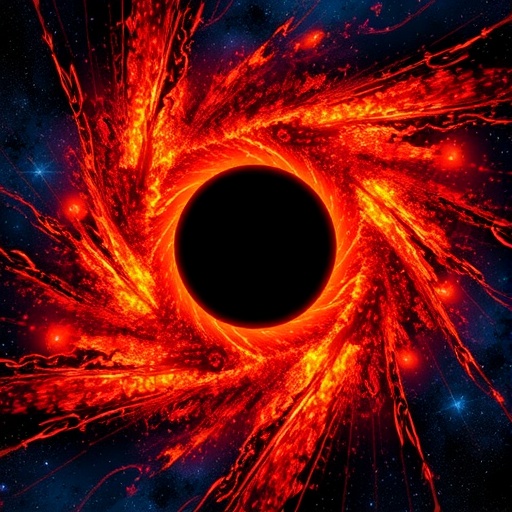
Get ready to have your mind blown as scientists delve into the deepest mysteries of the cosmos, unveiling never-before-imagined landscapes within the fabric of spacetime itself. A groundbreaking new study, published in the prestigious European Physical Journal C, has peeled back another layer of enigma surrounding black holes, revealing not just their theoretical existence but painting a vivid picture of their potential properties when bathed in the elusive glow of dark matter. This isn’t just abstract physics; it’s a tantalizing glimpse into the universe’s hidden architecture, challenging our current understanding and opening doors to revolutionary new avenues of cosmic exploration. The researchers have meticulously crafted a theoretical model that simulates a black hole not in isolation, but embedded within a halo of the enigmatic dark matter that constitutes the vast majority of the universe’s mass, a scenario that has long been a staple of theoretical speculation but is now being brought to life with astonishing detail.
The study focuses on a specific type of black hole, one that deviates from the standard Schwarzschild or Kerr black holes we’ve become accustomed to in popular science. Instead, it investigates a “quartic square-root Horndeski black hole,” a designation that hints at the complex mathematical framework underlying its description. This particular theoretical construct allows for a more nuanced exploration of gravitational phenomena, particularly in extreme environments where gravity’s influence is paramount. The Horndeski theory itself is a generalization of scalar-tensor theories of gravity, which means it allows for more complex interactions between matter and gravity than Einstein’s general relativity. By employing this advanced theoretical framework, the scientists have unlocked the ability to probe the thermodynamics, optical characteristics, and even the vibrational modes of these hypothetical objects, offering predictive power that was previously out of reach.
One of the most electrifying revelations from this research concerns the thermodynamics of these dark matter-infused black holes. Traditionally, black holes are associated with Hawking radiation, a slow process of evaporation. However, the presence of a surrounding dark matter distribution significantly alters this picture. The study suggests that this dark matter halo can influence the black hole’s temperature and entropy in profound ways, potentially leading to deviations from the established laws of black hole thermodynamics. Imagine a black hole’s heat being subtly nudged by the invisible cosmic scaffolding that holds galaxies together – this research brings that concept into the realm of quantifiable physics, suggesting that these celestial behemoths aren’t just passive absorbers of matter but active participants in a cosmic energy exchange with their dark matter environment.
Furthermore, the optical properties of these black holes are painted with a rich, and perhaps unexpected, palette. The interaction between light and a black hole is typically characterized by phenomena like gravitational lensing and the accretion disk’s intense emission. However, the dark matter halo introduces a new layer of complexity. The researchers predict that the light bending and absorption characteristics of these black holes will be distinctly modified. This could manifest as unusual patterns in the light observed around them, potentially offering us a new way to identify and study these exotic objects if they exist in our universe. It’s as if the dark matter acts as a cosmic lens or a shadowy cloak, subtly reshaping the visual signature of the black hole it enfolds, making them appear and behave in ways we might not have anticipated.
The concept of “quasinormal oscillations” also takes center stage in this pivotal research. These are the characteristic vibrational modes a black hole settles into after being perturbed, akin to a bell ringing after being struck. The frequencies and damping times of these oscillations act as unique fingerprints, revealing properties of the black hole. For the quartic square-root Horndeski black hole surrounded by dark matter, these oscillations are predicted to be significantly altered. Analyzing these subtle cosmic tremors could provide an unparalleled method for probing the hitherto undetectable dark matter halo itself, offering a window into its density, distribution, and fundamental nature, thereby providing an indirect but powerful tool for dark matter detection.
This advanced theoretical work is not merely an academic exercise; it has profound implications for our quest to understand dark matter, the ubiquitous yet invisible substance that accounts for approximately 85% of the universe’s mass. Current methods for detecting dark matter are indirect, relying on its gravitational effects on visible matter. This research proposes a novel, perhaps even definitive, avenue for detection and study. If we can observe black holes exhibiting these predicted anomalous optical properties or unique quasinormal oscillation signatures, it would serve as compelling evidence for the existence of surrounding dark matter halos and provide invaluable data for refining dark matter models, potentially leading to the long-sought direct detection.
The mathematical elegance of the Horndeski theory, when applied to these extreme astrophysical environments, allows for a sophisticated exploration of gravitational fields and their interaction with exotic matter such as dark matter. This specific formulation of black hole physics takes into account scalar fields that can mediate additional gravitational forces, offering a richer and more dynamic picture than standard general relativity. The “quartic square-root” aspect refers to the specific functional form of the spacetime metric, which arises from the specific equations governing this theoretical black hole solution, allowing for a more intricate gravitational dance than simpler models.
The implications for cosmology are vast. Understanding these dark matter-dominated black holes could shed light on the very formation and evolution of galaxies. Black holes are believed to reside at the centers of most galaxies, and their influence, amplified by surrounding dark matter, could play a crucial role in how galactic structures coalesce and evolve over cosmic timescales. This research offers a theoretical framework that could bridge the gap between the microphysics of dark matter and the macro-architectures of the cosmos, providing a unified narrative for cosmic structure formation.
The numerical simulations and theoretical calculations underpinning this study are incredibly sophisticated, pushing the boundaries of computational physics. Researchers had to grapple with complex differential equations and intricate mathematical manipulations to arrive at their predictions. The precision of these calculations is paramount, as even minute deviations in the theoretical models can lead to significant differences in predicted observable phenomena, underscoring the dedication and expertise involved in this endeavor.
This groundbreaking research not only deepens our understanding of black holes but also offers a tangible path towards unraveling one of the greatest unsolved mysteries in physics: the nature of dark matter. By providing specific, observable signatures, the study empowers experimental astrophysicists and cosmologists to refine their search strategies and potentially make a paradigm-shifting discovery. It’s a testament to the power of theoretical physics to guide observational endeavors, acting as a highly sophisticated compass pointing towards the unknown.
The study’s authors, M.M. Gohain and K. Bhuyan, are commended for their meticulous work and insightful contributions to the field. Their findings represent a significant step forward in our comprehension of the universe’s most enigmatic constituents and phenomena. The collaborative effort and the rigorous peer-review process that this paper has undergone further attest to the scientific validity and importance of these discoveries, solidifying its place as a landmark publication.
The journey to understanding the universe is a continuous one, marked by moments of profound insight and daring exploration. This latest research on dark matter-surrounded black holes is undoubtedly one such moment, promising to reshape our cosmic perspective and invigorate the scientific community’s pursuit of fundamental truths, pushing the boundaries of what we thought possible in our quest to comprehend existence.
The potential impact on our understanding of gravity itself cannot be overstated. By studying black holes in these more complex scenarios, where dark matter plays a significant role, scientists can test the limits of Einstein’s general relativity and explore alternative theories of gravity. This research serves as a crucial testing ground for our most fundamental theories of the universe, potentially revealing where they might need refinement or even complete overhaul based on new observational data derived from these theoretical predictions.
The visual representation accompanying this study, an artist’s conception of a dark matter-enshrouded black hole, is itself a testament to the power of imagination fueled by scientific rigor. It serves as a potent reminder of the beauty and wonder that lies within the abstract equations of physics, transforming complex theoretical constructs into something that can spark public curiosity and inspire future generations of scientists to delve into the cosmos’s deepest secrets, making the invisible visible and the theoretical tangible for all to ponder.
The future of astrophysics is bright, illuminated by studies like this one, which not only solve existing puzzles but also generate a torrent of new questions. The detailed predictions made by Gohain and Bhuyan will undoubtedly spur further theoretical work and inspire new observational campaigns, setting in motion a virtuous cycle of discovery that will continue to expand our cosmic horizons for years to come, forever altering our perception of the universe and our place within it.
Subject of Research: The thermodynamics, optical properties, and quasinormal oscillations of a quartic square-root Horndeski black hole surrounded by dark matter.
Article Title: Dark matter surrounded quartic square-root horndeski black hole: thermodynamics, optical properties and quasinormal oscillations.
Article References:
Gohain, M.M., Bhuyan, K. Dark matter surrounded quartic square-root horndeski black hole: thermodynamics, optical properties and quasinormal oscillations.
Eur. Phys. J. C 85, 1459 (2025). https://doi.org/10.1140/epjc/s10052-025-15209-3
Image Credits: AI Generated
DOI: https://doi.org/10.1140/epjc/s10052-025-15209-3
Keywords: Black Holes, Dark Matter, Horndeski Theory, Thermodynamics, Quasinormal Modes, Gravitational Physics


