

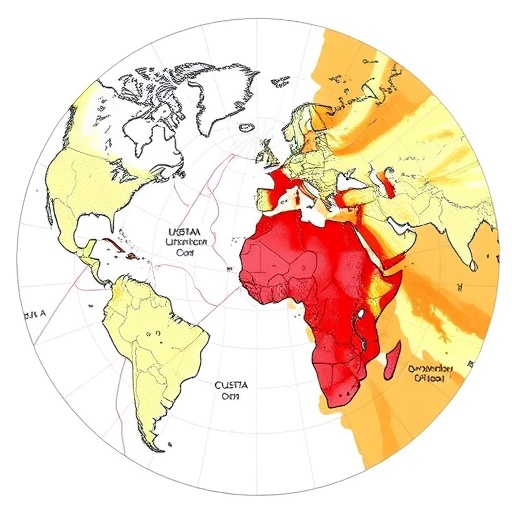
A groundbreaking study published in Communications Earth & Environment in 2026 unveils how the mechanical strength of Earth’s crust decisively influences the architecture of fault systems and, intriguingly, how this relationship shapes the global distribution of hydrocarbons. The research by An and So employs advanced discrete element modeling (DEM) to simulate crustal deformation processes, illuminating previously uncharted intersections between structural geology and energy resource distribution. As the world searches for new energy sources and more sustainable extraction methods, these insights could rewrite exploration strategies and risk assessments in hydrocarbon basins worldwide.
Fault systems — the fractured zones where tectonic plates or crustal blocks slide past, collide, or separate — have long been studied as conduits for earthquake activity and crustal deformation. However, their role as critical determinants in the localization and trapping of hydrocarbons has remained only partially understood. The factors governing fault formation, geometry, and evolution are complex and dynamic, influenced by crustal stress fields, rock properties, temperature, fluid pressure, and time. An and So’s utilization of discrete element modeling introduces an unprecedented method to portray the micro-mechanical behavior of rock particles and aggregates under stress, offering detailed insights into fault system development at scales from centimeters to kilometers.
Discrete element modeling is a computational technique that divides materials into assemblies of individual, interacting particles, allowing researchers to simulate how rocks fracture, slide, and deform under various stress regimes. Unlike traditional continuum mechanics models, DEM captures grain-scale mechanics and emergent fault structures, providing a more realistic depiction of fault nucleation and propagation. By calibrating their models against observed geological features and laboratory data, An and So accurately reproduce fault geometries observed globally, including strike-slip, normal, and thrust faults.
The team’s findings emphasize the controlling influence of crustal strength heterogeneity on fault network complexity and connectivity. Variations in mineral composition, temperature gradients, and prior deformation history create zones of differing mechanical strengths within the crust. These strength contrasts dictate where faults initiate, how they link, and whether they develop into isolated fractures or interconnected fault networks. Crucially, the architecture of these faults determines pathways for fluid migration, including hydrocarbon-rich fluids, influencing where oil and gas accumulate and where reservoirs remain impermeable.
Through a series of simulations, the study demonstrates that stronger crustal segments tend to focus strain along fewer, larger faults, while weaker crust promotes the development of diffuse fault networks with many smaller fractures. These differing architectures have profound implications for hydrocarbon trapping. Large, well-organized faults can form robust seals and structural traps that isolate hydrocarbons, whereas diffuse fault networks may create leakage pathways that limit accumulation. The research thus reconciles disparate observations from various petroleum basins and offers predictive models for unexplored regions.
Beyond mere geological curiosity, the study’s insights have significant economic and environmental ramifications. Hydrocarbon exploration remains costly and uncertain, often relying on surface geological and indirect geophysical data. By integrating crustal strength parameters into exploration models, energy companies could optimize drilling locations, reducing financial risk and minimizing environmental disruption. Anticipating fault complexity and associated fluid migration pathways also improves our understanding of induced seismicity risks related to hydrocarbon extraction techniques such as hydraulic fracturing and enhanced oil recovery.
Moreover, the work bridges disciplinary divides, combining structural geology, geomechanics, and energy science into a cohesive framework. An and So’s models elucidate fault system behavior at crustal depths inaccessible to direct observation, enhancing interpretation of seismic data and well logs. The application of DEM could extend to earthquake hazard assessment, geothermal energy exploration, and subsurface carbon storage, marking this research as a cornerstone for future multidisciplinary geoscience innovations.
The research also highlights how tectonic history and regional stress fields modulate crustal strength over geological time, impacting fault system evolution and corresponding hydrocarbon accumulations. As sediments are deposited and buried, temperature and pressure conditions change, converting soft sediments to brittle rocks and progressively increasing crustal strength. This temporal evolution shapes fault networks differently across sedimentary basins, explaining variations in hydrocarbon plays from one region to another. Understanding these temporal dynamics enhances basin modeling and resource prediction accuracy.
Intriguingly, the model’s predictions align well with observed global hydrocarbon distributions, particularly in regions where traditional exploration has struggled. For example, certain mature basins with unexpectedly limited reserves correspond to crustal settings predicted to develop diffuse, leaky fault architectures. Conversely, prolific fields in areas with strong crustal segments and focused fault strain validate the model’s assumptions. Such alignments instill confidence in deploying these simulations as practical tools for exploration decision-making.
The study’s methodology includes sensitivity analyses that investigate how changing rock mechanical properties and stress orientations alter fault development. Results underscore the dominant role of crustal strength contrast rather than absolute strength in shaping fault systems, suggesting that relative variations and localized heterogeneities drive fault localization and architecture more than generic rock strength parameters. This nuance advances theoretical frameworks for crustal deformation and offers new perspectives on interpreting field and seismic observations.
An and So’s contribution also extends to the understanding of unconventional hydrocarbon reservoirs, such as shale gas and tight oil plays, where fault-bound fractures enhance permeability yet also pose challenges to reservoir integrity. By simulating fault system evolution in these complex settings, the research provides clues to optimize production strategies that balance fracture connectivity with containment to maximize recovery while mitigating risks.
The study’s innovative use of discrete element modeling establishes a new paradigm in geoscience research and exploration. While existing models often rely on large-scale continuum assumptions or empirical correlations, DEM allows for bottom-up simulations that incorporate grain-scale physics, naturally emergent fault behaviors, and realistic fault network architectures. This approach delivers higher fidelity predictions that can be tested and refined with field data, promising iterative improvements that accelerate knowledge and practical application.
In an era when energy security and environmental sustainability are paramount, the ability to accurately predict hydrocarbon distribution and manage reservoir risks is invaluable. An and So’s research not only enhances our fundamental geological understanding but also equips industry and policymakers with scientifically grounded tools for responsible resource management. As offshore drilling moves into deeper, more challenging crustal domains and onshore plays face stricter regulatory scrutiny, such advancements become critical.
Future research directions proposed by the authors include integrating fluid-rock interactions within discrete element models, capturing multiphase fluid flow and pressure evolution associated with hydrocarbon generation and migration. Such coupling could reveal further complexities in fault sealing and leakage behavior, refining predictions of reservoir quality and extraction feasibility. Additionally, extending DEM models to simulate post-failure fault healing and cyclical slip behavior could deepen comprehension of seismic hazards linked to hydrocarbon exploitation.
In conclusion, this pioneering study by An and So represents a major leap forward in linking crustal mechanics to fault architecture and hydrocarbon system analysis through sophisticated discrete element modeling. It highlights the pivotal role of crustal strength contrasts in governing fault network development and ultimately the global distribution of hydrocarbon resources. The implications span scientific, economic, and environmental spheres, setting the stage for transformative approaches to subsurface exploration and risk management. As geoscience advances toward increasingly integrative and predictive frameworks, such research paves the way for more sustainable and efficient energy futures.
Subject of Research: Crustal strength influence on fault system architecture and implications for global hydrocarbon distribution using discrete element modeling.
Article Title: Discrete element modeling reveals crustal strength control on fault architecture with global hydrocarbon distribution implications.
Article References:
An, S., So, BD. Discrete element modeling reveals crustal strength control on fault architecture with global hydrocarbon distribution implications. Commun Earth Environ (2026). https://doi.org/10.1038/s43247-026-03411-4
Image Credits: AI Generated
DOI: 10.1038/s43247-026-03411-4
Keywords: Crustal strength, fault architecture, discrete element modeling, hydrocarbon distribution, fault systems, geomechanics, petroleum geology, fault networks, reservoir characterization, tectonic deformation


