

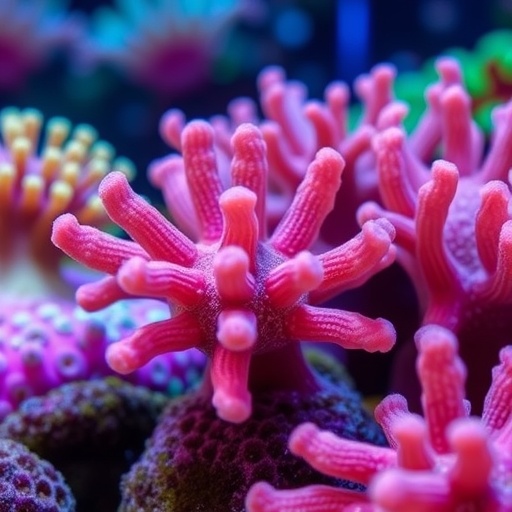
In the face of mounting threats to marine biodiversity, coral reefs stand as both vibrant ecosystems and harbingers of environmental change. These intricate underwater structures are bastions of life, supporting an astonishing array of marine species and providing critical ecological services. Yet, the peril they face from rising ocean temperatures, driven by relentless climate change, casts a shadow over their future. The fragile corals that form these reefs are vulnerable to bleaching events and degradation, prompting scientists worldwide to seek deeper understanding and innovative interventions. Now, a groundbreaking advancement promises to transform coral research and conservation: the development of CRISPR–Cas9 gene-editing techniques tailored specifically to reef-building corals.
Historically, delving into the molecular underpinnings of coral biology has posed significant challenges. Unlike many model organisms, corals possess complex life cycles and are notoriously difficult to manipulate genetically due to their marine environment and reproductive intricacies. Traditional genetic tools and methods have fallen short in providing the resolution necessary to dissect gene function and ecological adaptations in these creatures. The gap in available genetic technologies has meant that researchers were largely limited to observational and correlational studies, leaving many questions about coral resilience and susceptibility unresolved.
In a transformative stride, the team led by Tinoco, Henderson, Meier, and colleagues has introduced a pioneering protocol that harnesses CRISPR–Cas9 technology to engineer precise genetic modifications in the coral species Acropora millepora. This reef-building coral, known for its pivotal role in reef ecosystems, serves as the ideal candidate for pioneering genome editing improvements meant to decode the genetic basis of vital traits such as heat tolerance and skeleton formation. The breakthrough not only sets a new standard for coral genetics but also provides the scientific community with crucial tools to probe gene functions across multiple life stages of coral development.
Central to their method is the ability to spawn and collect coral gametes during their naturally occurring seasonal spawning events. These meticulously timed collections make it possible to obtain fertile eggs and sperm that can be fertilized in controlled laboratory conditions, yielding one-cell zygotes ready for genetic manipulation. The collection process itself demands precise coordination and environmental monitoring, given the narrow window in which coral spawning occurs, driven by lunar cycles and water temperature cues. Mastery of this phase is essential, as it forms the foundation for all subsequent gene editing procedures.
Following gamete collection, the researchers have devised a detailed microinjection technique designed to introduce CRISPR–Cas9 components directly into single-cell coral zygotes. This approach ensures the editing machinery is delivered at an early stage of development, increasing the chances of successful genetic modification that manifests in the entire organism. Fine-tuned injection protocols allow for high survival rates of injected embryos while maintaining robust editing efficiency. The precision of microinjection counters previous limitations, enabling targeted gene disruptions or insertions with unprecedented reliability.
A particularly innovative aspect of the protocol lies in the design of single-guide RNAs (sgRNAs), a critical element dictating the specificity and efficiency of CRISPR–Cas9 targeting. The team outlines rigorous computational strategies for sgRNA selection, ensuring minimal off-target effects and maximum cleavage activity. This tailored approach not only enhances editing precision but also reduces potential unintended genetic alterations, a common hurdle in genome editing experiments. These optimized sgRNAs are integral to unlocking the potential of coral genome manipulation without compromising organism viability.
Identification of successfully edited individuals presents another layer of complexity. The researchers incorporate innovative identification strategies that include the use of fluorescent markers or genotyping assays to single out mutants among cohorts of larvae and juveniles. These methods facilitate the tracking of edited corals through developmental stages, enabling detailed investigation of gene function in physiological contexts relevant to environmental stressors. Through these advances, it becomes possible to link specific genetic changes to phenotypic outcomes, a dream long sought by marine biologists.
The protocol also tackles the challenge of rearing mutant coral larvae and juveniles beyond initial editing. Corals in early life stages are especially vulnerable to environmental factors and experimental manipulations. By establishing optimized culture conditions and growth environments, the researchers ensure that edited corals can develop naturally, providing insights that extend from molecular changes to organismal physiology. The ability to rear healthy mutant juveniles is crucial for experiments assessing traits such as skeleton formation—a process fundamental to reef construction and stability.
Molecular detection and quantification of genome modifications form a critical endpoint of this protocol. Employing established genotyping techniques, the protocol ensures that genomic alterations can be reliably measured and characterized. This includes PCR-based assays and sequencing methods that confirm the presence, type, and efficiency of edits within coral genomes. These validation steps are foundational to interpreting experimental outcomes and linking genotype to phenotype in functional studies.
The impact of these technical advances is profound. For the first time, researchers can perform reverse genetics in corals, knocking out or modifying genes to observe direct causal effects on traits critical to survival under climate stress. Early applications of this technology have already highlighted genes key to heat tolerance in coral larvae, shedding light on the genetic mechanisms that might buffer reef species against warming seas. Similarly, genes involved in calcium carbonate skeleton formation in juvenile corals have been elucidated, providing targets for potential biotechnological interventions aimed at reef restoration.
Beyond single-gene analyses, the capability to manipulate coral genomes opens the door for exploring complex traits such as symbiotic relationships with photosynthetic algae. These symbioses underpin coral nutrition and energy acquisition but can break down under heat stress, leading to bleaching. Using CRISPR–Cas9, scientists now have the means to dissect the genetic pathways controlling symbiosis establishment and maintenance, potentially revealing novel strategies to engineer resilience into vulnerable coral populations.
This protocol takes approximately 2–4 weeks to complete, a relatively swift timeline considering the biological intricacies involved. Its efficiency and broad applicability mark it as an essential tool for marine molecular biology moving forward. Importantly, the methodology is designed to be accessible, allowing laboratories worldwide to implement coral genetic modifications without requiring prohibitively specialized equipment or expertise.
By bridging the gap between ecological observation and molecular experimentation, these advances fundamentally alter the landscape of coral research. The ability to manipulate coral genomes with precision not only accelerates the pace of discovery but concurrently informs efforts to conserve and rehabilitate reef ecosystems. This technique equips researchers with a powerful lens to investigate the genetic foundations of coral resilience, adaptation, and vulnerability, providing hope for proactive responses to environmental threats.
As the ocean continues to warm and coral bleaching events increase in frequency and intensity, the scientific community faces a critical imperative: to understand and protect these keystone species before irreversible damage ensues. The introduction of CRISPR–Cas9 genome editing in corals represents a quantum leap forward, furnishing tools that could lead to innovative conservation strategies grounded in molecular insight.
In summation, this pioneering protocol unites cutting-edge genome editing technology with the complexity of coral biology, enabling transformative studies into gene function and organismal adaptation within reef ecosystems. It not only paves the way for breakthroughs in marine science but also highlights emerging pathways to mitigate the impacts of climate change on coral reefs globally. This fusion of genetic toolsets and marine ecology ushers in a new era where science meets stewardship in the fight to preserve the oceans’ irreplaceable underwater treasures.
Subject of Research: Genome editing in reef-building corals (Acropora millepora) using CRISPR–Cas9 for functional genetic studies related to heat tolerance and skeleton formation.
Article Title: Efficient genome editing using CRISPR–Cas9 in reef-building corals.
Article References: Tinoco, A.I., Henderson, C.F., Meier, E.K. et al. Efficient genome editing using CRISPR–Cas9 in reef-building corals. Nat Protoc (2026). https://doi.org/10.1038/s41596-025-01293-y
Image Credits: AI Generated


