

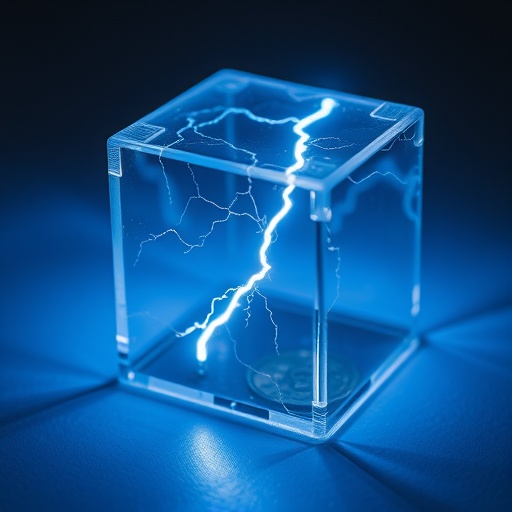
In a groundbreaking development that challenges long-held assumptions about the nature of lightning, researchers at Penn State University have unveiled a new understanding of how lightning-like discharges can form, not just in vast storm clouds but within everyday materials right on a laboratory bench. This paradigm-shifting discovery, published in the prestigious journal Physical Review Letters, reveals that the immense electrical phenomena responsible for lightning can be replicated in miniature inside solid insulating materials such as glass, acrylic, and quartz.
Lightning has traditionally been viewed as an atmospheric marvel, resulting from vast electric fields generated across kilometers within thunderclouds. These electric potentials, often reaching approximately 100 million volts, facilitate the collision of electrons with nitrogen and oxygen atoms in the air, spawning intense bursts of gamma rays and initiating the iconic lightning stroke. However, the Penn State team led by electrical engineering professor Victor Pasko has mathematically demonstrated that by applying the same models used in large-scale atmospheric research to much smaller, denser materials, lightning-like processes can be triggered on a scale smaller than a thumb.
Central to this discovery is a phenomenon known as the relativistic runaway electron avalanche (RREA). This process involves electrons accelerating rapidly under strong electric fields, gaining immense energy, and initiating a chain reaction where these high-energy electrons collide with molecules, producing X-rays and gamma rays. While RREA has been extensively studied in the context of thunderstorms, the novel insight from Pasko’s team is that similar conditions can be established inside solid dielectric media, which are roughly a thousand times denser than air. This density allows equivalent electric potentials to develop over distances a thousand times smaller than those found in the atmosphere.
Utilizing sophisticated computational modeling and numerical simulations, the researchers demonstrated that when such dense, insulating materials are exposed to high-powered electron sources, they can sustain lightning-like discharges through a mechanism called photoelectric feedback discharge. This mechanism involves energetic photons knocking electrons loose from atoms, perpetuating a feedback loop that resembles the electron runaway process observed in storm clouds. Remarkably, this feedback loop can occur within a timeframe of just one-billionth of a second, a thousand times faster than natural lightning.
The implications of this research are profound. By recreating lightning-like electrical phenomena in controlled lab environments, scientists can more precisely investigate the physics of lightning initiation and propagation without the logistical and financial challenges of rooftop or aerial storm studies. This advancement offers a potential revolution in our fundamental understanding of atmospheric electricity, providing a platform to unravel mysteries about how lightning forms, behaves, and can sometimes produce extraordinary bursts of terrestrial gamma-ray flashes — phenomena that propel radiation hundreds of miles into space.
Beyond augmenting basic science, this discovery holds practical promise. Dense crystalline materials such as bismuth germanate, commonly employed as X-ray detectors, could be harnessed to develop more compact and safer X-ray sources. These sources might find applications in medical diagnostics or security screening, offering advantages in portability, safety, and cost-effectiveness compared to traditional equipment.
The research draws on previous experimental findings that observed discharge processes resembling lightning in small volumes of specific dielectric materials, opening new pathways for cross-disciplinary innovations. The interplay of computational simulations and prior laboratory results suggests that myriad natural and technological processes governed by high-energy electron avalanches could be better understood, controlled, or even replicated with engineered materials.
One of the most striking aspects of this work is its challenge to scale assumptions entrenched in atmospheric science. Whereas lightning has always been seen in the context of vast spatial and temporal scales—thunderstorms spanning kilometers and lasting seconds—this new perspective compresses these effects into millimeter-scale volumes and nanosecond timespans within solid matter. Such miniaturization of a powerful natural phenomenon not only fascinates from a theoretical viewpoint but portends a rich seam of applied research possibilities.
The research team, which includes physicist Sebastien Celestin from the University of Orléans and Anne Bourdon, a research director at École Polytechnique and France’s National Center for Scientific Research, highlights the potential democratization of lightning research. In contrast to the extensive logistical demands of studying thunderclouds—such as deploying rockets, aircraft, or weather balloons—the desktop study of lightning-like discharges could make such high-voltage physics accessible to many more researchers worldwide.
Moreover, studying lightning at this reduced scale could yield critical insights into meteorological processes, atmospheric chemistry, and even climate modeling by providing a clearer understanding of how electrical discharges influence storm development and terrestrial weather patterns. This integration of solid-state physics with atmospheric science charts a novel interdisciplinary research frontier.
Federal funding, provided here by the U.S. National Science Foundation, remains vital for advancing this innovative research, which promises to enhance safety and innovation in multiple sectors. The implications of budget cuts to scientific initiatives risk hindering progress not only in understanding the electrifying dynamics of nature but also in developing practical technologies that leverage these discoveries.
In sum, the revelation that lightning-like relativistic feedback discharges can occur in minute volumes of everyday dielectric solids revolutionizes the way scientists can interrogate one of nature’s most spectacular high-energy phenomena. By shrinking the scale of lightning itself, Penn State’s research ushers in a new era of laboratory-based explorations that could illuminate the fundamental mechanisms of electricity in storms and inspire next-generation applications in medicine, security, and beyond.
Subject of Research: Not applicable
Article Title: Relativistic Feedback Discharges in Dielectric Solids
News Publication Date: 5-Mar-2026
Web References:
- Physical Review Letters article: https://journals.aps.org/prl/abstract/10.1103/4p6l-rzck
- Related Science journal article: https://doi.org/10.1126/science.ado5943
References:
- Pasko, V., Celestin, S., & Bourdon, A. (2026). Relativistic Feedback Discharges in Dielectric Solids. Physical Review Letters. DOI: 10.1103/4p6l-rzck
- Previous experiments on atmospheric electrical phenomena: https://doi.org/10.1126/science.ado5943
- Supporting study on discharge propagation in materials: https://doi.org/10.1103/m62y-7lf8
Keywords: Lightning, Relativistic Runaway Electron Avalanche, Photoelectric Feedback Discharge, Dielectric Solids, Electrical Discharges, Atmospheric Physics, Computational Modeling, High-Energy Electrons, Terrestrial Gamma-Ray Flashes


