

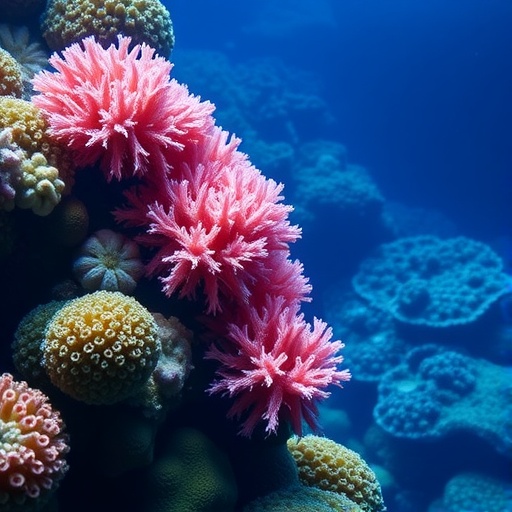
In a groundbreaking study poised to reshape our understanding of marine biology and the effects of climate change on coral ecosystems, researchers led by mathematician and marine biologist Dr. Marco Stuhr have unveiled significant differences in proteomic responses to ocean acidification among two commonly found pocilloporid corals. As climate change accelerates, leading to increased levels of carbon dioxide in the atmosphere, ocean acidification poses a critical threat to coral reefs worldwide. Understanding how these vital organisms react at a cellular level is key to developing strategies for their conservation.
The research highlighted in this study examined the proteomic shifts in two species of pocilloporid corals: Pocillopora damicornis and Pocillopora verrucosa. These species, known for their ecological significance and abundance in coral reef ecosystems, were subjected to controlled conditions simulating future ocean acidification scenarios. By focusing on the proteome— the entire set of proteins expressed by these corals under varying acidification conditions—the researchers aimed to decipher how these corals might adapt or succumb to the ongoing challenges posed by climate change.
Proteomics, a field dedicated to the large-scale study of proteins, is crucial for understanding cellular responses to environmental changes. In this study, the authors employed advanced proteomic techniques, including mass spectrometry, to analyze the protein composition in coral samples taken from both species. The results revealed astonishing variances in the expression of key proteins, indicating distinct protective mechanisms adopted by each coral species when exposed to decreased pH levels. Such findings amplify the complexities involved in coral responses to environmental stressors.
Interestingly, Pocillopora damicornis exhibited a heightened expression of stress-related proteins and antioxidants in response to increased acidification. This suggests that this species may have developed a more robust protective strategy, potentially enabling it to better withstand acidified conditions. Conversely, Pocillopora verrucosa showed a different pattern; it presented a diminished expression of calcification-related proteins, which could hinder its ability to maintain calcium carbonate structures essential for coral health. This divergence illuminates the intricate biological responses intrinsic to coral resilience in the face of changing environments.
Given that corals are foundational species in marine ecosystems, providing habitat for countless marine organisms, understanding their biochemical responses to environmental change becomes immensely important. Coral reefs support an estimated quarter of all marine species, and their degradation due to climate change threatens biodiversity and the livelihoods of millions of people who depend on them. By evaluating the proteomic differences between these two coral species, the research provides critical insights into predicting which species may thrive and which may falter in future ocean conditions.
Further elaboration on the implications of the findings reveals that the adaptive strategies seen in Pocillopora damicornis could inform conservation efforts. If certain species can withstand the stress of acidification better than others, targeted restoration efforts could prioritize these resilient species. Moreover, understanding the molecular mechanisms behind such resilience could lead to innovative approaches, including selective breeding programs aimed at enhancing coral survivability in harsher environments.
The implications of this research extend beyond the immediate focus on pocilloporid corals. As marine environments transform, exploring the proteomic responses of diverse coral species may reveal broader patterns of resilience and vulnerability across coral ecosystems. Such patterns could inform predictive models, aiding scientists and conservationists in developing strategies to mitigate the impacts of ocean acidification on coral reefs globally.
In summary, as the oceans continue to absorb atmospheric CO2 and face rising temperatures, studies like this are essential in painting a clearer picture of marine biological responses to climate stressors. By elucidating the proteomic landscape that underpins the resilience and adaptability of coral species, researchers are unlocking crucial secrets that could pave the way for innovative conservation strategies and a deeper understanding of marine ecosystem dynamics.
In a world grappling with the reality of climate change, this research not only highlights the challenges faced by marine life but also underscores the hope that exists through scientific inquiry and innovation. As scientists strive to protect coral reefs, these findings serve as a pivotal resource, providing a pathway toward sustainable management practices aimed at preserving one of Earth’s most vital and beautiful ecosystems.
Ultimately, the quest to understand how marine organisms respond to environmental stression goes beyond academic interest. It poses urgent questions about our responsibility to protect our planet’s resources. By amplifying the voices of research entities like Dr. Stuhr’s team, we advance a crucial agenda in marine conservation, making strides towards a more sustainable future for coral reefs and the myriad life forms they harbor.
Subject of Research: Proteomic responses of Pocillopora corals to ocean acidification.
Article Title: Differing proteome responses to ocean acidification between two common pocilloporid corals.
Article References:
Stuhr, M., Kollipara, L., Reymond, C.E. et al. Differing proteome responses to ocean acidification between two common pocilloporid corals.
Coral Reefs (2025). https://doi.org/10.1007/s00338-025-02801-y
Image Credits: AI Generated
DOI: https://doi.org/10.1007/s00338-025-02801-y
Keywords: Coral reefs, ocean acidification, proteomics, climate change, Pocillopora.


