

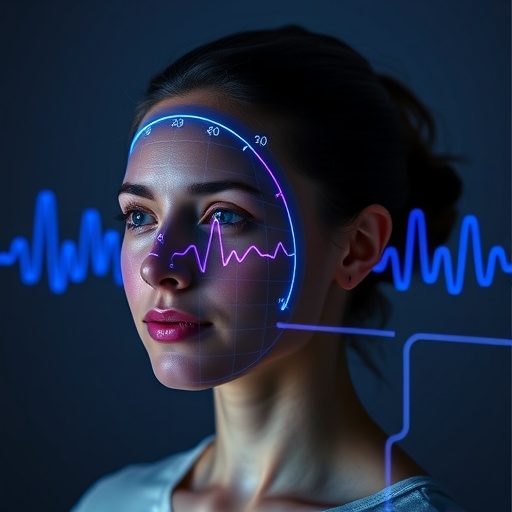
In a groundbreaking advancement poised to reshape mental health diagnostics, researchers have unveiled a novel contactless method for depression screening utilizing facial video-derived heart rate variability (HRV). This innovative approach, presented in a recent study published in Translational Psychiatry, offers a nonintrusive, cost-effective, and scalable alternative to traditional clinical assessments, potentially transforming how depression is detected and monitored globally.
Depression, a pervasive mental health disorder affecting millions worldwide, often goes undiagnosed or is identified late due to the subjective nature of current screening tools, which rely heavily on self-reporting and clinician observation. The new study addresses this challenge by harnessing subtle physiological signals that manifest through the face, captured by standard video cameras, to infer heart rate variability—a known biomarker for autonomic nervous system functioning closely linked to emotional regulation and mood disorders.
Heart rate variability refers to the fluctuations in time intervals between consecutive heartbeats, reflecting the interplay between sympathetic and parasympathetic nervous system dynamics. Lower HRV has been consistently associated with increased stress, emotional dysregulation, and depressive symptoms. However, conventional HRV measurement necessitates electrocardiography or wearable sensors, limiting accessibility and convenience, particularly in large-scale or remote mental health evaluations.
The research team, led by Jhon, M., Kim, JW., and Lee, K., developed an advanced computational framework that extracts HRV metrics from facial videos using remote photoplethysmography (rPPG). This technique capitalizes on subtle color changes in the skin linked to blood volume pulse, which high-resolution cameras can detect even under ambient lighting conditions. By employing sophisticated signal processing algorithms and machine learning models, the authors refined the extraction of reliable cardiac signals from facial footage, overcoming challenges posed by motion artifacts and varying environmental factors.
Through a meticulously designed validation process involving clinical populations diagnosed with major depressive disorder and matched healthy controls, the study demonstrated robust correlations between video-derived HRV parameters and clinical depression scores. Importantly, their model could distinguish depressed individuals from controls with high sensitivity and specificity, indicating strong potential as a screening tool. This is a significant stride forward, as it paves the way for unobtrusive, real-time mental health assessments that can be administered remotely or embedded within everyday devices such as smartphones or laptops.
Beyond technical achievements, the researchers emphasize the method’s practical implications. Mental health services often face bottlenecks due to limited personnel and stigmatization barriers. By enabling passive monitoring through routine interactions with digital platforms, individuals might receive early alerts prompting professional consultation before symptoms escalate. This proactive approach could contribute to lowering the global burden of depression by facilitating timely interventions.
The study also delves into the physiological underpinnings that link facial video signals to mood states. Changes in autonomic tone during depressive episodes influence cardiovascular regulation, hence altering the photoplethysmographic patterns detectable on facial skin. The research contributes to a deeper biological understanding of depression, bridging psychophysiology and digital health technologies, and encouraging interdisciplinary collaboration for future innovations.
Nonetheless, the authors acknowledge certain limitations and avenues for refinement. The accuracy of video-based HRV extraction can be affected by lighting variability, skin pigmentation diversity, and participant movement, which may necessitate adaptive modeling and hardware improvements. Further, larger-scale studies encompassing diverse demographic groups are crucial to validate generalizability and reduce biases.
Future research directions poised to build upon this foundation include integration with other biometric indicators such as facial expression analysis, speech patterns, and eye movement metrics, potentially enhancing diagnostic precision. Moreover, embedding these capabilities into consumer electronics could democratize mental health surveillance, empowering users with continuous insights into their emotional well-being through everyday technology use.
Ethical considerations surrounding privacy and data security remain paramount, given the sensitivity of mental health data and potential misuse risks. The researchers advocate for transparent policies, informed consent, and anonymized data processing protocols to ensure user trust and compliance with regulatory frameworks.
In sum, this pioneering work heralds a new era in mental health diagnostics, leveraging the convergence of computer vision, signal processing, and psychological science. By enabling contactless, objective, and scalable depression screening, this technology transcends conventional boundaries, offering hope for more accessible and effective mental healthcare solutions worldwide.
As the global community grapples with rising mental health challenges exacerbated by modern lifestyles and sociopolitical stressors, innovations such as this reveal the transformative potential of interdisciplinary science. It underscores how advances in seemingly unrelated fields—like video analytics and cardiovascular physiology—can converge to address pressing societal needs.
The publication in Translational Psychiatry marks a milestone reflecting rigorous peer review and scientific validation. Researchers anticipate this method will inspire further empirical investigations, commercial development, and eventual clinical adoption, shaping the future landscape of mental health diagnostics.
This development also opens intriguing questions regarding how remote biometric monitoring might intersect with telemedicine, artificial intelligence-driven therapeutic interventions, and personalized medicine paradigms. It could redefine patient-physician interactions and foster deeper patient engagement through continuous, passive health monitoring.
Ultimately, the promise of contactless depression screening via facial video-derived HRV lies not only in technological novelty but also in its capacity to save lives by facilitating earlier, more accurate diagnosis and reducing the stigma associated with mental illness. This innovation exemplifies how technology can humanize healthcare by making it more empathetic, accessible, and proactive.
The ongoing challenge will be translating laboratory success into real-world impact, necessitating collaborations across academia, industry, healthcare providers, and policymakers. With concerted efforts, this breakthrough could democratize mental health care, bringing hope to those who suffer silently and transforming how society perceives and addresses depression.
The emergence of such a tool also signals a broader shift toward utilizing non-contact physiological measurements for diverse health conditions, hinting at a future where digital phenotyping becomes integral to holistic health management.
By capitalizing on the face as a window into the mind, this research bridges human expression and cardiovascular rhythm, delivering a compelling example of innovation at the intersection of technology and psychology that promises to reshape mental health care globally.
Subject of Research: Contactless depression screening using facial video-derived heart rate variability
Article Title: Contactless depression screening via facial video-derived heart rate variability
Article References:
Jhon, M., Kim, JW., Lee, K. et al. Contactless depression screening via facial video-derived heart rate variability. Transl Psychiatry (2026). https://doi.org/10.1038/s41398-026-03831-y
Image Credits: AI Generated


