

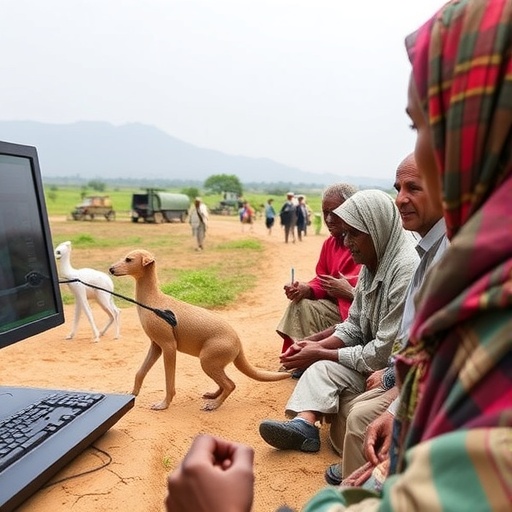
In a pioneering exploration of educational technology and social psychology, a recent experimental study unveils the transformative potential of computer simulations in reshaping teenagers’ attitudes toward migration. Conducted with 148 students across Swedish secondary schools, the research employed a sophisticated digital migration simulator to immerse participants in the complex realities faced by migrants originating from the Middle East and North Africa. This innovative approach moves beyond conventional pedagogical methods, offering an experiential learning journey that engages users directly with the multifaceted challenges and unpredictable events inherent in migration pathways.
Migration, often a subject mired in political rhetoric and misinformation, has long posed challenges for educators aiming to foster informed, empathetic understanding among youth. Traditional curricula generally rely on presenting statistical data and theoretical narratives, which, while informative, often fail to evoke deeper emotional engagement. The simulation addresses this gap by allowing students to assume the roles of individual migrants whose lives unfold within a randomly generated, dynamic global context. From birth to death, participants navigate socioeconomic barriers, health crises, and geopolitical obstacles that directly influence their characters’ ability to migrate and integrate.
The simulation’s design integrates rigorously researched migration data with interactive game mechanics, compelling users to make decisions against a backdrop of realistic constraints and opportunities. Each player’s journey is unique, influenced by variables such as the character’s country of origin, access to financial resources, health status, and external world events. Approximately one quarter of participants encountered scenarios where their characters’ migration attempts failed, underscoring the simulation’s fidelity to real-world complexities where migration is neither guaranteed nor straightforward.
Professors Thomas Nygren and Markus Al-Afifi, leading the study, underscore the educational significance of this method. Nygren highlights the simulation’s ability to deepen comprehension through immersive experience, remarking that the platform essentially melds the fact-driven clarity championed by statisticians like Hans Rosling with the engaging dynamics of modern computer gaming. This synthesis offers a compelling countermeasure to prevailing disinformation and polarized discourse surrounding migration, instilling an evidence-based perspective grounded in personal engagement rather than abstract statistics.
A critical component of the simulation is its reflexive design, which situates users within a feedback loop of fact-checking and critical thinking. Participants are not passive recipients of curated narratives but active agents whose decisions trigger consequences, fostering a nuanced understanding of the structural and individual factors steering migratory flows. By confronting the inherent unpredictability and risks migrants face, the experience dismantles simplistic assumptions about migration being universally accessible or straightforward.
Pre- and post-simulation assessments revealed substantial shifts in students’ social understanding and empathy towards immigrants. While political opinions regarding immigrants’ rights exhibited resilience to change, the quantitative analysis confirmed a meaningful increase in social cognition related to the lived realities and systemic challenges confronted by migrants. Such differentiation suggests that while deep-seated political beliefs may require more sustained interventions to evolve, simulations can effectively cultivate foundational social empathy and openness.
The theoretical underpinning of the study draws upon intergroup contact theory, which posits that structured interaction between distinct groups can attenuate prejudice. In contexts where direct interaction is infeasible, such as classrooms with no personal exposure to migrants, virtual simulations act as proxies for contact experience. By facilitating indirect yet substantive engagement, these tools foster a scaffolded learning environment conducive to attitudinal transformation.
Beyond attitudinal shifts, the simulation educates students on the socioeconomic and political factors precipitating migration decisions. It elucidates how constrained agency, environmental risks, and limited resources collectively shape migration trajectories. The role-playing element facilitates an embodied perspective, empowering users to experience uncertainty and decision-making dilemmas that migrants routinely confront. This format advances beyond didactic instruction to cultivate experiential knowledge, crucial for nurturing informed global citizenship.
Moreover, the study’s methodological rigor bolsters its findings’ credibility. Employing robust statistical techniques such as the Wilcoxon signed-rank test and hierarchical regression analysis, the research accounts for variables including prior knowledge, existing attitudes, and participants’ perceived learning. These measures ensure that observed shifts are attributable to the intervention rather than extraneous factors, underscoring the simulation’s efficacy as an educational tool.
This research opens new horizons for integrating technology and social science in education. By demonstrating that immersive simulations can tangibly influence complex social attitudes among adolescents, it challenges educators and policymakers to reconsider traditional instructional paradigms. The scalability and adaptability of such simulations promise broad applicability across diverse educational settings, providing a blueprint for fostering critical engagement with contentious sociopolitical topics.
While the simulation’s impact on political attitudes was modest, the broader implications for societal discourse are significant. Empathy cultivated through such experiences may lay the groundwork for more constructive dialogues surrounding migration policies and integration strategies. By humanizing migrants’ experiences and emphasizing structural constraints, simulations like this can contribute to depolarizing debates and promoting evidence-based understanding.
The integration of accurate, research-based migration data with interactive, gamified experiences marks a significant advancement in educational innovation. This approach aligns with contemporary pedagogical emphases on active learning, critical thinking, and digital literacy. It also acknowledges the necessity of evolving beyond passive reception of information toward engaging learners in complex, meaningful scenarios that mirror real-world challenges.
In conclusion, this groundbreaking study reveals the potent role that computer simulations can play in enhancing empathy, social understanding, and nuanced perspectives on migration among young learners. As global migration remains a pressing and often divisive issue, the application of such innovative educational tools signals a promising avenue for equipping future generations with the knowledge and empathy necessary to navigate and contribute thoughtfully to an interconnected world.
Subject of Research: People
Article Title: Gaining tolerance of immigrants through simulating migratory experiences: Quasi-experimental evidence from secondary school classrooms
News Publication Date: 11-Mar-2026
Web References:
http://dx.doi.org/10.1016/j.compedu.2026.105603
Image Credits: RealLives Foundation
Keywords: Migration education, computer simulation, intergroup contact theory, empathy development, critical thinking, digital learning tools, migratory experiences, adolescent attitudes, experiential learning, social understanding, political attitudes, educational innovation


