

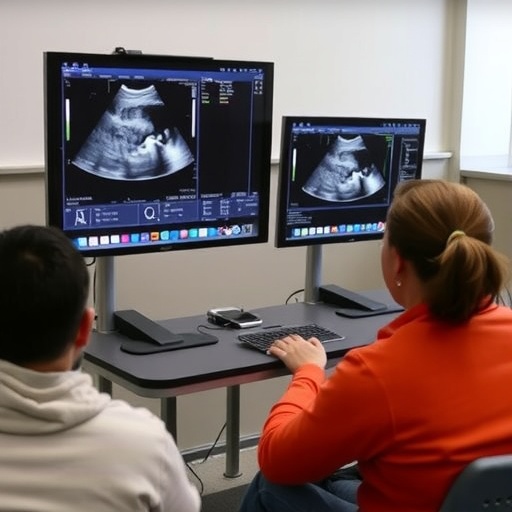
In a world where digital innovations continuously reshape the landscape of education, a groundbreaking study sheds light on an emerging trend in medical training: the efficacy of remote videoconference-assisted ultrasound education compared to traditional classroom instruction. This meticulous research effort led by Vatsvåg et al. delves into how remote learning technologies are revolutionizing ultrasound education, potentially paving the way for a new standard in the field of medical training.
In this pioneering investigation, the authors sought to determine whether students could achieve similar learning outcomes through remote training as they would in a traditional classroom setting. With the advent of online education, it has become increasingly essential to explore how these methods hold up under scrupulous academic scrutiny. The study not only looks into students’ acquisition of knowledge but also analyzes their ability to perform practical skills critical to the practice of ultrasound.
One of the standout features of this research is its comprehensive approach in methodology. The study involved a robust sample of participants who were divided into two groups: those who received standard classroom training and those who participated in remote videoconference sessions. This comparative analysis not only highlighted differences in knowledge retention but also examined the nuances of practical skill application in a real-world clinical setting. In doing so, the study sought to address the pressing question: “Can we trust virtual training as much as in-person training, especially for critical skill acquisition?”
The researchers utilized a series of assessments to gauge the competency of participants in both groups. These assessments ranged from theoretical examinations that tested their knowledge on ultrasound principles to practical evaluations that required students to demonstrate their skills in simulated clinical environments. This detailed evaluation design offered a holistic view of each participant’s learning journey in both modalities.
Moreover, the implications of this research extend beyond mere statistics. The broader context reveals a significant shift in educational paradigms, particularly in the wake of global events like the COVID-19 pandemic, which accelerated the adoption of remote learning practices. The findings of Vatsvåg et al. will likely contribute to shaping future training programs that employ a hybrid model, combining the best elements of both in-person and virtual instruction.
Students’ perspectives also played a crucial role in the study. The qualitative feedback provided by participants offered invaluable insights into their learning experiences. Many reported a sense of ease and flexibility that videoconference-assisted learning afforded them, allowing them to engage with content at their own pace. Conversely, some voiced concerns about the absence of hands-on guidance that is often a hallmark of in-person training.
Despite the clear advantages of remote learning, the researchers highlighted several challenges that need to be addressed. Critically, the lack of direct supervision during practical skill development poses potential risks in competency assurance. In ultrasound education, where precision is paramount, the capacity for instructors to provide immediate feedback is vital. The study contends that while remote formats can offer convenience and accessibility, they may also necessitate additional support systems to ensure skill proficiency.
The results of this research are particularly timely, as healthcare systems worldwide seek to bolster their educational frameworks amid staffing shortages and increased reliance on telehealth. By showcasing the potential of videoconference-assisted education, Vatsvåg et al. provide a compelling argument for the integration of technology in medical training programs at various levels.
As educational institutions grapple with the balance between innovation and traditional methods, the study offers evidence to inform curricula in ultrasound programs. These insights can help educators craft courses that are not only robust and effective but also adaptable to the evolving demands of medical education.
Furthermore, this study has implications for ongoing professional development for healthcare providers. As practitioners engage in continuous learning, the principles derived from remote education can enhance training methodologies and inform best practices across various medical specialties.
In conclusion, the research conducted by Vatsvåg et al. is a vital contribution to the discourse surrounding medical education and training. By examining the efficacy of remote videoconference-assisted ultrasound education, the authors not only address a contemporary challenge but also lay the groundwork for future research in this dynamic field. The findings could potentially reshape how educational institutions approach training in ultrasound and other critical fields within medicine, pointing toward a more flexible, accessible, and effective learning model for future healthcare professionals.
As the landscape of medical education continues to evolve, this study stands as a testament to the possibilities that technology can offer. With advancements in digital learning tools and the acceptance of remote education, practitioners of tomorrow may find themselves equipped with a rich tapestry of training experiences, melding traditional learning with innovative approaches.
Subject of Research: Efficiency of remote videoconference-assisted ultrasound education compared to standard classroom training.
Article Title: Efficiency of remote videoconference-assisted ultrasound education: comparison with standard classroom training.
Article References: Vatsvåg, V., Røislien, J., Hyldmo, P.K. et al. Efficiency of remote videoconference-assisted ultrasound education: comparison with standard classroom training. BMC Med Educ (2025). https://doi.org/10.1186/s12909-025-08452-5
Image Credits: AI Generated
DOI: 10.1186/s12909-025-08452-5
Keywords: remote education, ultrasound training, videoconference, medical education, digital learning, competency assurance, healthcare training.


