

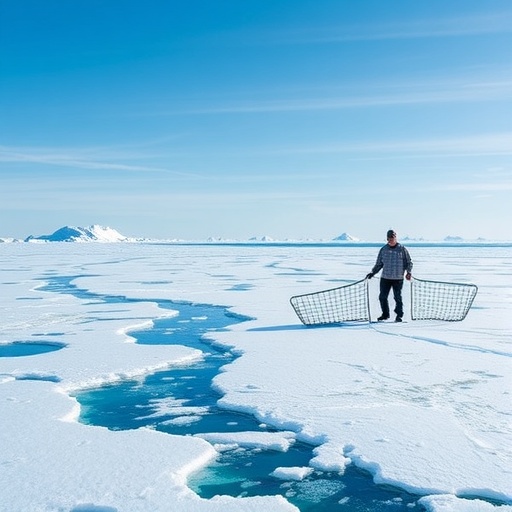
The Arctic environment is undergoing some of the most significant transformations in modern times, primarily attributed to climate change. Researchers across various disciplines have long sought to understand the pace and implications of these changes, especially concerning Arctic sea ice. New insights unveiled in the forthcoming article “Co-production of Arctic sea ice knowledge: A systematic review” by Monakhova, York, Peterson, and colleagues offer a comprehensive overview of the collaborative approaches in Arctic research. As the Arctic sea ice continues to dwindle, the urgency for resilient and adaptable knowledge frameworks becomes clear.
The Arctic ecosystem, with its unique habitats and species, is incredibly interconnected. Sea ice serves as a critical component, facilitating the biological processes necessary for the survival of species such as polar bears, seals, and various fish. The article examines how the decline of sea ice impacts these organisms, revealing disturbing trends and potential long-term consequences. The systematic review summarizes these effects, highlighting the necessity of immediate action based on solid scientific understanding, which the research provides.
Moreover, the authors delve into the importance of co-production in Arctic research, a methodology that emphasizes collaboration between scientists, Indigenous communities, and stakeholders. By leveraging traditional ecological knowledge alongside contemporary scientific methodologies, researchers can create a more comprehensive understanding of the changing Arctic conditions. This integration aims to ensure that the data being generated is not only relevant but also actionable for local communities affected by these environmental shifts.
The systematic review also explores various research frameworks utilized worldwide, which illuminate the role of multidisciplinary collaboration in Arctic studies. These include social sciences, environmental sciences, and policy-making. Findings indicate that the complexities surrounding climate change demand innovative approaches that capitalize on diverse perspectives and expertise. Such collaborations can enhance decision-making processes and foster adaptive strategies that resonate with local realities.
Additionally, the authors tackle the challenges inherent in Arctic research, such as logistical hurdles and funding constraints. Researchers often operate in harsh and unpredictable environments, where accessibility is a prime concern. The study underscores the importance of investing in infrastructure and training to empower local researchers and communities, thus reinforcing the resilience of Arctic research networks.
The review further discusses the narrative surrounding Arctic knowledge, depicting a landscape where scientific knowledge is often seen as superior to Indigenous perspectives. Monakhova and colleagues argue that this dynamic must shift to create an inclusive narrative that respects and integrates various forms of knowledge. The article advocates for a paradigm change that redefines the relationship between scientists and Indigenous peoples, promoting a partnership model.
The critical role of communication in the dissemination of Arctic sea ice knowledge is another focal point of the study. As climate change continues to impact global weather patterns, informing a broad audience about these changes is vital. Effective communication strategies can bridge the gap between researchers and the public, leading to heightened awareness and collective action. The authors emphasize that scientists must take on the responsibility of making complex data accessible and engaging to stimulate public interest and response.
Policy implications of the findings are significant. The systematic review identifies the gap between scientific research and policy-making in the Arctic region. Policymakers must draw upon current research findings to develop strategies that mitigate the rapid impacts of climate change. Incorporating co-produced knowledge into policy frameworks could lead to more effective and sustainable outcomes, ensuring community resilience.
In summary, the systematic review by Monakhova and her team not only provides a snapshot of the current state of Arctic sea ice knowledge but also highlights the potential paths forward. By advocating for inclusive and collaborative research models, they present a roadmap for future endeavors. This work underscores the need for resilience in both science and policy, reminding us that the future of the Arctic hangs in the balance.
This review signals a clarion call for sustained efforts in Arctic research, highlighting that the value of knowledge extends beyond academia. The ongoing changes in the Arctic region are not just an environmental issue; they pose social, economic, and political challenges that must be addressed through concerted, informed action. As we move into an era where the effects of climate change are felt widely, the integration of diverse knowledge systems will prove invaluable.
As the world awaits the full release of this pivotal review in Ambio, one can only hope that the findings and recommendations articulated by Monakhova et al. serve as a catalyst for meaningful dialogue and action. The Arctic is changing rapidly; hence, our understanding and responses must evolve just as swiftly. This research opens new avenues for understanding our planet’s changing climate and challenges each of us to take part in safeguarding the future.
In conclusion, the collective insights found within this systematic review extend beyond mere academic inquiry; they beckon for action. As the Arctic continues to transform, let us embrace diverse knowledge systems, enhance partnerships, and prioritize sustainable practices. The future rests upon our ability to unite science with community, ensuring that the voices of those most affected by climate change resonate within the halls of research and policy-making.
Subject of Research: Co-production of Arctic sea ice knowledge
Article Title: Co-production of Arctic sea ice knowledge: A systematic review
Article References: Monakhova, M., York, A., Peterson, M. et al. Co-production of Arctic sea ice knowledge: A systematic review. Ambio (2025). https://doi.org/10.1007/s13280-025-02303-9
Image Credits: AI Generated
DOI: 10 December 2025
Keywords: Arctic, sea ice, climate change, co-production, Indigenous knowledge, multidisciplinary research, policy implications.


