

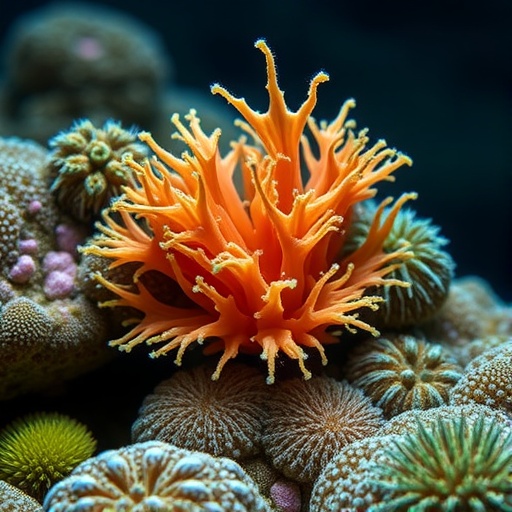
A groundbreaking study has revealed the delayed feeding behaviors of cold-water coral larvae and the first confirmed instance of microalgal ingestion in the species Desmophyllum pertusum. The intricate relationship between corals and microalgae has long been a focal point of marine biology research, particularly concerning their mutualistic symbiosis in warm-water reefs. However, the mechanisms and feeding behaviors of larvae in cold-water coral species have remained largely uncharted territory. This study addresses critical gaps in our understanding, illustrating how early life stages of these organisms interact with their environment and food sources, which are fundamental to their survival and growth.
The research, led by Paulsrud et al., employed fluorescence microscopy techniques to trace and visualize the ingestion processes of Desmophyllum pertusum larvae. This innovative approach allowed the researchers to capture high-resolution images, revealing the distinct cellular interactions as the larvae attempted to integrate microalgae into their diets. The results indicate a complex feeding strategy that appears adapted for a nutrient-sparse environment, characteristic of deep-sea habitats.
Prior to this investigation, the prevailing assumption was that cold-water coral larvae had a passive feeding strategy, reliant primarily on ambient particulate organic matter. What Paulsrud and colleagues observed, however, was a more proactive approach. The larvae demonstrated a clear capability to seek out and ingest microalgae, showcasing an evolutionary adaptation that enhances their potential for growth and survival in nutrient-limited conditions. This revelation challenges long-held notions about the developmental biology of these organisms.
One standout finding from the research was the observed delay in the onset of feeding, which appears to be an adaptive response to the environmental conditions of the larvae’s habitat. Given that deep-sea environments can differ significantly in nutrient availability, it raises intriguing questions about how these larvae balance energy expenditure against the uncertain availability of food. Such insights point towards a need for further investigation into the ecological implications of this behavior.
The study’s implications extend beyond just understanding larval behaviors; it underscores the necessity of reassessing conservation strategies for cold-water coral ecosystems. Since Desmophyllum pertusum plays a pivotal role in maintaining biodiversity in these marine environments, knowledge of its early life stage feeding habits could inform broader conservation and restoration efforts. Without sufficient understanding of these fundamental processes, efforts to protect and restore such ecosystems may be misguided.
Moreover, the findings could potentially have implications for climate change research. With rising ocean temperatures and acidification impacting marine ecosystems, understanding how species like Desmophyllum pertusum adapt at various life stages becomes crucial. It could help predict how these organisms may cope with ongoing environmental changes, which is essential for creating effective management strategies.
The fluorescence microscopy methodology used in this study represents a significant advancement in marine biological research techniques. By allowing for real-time observation of feeding behaviors, it opens up new avenues for exploring the feeding ecology of various marine organisms. The application of this technology could potentially lead to further breakthroughs in understanding not just corals, but a wide range of marine life.
The article leaves readers with a sense of anticipation about future research direction, particularly in exploring how larval feeding strategies may differ across various species of cold-water corals. Such comparative studies could elucidate evolutionary paths and adaptations that these organisms have undertaken over millennia, shaping their role in the marine ecosystem.
As the scientific community continues to delve deeper into the intricacies of coral biology, this study serves as a reminder of the importance of larval stages in the life cycles of marine organisms. It highlights the potential resilience of these species and their capacity to adapt over time, even in the face of ecological challenges.
The findings of Paulsrud and his team not only enhance our scientific understanding but also weave a richer narrative about the interconnectedness of marine life. The evidence of microalgal ingestion suggests a more dynamic interplay between corals and their symbiotic partners than previously understood. It signifies an invitation for further exploration and a deeper appreciation for the complexities of underwater ecosystems.
As our knowledge about cold-water coral larvae evolves, the implications for marine biodiversity conservation grow increasingly significant. The interconnected relationships among marine species, from microorganisms to apex predators, hinge on understanding these foundational dynamics. This new insight into the feeding habits of Desmophyllum pertusum larvae not only broadens the scope of marine biology but also cements the necessity of ongoing research to unravel the mysteries of the ocean’s depths.
In conclusion, the recent revelations about the delayed feeding onset and microalgal ingestion in Desmophyllum pertusum highlight the resilience and adaptability of cold-water coral larvae. This study sets a critical precedent for future research within marine biology, offering profound insights that could influence conservation strategies and deepen our understanding of ocean ecosystems.
Subject of Research: Cold-water coral larvae feeding behaviors and microalgal ingestion
Article Title: Delayed feeding onset in cold-water coral larvae: first evidence of microalgal ingestion in Desmophyllum pertusum revealed by fluorescence microscopy.
Article References: Paulsrud, E., Grosse, M., Larsson, A.I. et al. Delayed feeding onset in cold-water coral larvae: first evidence of microalgal ingestion in Desmophyllum pertusum revealed by fluorescence microscopy. Coral Reefs (2025). https://doi.org/10.1007/s00338-025-02789-5
Image Credits: AI Generated
DOI: https://doi.org/10.1007/s00338-025-02789-5
Keywords: Cold-water coral, Desmophyllum pertusum, larvae feeding, microalgal ingestion, fluorescence microscopy, marine biology conservation.


