

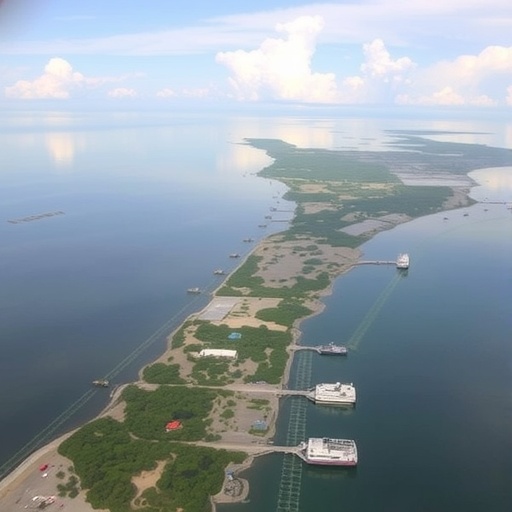
In the face of escalating climate change impacts, coastal regions worldwide are undergoing dramatic transformations, and the intricate land dynamics of Southwest Bangladesh stand as a poignant testament to this global phenomenon. A groundbreaking study published in Environmental Earth Sciences delves deeply into the complex interplay of climatic factors—particularly rainfall and temperature variations—and their consequential influence on the mangrove ecosystems that define the coastal landscape of this vulnerable region. The meticulous research conducted by Rahman, Hoque, Rahman, and colleagues offers unprecedented insights that could reshape our understanding of coastal resilience and vulnerability amid accelerating environmental shifts.
Southwest Bangladesh, characterized by its sprawling deltaic plains and dense mangrove forests, notably the Sundarbans, represents one of the most ecologically significant yet climate-sensitive regions in South Asia. Over recent decades, the area has witnessed pronounced changes in temperature trends and precipitation patterns, a direct repercussion of broader global climate dynamics. These climatic perturbations not only affect atmospheric conditions but propagate profound impacts on coastal geomorphology and land cover, especially the delicate balance maintained by mangrove ecosystems. The study underlines that these interactions form a critical feedback loop influencing sediment deposition, erosion processes, and ultimately, land accretion or loss along the coastline.
Utilizing advanced remote sensing techniques alongside long-term meteorological data analysis, the research team charted the evolving land cover of Southwest Bangladesh over several decades. This integrative approach allowed them to discern subtle shifts in coastal morphology, closely tied to variations in rainfall and temperature records. Particularly compelling was the finding that increased rainfall intensities during monsoon seasons contribute to enhanced sediment supply, fostering land accretion in certain zones. Conversely, elevated temperatures exacerbate evapotranspiration and disrupt precipitation cycles, which can trigger mangrove degradation and increase susceptibility to coastal erosion. These nuanced climatic relationships underscore the multifaceted drivers of landscape evolution in the region.
The importance of mangroves as natural coastal defense mechanisms cannot be overstated. They act not only as biological buffers against storm surges and sea-level rise but also as crucial facilitators of sediment retention and nutrient cycling. The study highlights that any alteration in mangrove health or distribution, driven by climate-induced stressors, holds cascading effects for land stability. In Southwest Bangladesh, where millions depend on coastal resources for sustenance and livelihood, understanding these dynamics is pivotal. The researchers emphasize that subtle climatic shifts can either fortify mangrove resilience or expedite their decline, thereby influencing broader socio-ecological systems.
In delving into the rainfall patterns, the study exposes increasing variability and intensity in annual precipitation, which directly modulates sediment dynamics along the coast. Flood pulses carrying sediment loads from upstream river systems significantly shape coastal accretion patterns, particularly in deltaic margins. Yet, such benefits are counterbalanced by periods of drought or reduced rainfall, which compromise sediment supply and impair mangrove regeneration. The investigation posits that future climate scenarios projecting heightened rainfall extremes may catalyze both opportunities and risks for coastal land development in Bangladesh, necessitating adaptive management approaches informed by scientific foresight.
Temperature assessments unveiled a consistent warming trend across the region, elevating average and peak temperatures beyond historical baselines. The ramifications of this thermal increase extend into physiological stress in mangrove flora, altering growth rates, reproduction, and survivability. Furthermore, warmer thermal regimes synergize with salinity intrusions from sea-level rise, compounding environmental stress experienced by mangrove communities. The paper underscores that these compounded stressors could initiate shifts in species composition and habitat distribution, effectively transforming the coastal landscape at fundamental levels.
One of the study’s pioneering contributions lies in connecting climatic variables directly to tangible geomorphological outcomes, bridging atmospheric science with physical geography. By integrating climate models with spatial land change analyses, the authors present a holistic depiction of coastal dynamics rarely achieved in prior research. This interdisciplinary framework not only advances academic understanding but equips policymakers and environmental managers with enhanced predictive capabilities to anticipate future land transformations under diversified climate scenarios.
Crucially, the findings reveal that the coastal land in Southwest Bangladesh is simultaneously experiencing processes of accretion and erosion, driven by localized variations in rainfall and temperature. The mosaic of land gain and loss calls for highly localized monitoring regimes capable of detecting subtle environmental signals. The authors advocate for investment in advanced monitoring infrastructure, including satellite platforms and ground-level reconnaissance, to better inform conservation initiatives aimed at sustaining mangrove ecosystems and mitigating land degradation risks.
The social implications of these ecological shifts are profound. Bangladesh’s southwestern coastline is heavily populated, with communities heavily reliant on fishing, agriculture, and forest resources. The degradation or expansion of coastal lands influences settlement patterns, resource availability, and disaster risk profiles. The researchers highlight the importance of embedding climate-driven ecological insights into community-based adaptation planning. Such integrative strategies can harness natural regeneration potentials of mangroves while buffering human populations from escalating climatic threats.
Interestingly, the study also points to potential feedback loops wherein land dynamics influenced by climate variability affect local microclimates. For example, mangrove loss could reduce evapotranspiration-driven cooling effects, contributing to localized warming and further ecosystem stress—a self-reinforcing cycle detrimental to coastal resilience. Therefore, preserving mangrove health is not only critical for physical land stability but also for maintaining favorable local climate regulation.
The interplay of freshwater inflow, sediment distribution, and sea-level rise further complicates the picture of Southwest Bangladesh’s coastal dynamics. Although this study focuses primarily on climatic drivers, it recognizes the importance of hydrological regimes determined by upstream river management and tidal patterns. These factors interact intricately with climate-induced rainfall and temperature changes, shaping landform evolution in ways that are spatially heterogeneous and temporally dynamic.
Exploring the policy relevance, the paper posits that climate adaptation frameworks in Bangladesh must prioritize nature-based solutions focusing on mangrove restoration and sustainable land management. Traditional engineering-centric approaches to coastal defense may prove insufficient or counterproductive in the face of evolving climate and ecological realities. Instead, fostering resilient coastal ecosystems through integrated watershed and land-use management promises a more sustainable pathway.
The urgency of these insights cannot be overstated as global sea levels continue their inexorable rise. Southwest Bangladesh, part of the world’s largest delta system, faces disproportionate exposure to inundation and salinization. The documented linkages between climate variables and coastal land dynamics underscore the necessity for comprehensive climate mitigation efforts alongside localized adaptation. This dual approach could help safeguard livelihoods and biodiversity concurrently.
Moreover, the study’s methodological innovations serve as a blueprint for similar investigations in other vulnerable coastal zones globally. The combined use of climatic data, remote sensing, and ecological indicators offers a replicable model to unravel complex land–climate interactions. Such comparative studies may illuminate universal patterns as well as regional idiosyncrasies essential for tailoring climate resilience actions.
In conclusion, the research spearheaded by Rahman and colleagues represents a significant leap forward in comprehending how climate-driven forces sculpt coastal landscapes through delicate ecological processes. Their elucidation of rainfall and temperature effects intertwined with mangrove dynamics brings forth a multifaceted narrative highlighting vulnerability, adaptation potential, and the critical role of nature-based resilience in a rapidly changing world. As coastal zones globally grapple with similar challenges, this work stands out as both a warning and a beacon of informed optimism, reminding us that understanding the subtle dance between climate and land is paramount to securing a sustainable future.
Subject of Research:
Climate-driven coastal land dynamics in Southwest Bangladesh, focusing on the interactions of rainfall, temperature, and mangrove ecosystems.
Article Title:
Climate-driven coastal land dynamics in Southwest Bangladesh: insights from rainfall, temperature, and mangrove interactions.
Article References:
Rahman, S.M., Hoque, A., Rahman, M. et al. Climate-driven coastal land dynamics in Southwest Bangladesh: insights from rainfall, temperature, and mangrove interactions. Environ Earth Sci 85, 48 (2026). https://doi.org/10.1007/s12665-025-12764-6
Image Credits: AI Generated


