

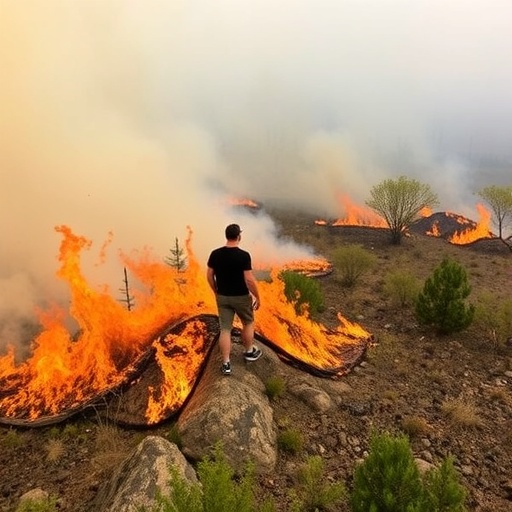
In a groundbreaking research study, scientists are uncovering the significant role that climate-driven wildfires are playing in altering nitrogen deposition patterns across the United States. This research, led by prominent scholars including P.C. Campbell, D.Q. Tong, and S. Chang, emphasizes the urgent need to understand how these increasingly frequent wildfires—exacerbated by climate change—are impacting ecosystems and atmospheric chemistry. The findings, to be published in the esteemed journal Commun Earth Environ in 2026, offer new insights that could reshape our approach to managing air quality and ecosystem health as we face a future marked by more severe climate events.
The research team employed a multi-faceted approach, utilizing satellite data, atmospheric models, and laboratory experiments to assess the contributions of wildfires to nitrogen deposition. Their comprehensive analysis highlights that nitrogen—a crucial nutrient for plant growth and soil fertility—can have both beneficial and detrimental effects on the environment. Understanding these dual roles is critical in policy-making, especially as instances of wildfires are likely to rise in intensity and frequency due to ongoing climate trends.
One of the most striking revelations from this study is the extent to which wildfires contribute to nitrogen deposition. Traditionally viewed as a mere consequence of combustion, nitrogen, when deposited into ecosystems, can provoke a surge in plant growth in the short term. However, the long-term effects are more complex, often leading to nutrient imbalances that can adversely affect biodiversity and soil health. The research underscores that while wildfires may temporarily enrich soils through nitrogen input, the overall ecological ramifications could be dire if left unregulated.
Moreover, the study highlights that nitrogen deposition from wildfires is becoming increasingly significant as the climate continues to warm. This warming trajectory influences fire intensity and duration, consequently amplifying the nitrogen input into various ecosystems. The scientists emphasize that these dynamics necessitate immediate scientific inquiry and public awareness campaigns to foster a better understanding of how nitrogen cycles within our environment, especially in the context of changing fire regimes.
The researchers also investigated the geographical variability in nitrogen deposition rates caused by wildfires. Their findings indicate that regions prone to wildfires, such as the western United States, are experiencing a marked increase in nitrogen deposition compared to other regions. This discrepancy poses ecological challenges unique to these areas, particularly in forest and grassland ecosystems that are already stressed from climate change. Managing this input becomes crucial, as excess nitrogen can lead to eutrophication in water bodies, contributing to harmful algal blooms and degrading water quality.
Given the global emphasis on sustainable agriculture and land management practices, the role of nitrogen from wildfires is particularly timely. The team asserts that farmers and land managers must adapt to these changes, considering that nitrogen levels can shift dramatically following wildfire events. As nitrogen can stimulate growth in certain plant species, it may inadvertently favor invasive species that further disrupt local ecosystems. This cycle underscores the necessity for integrated management strategies that account for the fluctuating inputs of nitrogen from wildfires and their broader ecological implications.
The research also points to the importance of ecological restoration efforts following wildfire events. Certain management practices can help mitigate the negative effects of elevated nitrogen levels. For instance, reforestation and the restoration of native plant communities can help return nitrogen levels to a balance, aiding in rebuilding healthy ecosystems. However, the window for action is closing, as ecosystems already under stress may not have the resilience to bounce back without strategic intervention on the part of local policies and land management practices.
In addition to its ecological ramifications, the study also touches upon public health concerns associated with increasing nitrogen deposition from wildfires. Air quality can deteriorate significantly following wildfires, leading to respiratory problems and other health issues in nearby communities. The research team makes a compelling case for addressing these health risks by not only focusing on the immediate aftermath of fire events but also considering how nitrogen deposition affects air quality over time.
This multifaceted study serves as a clarion call not only for policymakers but also for the scientific community to prioritize understanding the nuanced interplay between climate-induced wildfires and nitrogen deposition. Developing models that accurately predict how future fire regimes will behave in a warming world is of paramount importance. As we continue to grapple with the effects of climate change, the necessity for adaptive strategies in environmental management becomes ever more pressing.
In conclusion, as the world enters an era characterized by heightened wildfire activity, understanding the role of nitrogen deposition becomes increasingly critical. Researchers highlight that the implications of their findings stretch far beyond academic inquiry and into practical applications for communities, public health, and environmental sustainability. As ongoing climate changes reshape our landscapes, the dialogue surrounding fire management and nitrogen deposition must evolve, offering pathways toward more resilient ecosystems and healthier environments for all.
In light of these discussions, the urgency to act cannot be overstated. Education, policy reform, and coordinated responses will play pivotal roles in how society navigates this critical juncture. As researchers continue unraveling the intricate links between climate-driven wildfires and nitrogen dynamics, the impact of their findings is poised to resonate across multiple spheres, from scientific circles to community awareness initiatives and beyond.
Amidst uncertainty, the prospect of collaboration and shared knowledge presents a beacon of hope, where thoughtful engagement with the findings can lead to transformative outcomes for ecosystems and human health alike. As we look toward the future, the legacy of this research will undoubtedly pave the way for a deeper understanding of how to coexist with the landscapes shaped by our changing climate.
The path forward will undoubtedly require a concerted effort, grounded in the principles of sustainability and resilience, to address the multifaceted challenges posed by climate change. It is a moment of reckoning for humanity, where the choices made today will shape the quality of the air we breathe and the health of the ecosystems we rely upon tomorrow.
Subject of Research: Impact of climate-driven wildfires on nitrogen deposition in the United States.
Article Title: Increased contributions of climate-driven wildfires to nitrogen deposition in the United States.
Article References:
Campbell, P.C., Tong, D.Q., Chang, S. et al. Increased contributions of climate-driven wildfires to nitrogen deposition in the United States.
Commun Earth Environ (2026). https://doi.org/10.1038/s43247-026-03279-4
Image Credits: AI Generated
DOI:
Keywords: Climate change, nitrogen deposition, wildfires, ecosystems, environmental management.


