

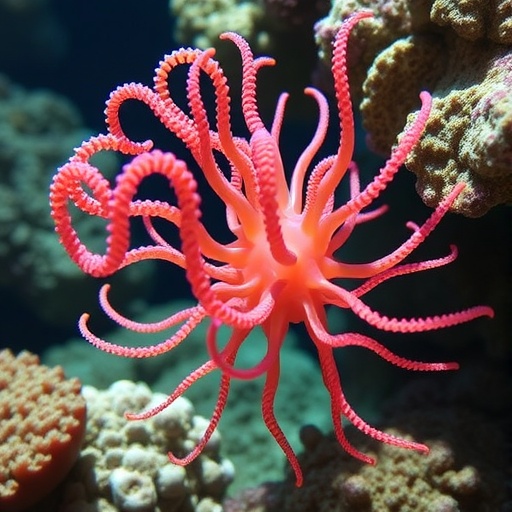
Climate change is exerting profound influences across the globe’s ecosystems, and its subtle yet critical effects on marine life remain an urgent area of investigation. Recent research illuminates how a mere two-degree Celsius rise in temperature can shift the timing of reproductive cycles within marine species, potentially wreaking havoc on ecological dynamics. A pioneering study focusing on the Mediterranean gorgonian (Paramuricea clavata), a temperate octocoral fundamental to reef biodiversity, unveils alarming phenological changes triggered by warming seas that threaten the species’ survival and the stability of marine habitats it supports.
The Mediterranean gorgonian, a sessile colonial invertebrate, forms intricate, tree-like structures on temperate seabeds. These colonies act as architectural keystones, offering shelter and substrate that foster rich biodiversity. Historically, their reproductive cycles have aligned closely with stable seasonal temperatures, ensuring successful gamete release and larval settlement during optimal environmental windows each spring. However, the study, conducted by researchers from the University of Barcelona and the Institute of Marine Sciences in Spain, reveals that rising water temperatures are advancing the onset of the gorgonian’s reproductive activities by approximately two weeks.
This temporal advancement arises amid progressively earlier warm spring conditions in the Mediterranean Basin, a direct consequence of accelerating global warming. Utilizing a combination of in situ field observations from protected marine parks—such as the Montgrí, Medes Islands, and Baix Ter Natural Park—and controlled laboratory experiments, scientists tracked gamete release and larval development under varying thermal regimes. Their data strongly indicate that the gorgonian’s reproductive phenology is highly sensitive to even slight thermal shifts, underscoring the species’ vulnerability to climate perturbations.
The researchers elucidate that an earlier larval release does not merely represent a shifted timeline but induces substantive biological stress. Larval biomass, crucial for successful dispersal and settlement, notably diminishes, resulting in larvae with reduced energy reserves. This compromised condition elevates larval mortality rates and diminishes settlement success on suitable substrates, thereby impairing the natural colonization and population replenishment processes essential for species resilience.
Compounding these reproductive hindrances, the Mediterranean gorgonian faces other anthropogenic pressures, notably the increasingly frequent and intense marine heatwaves. Prior investigations have linked these extreme temperature events to widespread mass mortality within gorgonian populations, accelerating declines in abundance and genetic diversity. The current study’s findings suggest that phenological shifts further exacerbate these vulnerabilities, creating a convergence of stressors that could precipitate population collapses.
Phenology— the study of cyclical biological events and their relationship to climate—has primarily focused on terrestrial systems, leaving marine phenological responses less understood. This novel research bridges that knowledge gap by highlighting the critical implications of climate-induced phenological shifts in marine animals, especially foundational species like octocorals. Alterations in such timing can ripple through the food web, disturbing ecological interactions, predator-prey dynamics, and overall community structure within coastal ecosystems.
The Mediterranean gorgonian’s sexual reproduction method, where external fertilization occurs via gamete release into the surrounding water column, is particularly susceptible to environmental timing changes. Synchronization with environmental cues is essential for maximizing fertilization success and subsequent larval recruitment. Advancing the reproductive phase risks decoupling gamete availability from optimal oceanographic conditions, such as plankton blooms or current patterns, further threatening reproductive success and population viability.
Given these pressing challenges, the authors emphasize the urgent need for comprehensive, long-term monitoring programs focused on phenological changes across key marine species. Only through detailed temporal and spatial data collection can conservationists develop accurate predictive models and effective management strategies to mitigate biodiversity loss in the face of ongoing climate change.
Moreover, this study advocates for integrating phenological data into marine conservation policies, ensuring adaptive frameworks account for shifting biological calendars rather than static environmental assumptions. Marine protected areas, while crucial, must expand their focus to include dynamic biological processes influenced by climate, thereby enhancing ecosystem resilience.
Beyond localized ecological consequences, the findings underscore broader concerns about how climate-induced phenological shifts could cascade to other marine organisms, possibly disrupting ecological networks more severely than direct thermal stressors. As marine ecosystems underpin vital services such as fisheries and carbon sequestration, their destabilization portends significant socio-economic ramifications.
This research signifies a pivotal advance in marine ecology by linking subtle phenological cues with broader climate change impacts. It sends a powerful message that even seemingly modest temperature increases have the capacity to disrupt foundational biological cycles, urging the scientific community to recalibrate conservation paradigms in a warming world.
As the Mediterranean continues to warm at rates exceeding the global average, the fate of the gorgonian and other ecologically critical species hangs in the balance. These findings provide a compelling basis for intensified research efforts and immediate conservation interventions aimed at preserving marine biodiversity for future generations.
Subject of Research: Animals
Article Title: Global Warming Drives Phenological Shifts and Hinders Reproductive Success in a Temperate Octocoral
News Publication Date: 14-Jan-2026
Web References: http://dx.doi.org/10.1111/gcb.70660
Image Credits: Núria Viladrich – University of Barcelona
Keywords: Ecology, Environmental Sciences, Climate Change, Marine Biology, Phenology, Reproductive Biology, Mediterranean Sea, Octocoral, Global Warming, Biodiversity


