

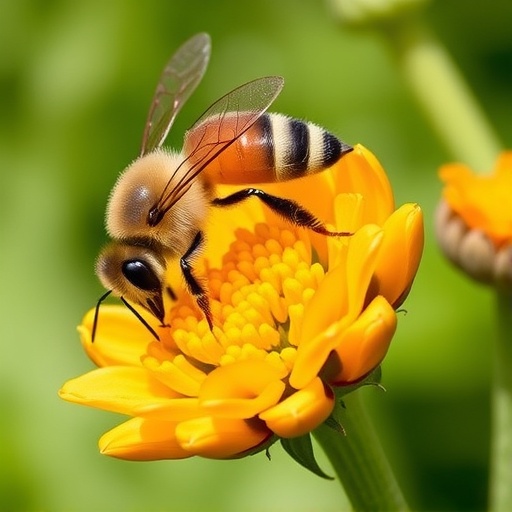
In the delicate balance of Earth’s ecosystems, honey bees hold a pivotal role as pollinators, essential for the reproduction of countless plant species and the global food supply. However, recent groundbreaking research published in Nature Communications reveals a disconcerting threat to the sustenance of these vital insects. Climate change, with its rapidly shifting weather patterns, rising temperatures, and altered flowering times, is increasingly jeopardizing the availability and quality of food resources for honey bees. This emerging crisis not only threatens bees themselves but also carries profound implications for biodiversity, agriculture, and human nutrition worldwide.
Honey bees rely heavily on floral nectar and pollen to meet their nutritional needs, with the timing and abundance of these resources finely tuned by seasonal cycles. The multilayered impacts of climate change disrupt these cycles in complex ways. Warmer temperatures can prompt earlier flowering of certain plants, but this phenological shift does not neatly align with bee foraging schedules, leading to significant mismatches known as temporal decoupling. Bees emerging to forage may find floral resources scarce or of diminished nutritional quality, undermining colony health and productivity.
The research team’s comprehensive analysis draws on longitudinal data from diverse geographic regions, revealing that climate-induced changes in temperature and precipitation patterns have variably influenced the floral landscapes bees depend on. In some areas, prolonged droughts reduce nectar availability, while in others, unseasonal rains impair pollen viability. Such variability creates patchy and unpredictable foraging conditions that challenge the adaptive capacity of honey bee colonies, which must buffer against nutritional deficits to sustain brood development and immune function.
Moreover, the study highlights the cascading consequences of environmental stressors exacerbated by climate change. Declines in floral diversity limit the range of nutrients bees can obtain, as diverse pollen sources are critical for providing essential amino acids, lipids, vitamins, and minerals. The nutritional stress undermines bees’ resilience against pathogens and pesticides, with weakened immune systems unable to fend off diseases such as the notorious Varroa mite or viral infections. This creates a pernicious feedback loop, where environmental degradation fuels biological vulnerabilities.
One of the striking revelations from the study is how urbanization and agricultural intensification, when combined with climate change, intensify the challenges bees face. Habitat fragmentation reduces the availability of natural forage, forcing bees to rely on monoculture crops whose flowering periods are limited and whose nutritional content is often inferior. The altered climate regimes exacerbate this by inducing erratic bloom patterns, leaving temporal gaps in resource availability that bees cannot easily bridge.
In examining global climate models alongside pollinator foraging behavior, the researchers identified potential scenarios for 2050 and beyond. Under high-emission trajectories, honey bee forage landscapes could decline by over 30% in some regions, especially mid-latitude zones where most commercial beekeeping occurs. The reduction in key nectar-producing species threatens the viability of traditional beekeeping livelihoods and agricultural systems dependent on pollination services, including fruit, nut, and vegetable crops.
This emerging threat necessitates urgent, multidimensional strategies. Conservation efforts must prioritize restoration of floral diversity and the creation of pollinator-friendly habitats that provide continuous bloom cycles throughout the foraging season. Landscape planning incorporating native wildflowers, hedgerows, and reduced pesticide use can bolster nutrient availability. Simultaneously, robust monitoring of climate impacts on plant-pollinator synchrony must guide adaptive management.
From a scientific perspective, this research underscores the critical need to integrate phenology studies with nutritional ecotoxicology to fully elucidate how climate change reshapes the energetic budgets of bee colonies. By leveraging remote sensing and citizen science pollinator monitoring networks, scientists can generate predictive models that inform policy and practical interventions to safeguard bee populations.
Furthermore, addressing climate change through global emission reductions remains paramount, as the root causes of phenological mismatches and habitat loss cannot be fully mitigated through local conservation alone. Interdisciplinary collaboration between climatologists, ecologists, agricultural scientists, and apiarists is essential to develop resilient agricultural landscapes that support pollinators amid climatic uncertainty.
The findings also open avenues for innovative technologies in apiculture. Selective breeding for traits conferring adaptability to nutritional stress or altered foraging windows could enhance colony survivability. Similarly, the development of supplemental feeding strategies that match bees’ nutritional needs when natural resources wane could buffer against food scarcity.
Ultimately, this study calls attention to the intricate, often overlooked connections between climate dynamics, plant ecology, and pollinator health. Honey bees serve as a sentinel species whose decline signals broader ecosystem distress. Their plight is a clarion call to reexamine how humanity’s footprint accelerates ecological change and to foster harmonious coexistence with the vital biodiversity that underpins food security.
The urgent message is clear: safeguarding honey bee food resources from the looming shadow of climate change is not just an environmental imperative but a crucial investment in the resilience of global agriculture and the sustenance of human populations. As we stand at this crossroads, the integration of cutting-edge research, innovative conservation, and climate action will determine whether honey bees continue to thrive or face a precipitous decline.
This research not only enriches our scientific understanding but also galvanizes a call for immediate pragmatic steps across sectors. Protecting floral diversity, enhancing landscape connectivity, reducing anthropogenic pressures, and tackling greenhouse gas emissions collectively represent the comprehensive strategy needed to secure a future where honey bees—and the ecosystems they support—can flourish in the face of change.
In reflecting on these findings, it becomes evident that the challenges honey bees face are emblematic of broader environmental crises driven by human-induced climate perturbations. Their survival depends on our collective ability to foster resilient, adaptive ecosystems that maintain essential services despite growing climatic unpredictability.
With the global population expanding and food demands increasing, the stakes have never been higher. Honey bees’ role as pollinators transcends nature; it is foundational to human well-being. Protecting these indispensable insects from the insidious effects of climate change demands sustained scientific inquiry, informed policymaking, community engagement, and global cooperation. Only through such concerted efforts can the vital threads linking pollinators, plants, and people endure.
Subject of Research:
Honey bee food resources and the impact of climate change on floral availability, phenological synchrony, and nutritional quality.
Article Title:
Honey bee food resources under threat from climate change.
Article References:
Quaresma, A., Baveco, J.M., Brodschneider, R. et al. Honey bee food resources under threat from climate change. Nat Commun (2025). https://doi.org/10.1038/s41467-025-68085-6
Image Credits:
AI Generated


