

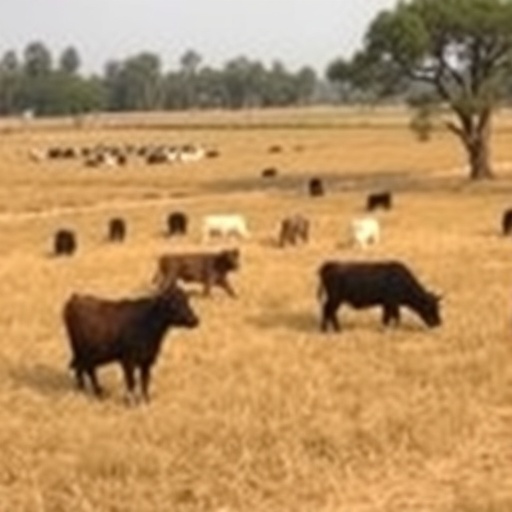
Groundbreaking research from the Potsdam Institute for Climate Impact Research (PIK) uncovers a dire future for the world’s grassland-based grazing systems as the planet warms. These vast expanses, which today span roughly one-third of Earth’s terrestrial surface and constitute the largest livestock production system globally, are headed for a precipitous decline. Projections suggest that by 2100, between 36 to 50 percent of land currently meeting the climatic criteria suitable for grazing will become inhospitable, jeopardizing the livelihoods of over 100 million pastoralists and imperiling up to 1.6 billion grazing animals.
The study, recently published in the esteemed journal Proceedings of the National Academy of Sciences (PNAS), offers a sophisticated analysis of the climatic parameters required for sustainable grazing of cattle, sheep, and goats. These systems have historically operated within a ‘safe climatic space’ characterized by temperatures ranging from −3 to 29 degrees Celsius, annual precipitation between 50 and 2627 millimeters, relative humidity from 39 to 67 percent, and wind speeds maintained at 1 to 6 meters per second. Deviations from this niche threaten the viability of grazing, triggering ecological and economic cascades.
Utilizing advanced computational simulations, the researchers meticulously modeled future climate scenarios, emphasizing the nuanced interplay of temperature, humidity, rainfall, and wind dynamics. Their findings indicate a profound contraction of these safe zones as greenhouse gas concentrations rise, fundamentally challenging centuries-old grazing practices. The diminution of these climatic niches portends significant disruptions not only to animal husbandry but also to the food systems and rural economies deeply entwined with pastoral livelihoods.
One of the key revelations is that the spatial distribution of suitable grazing lands is set to shift considerably. Regions currently thriving within the critical climatic thresholds will undergo thermal and moisture stress, pushing viable zones either poleward or toward higher altitudes. This migration of climates conducive to grazing will demand profound adaptations—or else risk the decimation of livestock populations dependent on these habitats.
Africa emerges as the epicenter of this looming crisis. Presently, the continent’s grazing ecosystems teeter at the upper temperature boundary of the identified safe climatic corridor. The study predicts an alarming reduction of grasslands by 16 percent in optimistic, low-emission futures, escalating to as much as 65 percent if fossil fuel dependency persists unabated. This stark contrast underscores the critical influence of global mitigation efforts on ecological resilience and food security.
In particular, the grazing regions of the Ethiopian Highlands, the East African Rift Valley, the Kalahari Basin, and the Congo Basin represent vulnerable hotspots. As climate belts shift southwards, these zones may effectively “disappear” from the African landmass—an insurmountable hurdle since the continent’s southern boundary meets the Southern Ocean. This geographical termination means that viable temperature ranges for grazing might simply extend into inhospitable marine environment, erasing critical grazing lands permanently.
The implications for adaptation strategies are profound. Conventional responses to climatic stress in pastoral systems, such as shifting livestock species or relocating herds, may no longer suffice when confronted with changes of this magnitude. The rapid and extensive nature of these climatic shifts imposes unprecedented constraints on traditional adaptive capacities, threatening to dismantle established livestock-based livelihoods.
Moreover, the socio-political ramifications are dire. Many regions facing the greatest climatic contractions in grazing suitability—particularly in Africa—are already grappling with chronic hunger, economic instability, political unrest, and entrenched gender inequalities. The compounded pressures from climate-induced losses in grazing lands could exacerbate vulnerability and catalyze humanitarian crises requiring urgent policy attention and intervention.
Researchers emphasize that the path forward demands immediate and substantial reductions in greenhouse gas emissions. Transitioning away from fossil fuels as swiftly as possible emerges as the paramount strategy to preserve the climatic spaces essential for sustaining global grazing systems. Failure to curtail emissions amplifies existential risks to food security and rural livelihoods, with cascading effects on biodiversity and ecosystem services.
This study’s reliance on computational modeling represents a leap forward in understanding the terrestrial impacts of climate change on agriculture. By integrating multifactorial environmental variables—temperature, precipitation, humidity, and wind—the research transcends simplistic climate projections to capture the complex conditions underpinning grazing viability. Such precision is vital for devising targeted adaptation and mitigation policies in an era of rapid climatic flux.
The findings also spotlight the urgency of incorporating climatic suitability assessments into land-use planning and livestock management frameworks worldwide. Policymakers, agricultural stakeholders, and scientists must collaborate to anticipate the spatial redistribution of grazing lands and to design resilient systems that can accommodate shifting environmental baselines.
Ultimately, this landmark research illuminates the intimate ties between climate stability and livestock farming sustainability. The contraction of global grazing systems epitomizes how climate change intersects with food production, rural economies, and social equity. The fate of over a billion grazing animals and millions of pastoralists hinges on humanity’s capacity to heed these warnings and commit to transformative climate action without delay.
Subject of Research: Not applicable
Article Title: Climate change drives a decline in global grazing systems
News Publication Date: 9-Feb-2026
Web References:
10.1073/pnas.2534015123
Keywords:
Climate change, Climate data, Climate systems, Climate zones, Range shifts


