

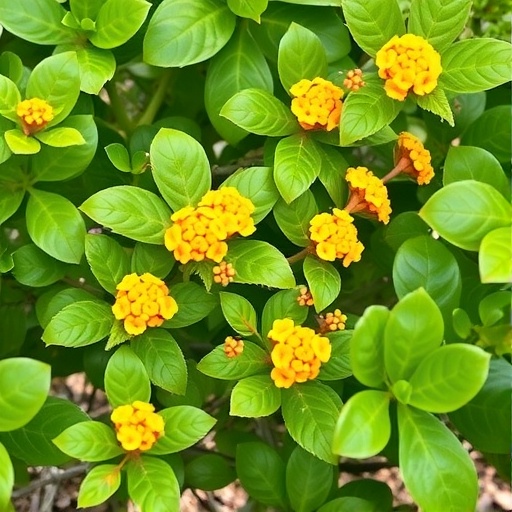
In a recent study, researchers have illuminated the intricate dynamics of invasive species, focusing on the notorious Lantana camara in the Central Himalayas. This vibrant yet aggressive plant has been a source of concern for ecologists and environmentalists alike due to its rapid spread and the significant impact it poses on local ecosystems. The study, led by Banerjee and Sati, investigates not only the current distribution of Lantana camara but also the potential future scenarios given the ongoing climate change crisis.
The study reveals that Lantana camara, native to Latin America, has established itself robustly across various landscapes. It thrives in the disturbed areas of the Central Himalayan region, often outcompeting local flora. This assertive behavior is alarming as it alters habitats, decreases biodiversity, and affects the livelihoods of those who depend on natural resources. The implications of such invasions are profound, raising critical questions regarding ecosystem stability, conservation, and management strategies in the face of climate change.
Researchers utilized advanced modeling techniques to assess the spatiotemporal patterns of Lantana camara’s invasion. They analyzed historical data and projected future distributions under various climate scenarios. The results indicated a striking correlation between rising temperatures and the plant’s invasive potential. Under predicted future climates, particularly with increased rainfall and temperature fluctuations, Lantana’s spread could greatly accelerate, threatening vulnerable plant species and disrupting ecological balances.
The study emphasizes the importance of understanding the mechanisms driving invasive species’ expansions. In the case of Lantana camara, several factors contribute to its success as an invader. Its adaptability to a range of environmental conditions, coupled with its prolific seed production, allows it to establish quickly in new areas. Furthermore, the absence of natural predators and diseases in the Himalayan ecosystem, which would otherwise keep its population in check, further exacerbates its spread.
One of the striking findings of this research is the identified hotspots where Lantana camara is likely to thrive in the future. The areas predicted to be most vulnerable are not only ecologically rich but also home to various indigenous and endemic species. This creates an urgent need for targeted management strategies that include both preventative measures and control actions. Addressing the invasive nature of Lantana camara will require collaboration among ecologists, policymakers, and local communities.
Moreover, the researchers underscore the necessity for early detection and rapid response strategies to mitigate the impact of such invasives. Public awareness campaigns can be instrumental in educating the community about the detrimental effects of Lantana camara. Engaging local populations in monitoring and managing this invasive species can foster a sense of stewardship towards the environment, which is crucial for the sustainable management of natural resources.
The implications of climate change on the spread of invasive species extend beyond mere ecological concerns; they pose significant socio-economic challenges as well. Communities reliant on agriculture and natural resources may face heightened competition with invasive species for land and resources, necessary for their sustenance. Thus, a multidisciplinary approach involving ecological research and socio-economic analysis is vital in addressing this multifaceted issue.
The findings also resonate with broader global trends. As climate change continues to unfold, the patterns observed in the Central Himalayas may reflect similar dynamics in other regions impacted by invasive species. The research serves as a wake-up call, urging other ecologists to investigate local invasives and consider climate change as a critical factor in their distribution models.
Looking forward, the researchers propose several avenues for continued research. One particular area of interest is the interaction between climate change and human activities that may further facilitate the spread of Lantana camara. Understanding how socio-economic factors intertwine with ecological conditions is key to developing comprehensive management strategies that are effective and enduring.
In conclusion, this rigorous study on Lantana camara provides essential insights into the future of biodiversity in the face of climatic shifts. The presented data is not merely a narrative of an invasive species; it is a clarion call to action. As the interdependence of species and ecosystems deepens with climate change, the need for proactive measures and informed policies has never been more critical. Only through concerted efforts can we hope to mitigate the effects of invaders like Lantana camara, thereby preserving the ecological integrity of vulnerable environments such as the Central Himalayas.
In light of these findings, it is imperative for governments and conservation organizations to prioritize funding and support for invasive species management programs. Innovative solutions, including the use of technology for monitoring and managing invasive species, can offer promising pathways for effective management. The complex challenge posed by climate change and invasive species demands a collaborative approach, engaging scientists, policymakers, and local communities alike in a shared vision for the future.
In summary, the status of Lantana camara serves as a poignant reminder of the broader narrative of climate change impacts on ecosystems worldwide. As we face these challenges, it is crucial to build resilience among ecological communities and create adaptive management strategies that account for the multifaceted influences of climate. The continued study of species like Lantana camara will be vital in shaping effective conservation strategies needed to navigate a rapidly changing world.
Subject of Research: The invasion of Lantana camara in the Central Himalayas due to climate change.
Article Title: Spatiotemporal pattern and climate change impact on current and future invasion of Lantana camara in the Central Himalayas.
Article References: Banerjee, S., Sati, V.P. Spatiotemporal pattern and climate change impact on current and future invasion of Lantana camara in the Central Himalayas. Environ Monit Assess 198, 93 (2026). https://doi.org/10.1007/s10661-025-14939-x
Image Credits: AI Generated
DOI: https://doi.org/10.1007/s10661-025-14939-x
Keywords: climate change, invasive species, Lantana camara, Central Himalayas, biodiversity, ecosystem management.


