

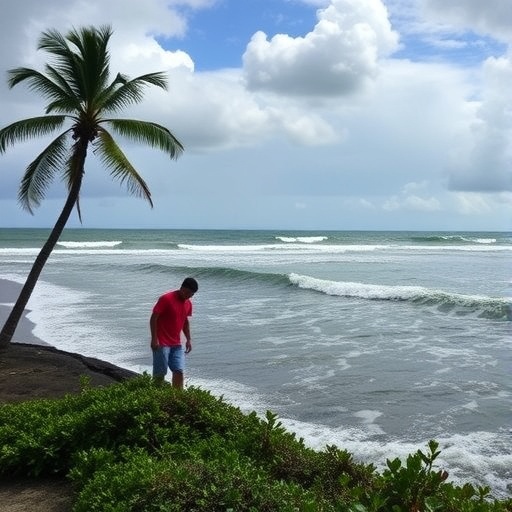
In late September 2024, the southeastern United States endured the onslaught of Tropical Storm Helene, a devastating weather event characterized by extreme winds and catastrophic flooding. This storm, intense yet not unprecedented in its meteorological nature, left behind a trail of extensive destruction and claimed more than 250 lives. Beyond the immediate human and material toll, Helene arrived amid a politically charged atmosphere, coming just a few weeks before the U.S. presidential election. This timing sparked scientific curiosity: does experiencing such a calamitous natural event alter public perceptions about climate change or shift political support towards more stringent environmental policies?
To explore this question with scientific rigor, researchers embarked on a longitudinal study involving 1,155 American participants. The methodology included two waves of survey data collection—one conducted one month prior to Hurricane Helene’s landfall and a second immediately following the storm’s passage. This paired approach allowed the investigators to observe any shifts in attitudes or behaviors attributable directly to the extreme weather experience. The surveyed individuals spanned regions both affected and unaffected by the storm, enabling the comparison of geographically contingent impacts.
Contrary to what might be expected, the findings revealed no significant change in public attitudes towards climate change after the storm. Participants’ concern about extreme weather and interest in voting for candidates supporting tougher climate regulations remained notably stable. This resistance to attitudinal change persisted even among those who lived within the storm’s destructive path. These outcomes underscore the complexity of public opinion dynamics in the context of environmental disasters and challenge prevailing assumptions that firsthand experience of extreme weather events invariably heightens climate action support.
Magnus Bergquist, Associate Professor of Psychology at the University of Gothenburg and co-author of the study, emphasized the importance of their research design in producing these insights. Earlier studies on the relationship between catastrophic weather and climate belief often relied on cross-sectional data, which limits the capacity to infer causality. By capturing data before and after the storm from the same individuals, this study concretely demonstrates that a severe hurricane did not induce measurable changes in climate concern or voting inclinations during the politically sensitive period preceding the presidential election.
These findings highlight the entrenched nature of climate change attitudes and suggest that extreme weather alone may not be sufficient to shift public opinion in deeply polarized socio-political contexts. Political affiliation emerged as a far stronger determinant of voting preferences than direct storm exposure. Democrats consistently favored candidates advocating for enhanced environmental policies, while Republicans exhibited stable reluctance towards such measures. This partisan divide considerably outweighed regional differences or temporal shifts linked to the storm’s impact.
The media’s framing of Hurricane Helene likely played a pivotal role in shaping public interpretation of the event. According to PhD candidate Sofiia Skipor, media coverage predominantly concentrated on political and institutional management of the disaster rather than linking the hurricane explicitly to climate change causes. This framing potentially diminished the storm’s capacity to serve as a catalyst for public climate concern or to influence electoral decisions related to environmental policy.
The lack of attitudinal change observed after Helene contrasts with the intuitive hypothesis that increasingly frequent and severe weather disasters would naturally accelerate public recognition of climate risks. One explanation might be that the complex scientific relationships between individual extreme weather events and global climate change are not easily distillable for the general public, especially when filtered through politicized media discourses. The cognitive challenge of connecting a singular weather disaster to broader climate science may limit the storm’s impact on individual perceptions.
Moreover, this stability in climate attitudes despite dramatic environmental trauma points toward the need to reconsider assumptions underlying climate communication strategies. Public engagement efforts that rely on storm experiences to motivate climate action may be overestimating the power of such events to alter established beliefs. Tailoring communication to account for political identity and media narratives is crucial for effectively galvanizing support for environmental policy.
The study’s implications extend beyond Hurricane Helene and the United States context. As climate change progresses globally, extreme weather events will continue to increase in frequency and severity, yet the translation of these concrete experiences into widespread public and political commitment to climate mitigation remains uncertain. Understanding the psychological and sociopolitical mechanisms that mediate this dynamic is essential for crafting interventions that bridge the gap between experience and action.
In essence, the comprehensive research conducted around Hurricane Helene’s impact reveals a sobering truth: even amid direct exposure to disaster, entrenched political identities and media framing wield more influence over climate attitudes than the storm’s immediate experience. The implication for scientists, policymakers, and activists alike is the necessity to engage with the broader ecosystem of public opinion formation rather than focusing narrowly on the experiential impetus provided by extreme weather.
This study represents one of the most methodologically robust attempts to isolate the causal impact of a natural disaster on climate change perceptions and voting intentions. By employing a longitudinal panel design, the researchers have provided a benchmark against which future studies of extreme weather and attitudes can be compared. However, they caution that findings from this single event may not generalize to all types of climate-related disasters or individual-level responses, underscoring the complexity and heterogeneity of human attitudes toward climate change.
Ultimately, Hurricane Helene’s destructive power tested not only physical infrastructures but also the resilience of climate change beliefs within a polarized society. As the climate crisis deepens, bridging the gap between firsthand environmental experience and transformative social and political change will remain one of the most pressing challenges for science communicators and policymakers.
Subject of Research: People
Article Title: Attitudes unchanged: no support for increased climate change beliefs, concerns, or voting intentions after Hurricane Helene
News Publication Date: 8-Jan-2026
Web References:
References:
- Bergquist, M., Skipor, S. (2026). Attitudes unchanged: no support for increased climate change beliefs, concerns, or voting intentions after Hurricane Helene. Environmental Research Communications, DOI: 10.1088/2515-7620/ae2f91
Keywords: Climate change attitudes, extreme weather, political affiliation, Hurricane Helene, public opinion, environmental policy, media framing, longitudinal survey, causality


