

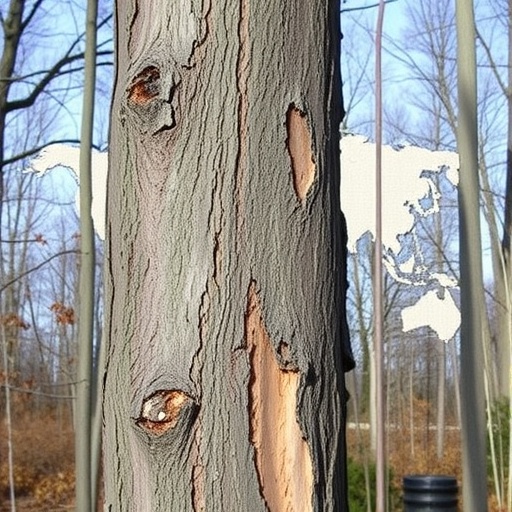
In the intricate web of forest ecosystems, the decomposition of plant material stands as a fundamental process shaping nutrient cycling and carbon dynamics. Among the various components of woody plants, bark—a complex biological layer shielding trees—has garnered limited attention in the context of decomposition science. A groundbreaking study led by Chang and colleagues published in Nature Communications unravels the global patterns and drivers behind bark decomposition, revealing how climatic variables and intrinsic bark traits synergistically dictate the pace and mechanism of decay.
The research advances our understanding by dissecting bark decomposition beyond a regional or species-specific scale. Instead, it embraces a comprehensive, global perspective spanning multiple biomes and climatic regimes. Such a wide scope allows the authors to delve into the nuanced interplay between environmental factors and functional traits of bark that collectively shape decomposition trajectories. This shift from generalized assumptions to detailed empirical scrutiny addresses a significant knowledge gap in forest ecology, especially under the lens of ongoing climate change.
Bark serves as a unique substrate that interfaces with both living wood and the external environment. Its composition—which includes lignocellulosic materials, suberin, phenolics, and various secondary metabolites—renders it chemically and structurally distinct from other plant litter components such as leaves or wood. This complexity implies that the drivers affecting bark decay may diverge from those traditionally studied or assumed. For instance, the presence of antimicrobial compounds or physical barriers in bark could modulate microbial colonization, while structural properties like thickness or density might influence exposure to environmental factors.
To capture this complexity, the study meticulously quantified bark traits across numerous species and geographies, correlating these traits with experimentally measured decomposition rates under varying climatic settings. The authors incorporated innovative methodologies involving standardized bark samples placed in diverse ecosystems worldwide, thereby minimizing methodological biases. Such a robust design ensured that observed patterns could be confidently attributed to underlying ecological drivers rather than experimental artifacts.
One of the pivotal findings highlighted the critical role of climate—temperature and moisture regimes—in accelerating or decelerating bark decomposition. Warmer and wetter environments were generally associated with faster decay rates, consistent with established theories of microbial activity augmented by favorable abiotic conditions. However, the study also uncovered deviations from this trend based on local adaptations or bark-specific features, underscoring that climate alone cannot fully explain decomposition variability.
Closely intertwined with climate, the intrinsic trait variation among bark types emerged as a powerful modulator of decomposition dynamics. Traits such as chemical composition, particularly lignin and extractive contents, influenced microbial accessibility and enzymatic degradation efficiency. Additionally, physical traits including bark thickness and density impacted microhabitat conditions, thereby affecting moisture retention and microbial habitat suitability. These findings affirm that functional traits confer resilience or susceptibility to decay in a context-dependent manner.
Beyond chemical and physical traits, the authors explored how bark-associated microbiomes contribute to decomposition. Bark surfaces harbor distinct microbial communities that initiate colonization and govern degradation pathways. By integrating trait and microbial data, the study proposed a conceptual model where climate shapes microbial community assembly, which then interacts with bark traits to determine decay outcomes. This multilayered interaction offers a nuanced understanding of bark decomposition extending beyond simplistic cause-effect narratives.
The implications of these findings reverberate through ecological and biogeochemical domains. Bark decomposition acts as a modulator of nutrient release and carbon sequestration in forests. Variations in decomposition rates induced by climate change could alter carbon fluxes, with potential feedbacks to global climate systems. Moreover, since bark provides habitats for various organisms, shifts in its decay dynamics may cascade into broader biodiversity and ecosystem functioning consequences.
Importantly, the study’s global dataset and mechanistic insights propose avenues for refining Earth system models. Current large-scale models often oversimplify litter decomposition processes, frequently ignoring the nuanced role of bark. Integrating trait-mediated and climate-dependent bark decay parameters could enhance the predictive accuracy of carbon cycling projections—an urgent need as forest ecosystems face unprecedented environmental shifts.
Furthermore, the research advances forest management perspectives. Understanding which bark traits confer greater decomposition resistance could inform tree species selection in reforestation or afforestation projects aimed at maximizing carbon storage. Similarly, insights into climate influences could guide anticipatory strategies for managing forest residue and deadwood in the face of warming conditions to mitigate wildfire risks or pest outbreaks.
The multidisciplinary nature of this investigation—interweaving plant functional ecology, microbiology, and climate science—exemplifies the sophistication required to tackle contemporary ecological questions. Its approach bridges scales from molecular and microbial processes to biome-wide patterns, delivering a holistic view rarely achieved in decomposition studies. This integrative framework sets a precedent for future research probing the interfaces of organismal traits, ecological processes, and environmental change.
To conclude, Chang et al.’s seminal work elevates the ecological significance of bark decomposition within the broader context of forest ecosystem dynamics. By illuminating how climate and bark traits jointly orchestrate decay patterns on a planetary scale, it provides a critical piece in the puzzle of global biogeochemical cycling. As climate change continues to reshape environmental conditions, such fundamental insights become indispensable for predicting and stewardship of forest resilience and carbon balance in the Anthropocene epoch.
Subject of Research: The global decomposition patterns of tree bark and the influences of climate and bark traits on these processes.
Article Title: Climate and traits drive bark decomposition patterns at global scale.
Article References:
Chang, C., Liu, J., Zhu, B. et al. Climate and traits drive bark decomposition patterns at global scale. Nat Commun 17, 299 (2026). https://doi.org/10.1038/s41467-025-68249-4
Image Credits: AI Generated


