

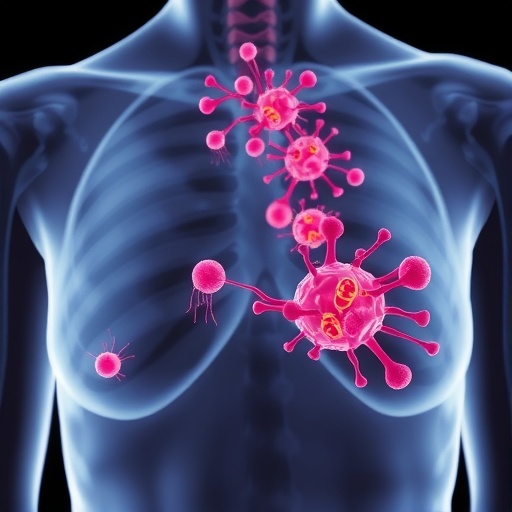
In the relentless fight against breast cancer, a formidable adversary continues to challenge clinicians and researchers alike: bone metastasis. This phenomenon, wherein cancerous cells migrate from the primary tumor to colonize the skeletal system, is a critical factor that drastically affects both prognosis and therapeutic outcomes. Recent advances have pointed to circulating tumor cells (CTCs) as pivotal players in this deadly cascade. In a groundbreaking publication set to redefine our understanding, Ma, Wang, Qiu, and colleagues delve deep into the complex mechanisms, clinical implications, and innovative directions related to CTCs in breast cancer bone metastasis.
Circulating tumor cells represent a beacon of insight into the metastatic process. These cells detach from the primary breast tumor, intravasate into the bloodstream, and navigate through the hostile circulatory environment to lodge within distant organs, predominantly the bones. Their journey is fraught with peril—from immune surveillance to physical shear stress—yet these resilient cells possess unique adaptations that enable survival and eventual colonization, making them key contributors to secondary tumor formation. Understanding the biology of CTCs offers unprecedented avenues for early detection and targeted intervention.
The bone microenvironment is uniquely conducive to metastatic colonization. It serves as a fertile “soil” according to Paget’s seed and soil hypothesis, with elements such as bone-derived growth factors and extracellular matrix components presenting a hospitable niche. CTCs engage in a dynamic crosstalk with the bone marrow stroma and osteoclasts, orchestrating a vicious cycle that promotes tumor growth and bone resorption. This interaction not only facilitates tumor establishment but also contributes to the skeletal-related events, such as fractures and hypercalcemia, which devastate patient quality of life.
A central mechanism highlighted involves the epithelial-to-mesenchymal transition (EMT), an evolutionary cellular reprogramming that confers plasticity on breast cancer cells. Through EMT, cancer cells acquire motility and invasiveness, traits that enhance their capacity to intravasate and become CTCs. Moreover, this phenotypic switch potentiates resistance to apoptosis and therapeutic agents. Identifying molecular markers of EMT within CTC populations could thus serve as a predictive biomarker for metastasis risk and treatment response.
Technological breakthroughs in detecting and characterizing CTCs have accelerated research in this field. Utilizing advanced microfluidic platforms and single-cell sequencing techniques, researchers can now isolate rare CTCs with high precision and uncover their genomic and transcriptomic landscapes. Such detailed profiling reveals heterogeneous subpopulations within CTCs, each with distinct metastatic potentials and therapeutic susceptibilities, enabling a move towards personalized medicine in breast cancer management.
Clinically, quantifying CTC levels in patient blood samples has emerged as an invaluable prognostic tool. Elevated CTC counts correlate strongly with disease progression, metastasis burden, and poorer survival outcomes. Furthermore, longitudinal monitoring of CTCs offers a minimally invasive method to evaluate treatment efficacy, detect emerging resistance, and guide therapeutic adjustments in real-time, thereby refining patient management strategies.
Therapeutic targeting of CTCs and their metastatic processes is a burgeoning frontier. Strategies aimed at disrupting CTC survival mechanisms, such as inhibition of key surface receptors involved in adhesion and homing, or modulation of EMT pathways, hold promise. Additionally, the bone microenvironment itself presents potential targets—including osteoclast inhibitors and bone-modifying agents—to halt or reverse metastatic colonization, underscoring a multipronged approach in treatment paradigms.
Emerging research also suggests that CTC clusters, groups of tumor cells traveling collectively, possess even greater metastatic potential compared to single CTCs. These clusters exhibit enhanced survival, immune evasion, and cooperative intercellular signaling, leading to more efficient colonization in secondary sites. The implications of cluster biology in breast cancer metastasis open new investigative avenues for anti-metastatic therapies.
Another dimension explored is the immunological landscape intersecting with CTC-mediated metastasis. CTCs can manipulate immune checkpoints and evade cytotoxic immune responses, effectively cloaking themselves as they traverse the bloodstream and establish new lesions. Immune modulatory strategies aiming to reinvigorate host defenses against CTCs could form essential adjuncts to conventional therapies, particularly in the context of bone metastasis.
The heterogeneity of breast cancer subtypes further complicates the interplay with CTCs. Hormone receptor-positive, HER2-enriched, and triple-negative breast cancers exhibit distinct patterns of CTC presence, EMT activation, and metastatic tropism for bone. Decoding subtype-specific CTC behaviors is crucial for tailoring precise therapeutic regimens and improving clinical outcomes.
Future directions raised by Ma and colleagues emphasize the integration of multi-omic data, including proteomic and metabolomic profiles, to build comprehensive maps of CTC biology and metastatic networks. Artificial intelligence and machine learning tools are poised to harness these data troves, enabling predictive modeling of metastasis and response to interventions with unprecedented accuracy.
Furthermore, the potential of liquid biopsies, leveraging CTC analysis in conjunction with circulating tumor DNA (ctDNA) and exosome profiling, heralds a new era in oncology diagnostics and monitoring. This non-invasive strategy promises earlier metastasis detection, real-time surveillance, and improved patient stratification in clinical trials.
Clinical translation of these insights demands rigorous validation in large, multicenter cohorts and refinement of detection technologies for widespread adoption. Collaborative efforts bridging basic science, engineering, and clinical oncology are vital to accelerate bench-to-bedside application and enhance survival rates for breast cancer patients afflicted with bone metastases.
In conclusion, circulating tumor cells occupy a strategic nexus in the metastasis of breast cancer to bone, embodying both a challenge and an opportunity for modern oncology. The comprehensive mechanistic insights and translational applications articulated in this seminal work illuminate a path forward, where precise detection and targeted disruption of these cancerous emissaries could transform outcomes. As research propels forward, the battle against metastatic breast cancer enters a new, hopeful phase driven by the promise of CTC-centered science.
Subject of Research: Circulating tumor cells in breast cancer bone metastasis
Article Title: Circulating tumor cells in breast cancer bone metastasis: mechanisms, clinical relevance, and future directions
Article References:
Ma, L., Wang, Y., Qiu, S. et al. Circulating tumor cells in breast cancer bone metastasis: mechanisms, clinical relevance, and future directions. Cell Death Discov. (2025). https://doi.org/10.1038/s41420-025-02910-1
Image Credits: AI Generated


