

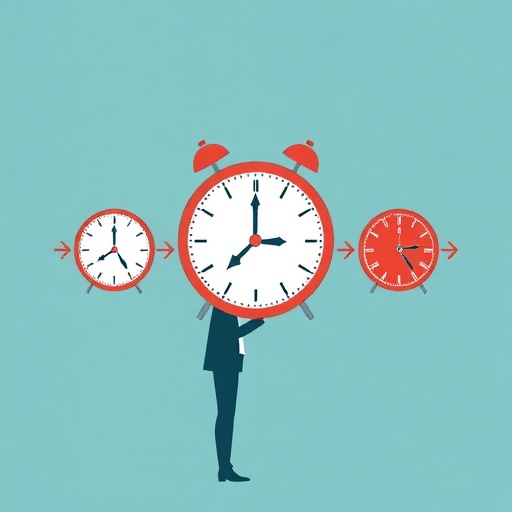
In the evolving landscape of psychological research, a groundbreaking study has illuminated the intricate relationship between an individual’s chronotype—their innate circadian rhythm preference—and the pervasive behavioral challenge of academic procrastination. Published in BMC Psychology, this research unravels not only the direct effects of chronotype on procrastination but also delves into the nuanced mediating psychological mechanisms that bridge this connection, namely future self-continuity and self-control. The findings promise to reshape how educators, psychologists, and students themselves conceptualize time management and motivation in academic contexts.
Chronotypes, generally categorized as morning types (larks), evening types (owls), or intermediate types, reflect the natural preference for sleep and activity at certain times of the day. This biological predisposition has long been hypothesized to influence behavioral patterns, but its link to procrastination, especially academic procrastination, has often been tangential. The new study articulates a clear pathway from chronotype variations to procrastinatory behaviors, mediated through cognitive and motivational constructs that govern self-regulation.
The crux of the research hinges on two pivotal psychological constructs: future self-continuity and self-control. Future self-continuity refers to the perceived connection an individual feels with their future self—the mental representation of who they will become. This psychological bridge significantly influences motivation, decision-making, and goal pursuit. High future self-continuity promotes behaviors aligning with long-term benefits, whereas low continuity predisposes individuals to prioritize immediate gratification, often at the expense of future rewards.
Self-control, the capacity to regulate impulses, emotions, and behaviors in the pursuit of longer-term goals, plays an inseparable role in mitigating procrastination. Prior work has established self-control as a fundamental personality trait influencing academic success and daily productivity; however, the interplay with chronotype and future self-continuity paints a more dynamic picture. This study demonstrates that self-control operates not in isolation but as a link within a mediating chain between chronotype and procrastination, influenced by how vividly one envisions their future self.
The researchers employed a rigorous methodology encompassing a sizable and diverse sample of college students, arguably the demographic most vulnerable to academic procrastination. Utilizing validated psychometric instruments, they assessed chronotype preference, measured individuals’ sense of future self-continuity, and gauged levels of self-control alongside self-reported procrastination tendencies. Sophisticated statistical modeling, including chain mediation analysis, allowed the researchers to dissect the intricate relationships among these variables.
One of the most striking revelations of this study is the identification of a sequential mediating effect. An individual’s chronotype influences their perception of future self-continuity, which in turn affects self-control capacities, culminating in varying degrees of procrastinatory behavior. For instance, evening types demonstrated less future self-continuity, which impaired their self-control, leading to higher academic procrastination scores compared to morning types who displayed stronger connections to their future selves and better self-control outcomes.
This nuanced understanding challenges simplistic interventions often suggested to combat procrastination, such as enforcing rigid schedules or advocating motivational slogans. Instead, it points toward personalized strategies that take into account an individual’s biological rhythms and their psychological relationship with their future identity. Tailored interventions could bolster future self-continuity through mental time travel exercises, visualization techniques, or narrative self-reconstruction, potentially enhancing self-control and reducing procrastination.
The implications of these findings extend beyond academic settings. Since procrastination permeates various life domains, including health behaviors, financial decision-making, and career development, understanding the chronotype-future self-continuity-self-control nexus offers a versatile framework for broader behavioral modification strategies. This neuropsychological perspective situates procrastination not merely as a deficit in willpower but as an outcome modulated by temporal self-perceptions rooted in circadian biology.
Moreover, the study adds to the growing evidence that intrinsic biological factors such as chronotype warrant greater emphasis in psychological research and practical interventions. Traditionally, psychological constructs were largely studied in isolation from biological rhythms, but this integrative approach underscores the necessity of multidisciplinary perspectives in comprehending human behavior.
Future research directions suggested by the authors include longitudinal designs to track changes in future self-continuity and self-control over time and their relationship with evolving chronotypes, potentially influenced by age, lifestyle, and environmental factors. They also propose exploring neuroimaging correlates that might elucidate the neural substrates underpinning the chain mediation mechanism discovered, particularly focusing on brain regions implicated in self-referential thought and executive control.
The technological advancement represented by the study’s execution, including possibly AI-assisted data analysis and visualization, symbolizes the cutting-edge nature of contemporary psychological research. Such tools enable finer resolution analyses and novel insights that were previously challenging to achieve, promising even richer understanding of complex human behaviors in future investigations.
This study fundamentally reframes procrastination as the confluence of biological timing and psychological time perspective, interconnected through self-regulatory processes. As educational institutions grapple with improving student performance and well-being, incorporating chronotype assessments and psychological interventions designed to enhance future self-continuity and self-control may prove transformative.
In summation, the research by Song, Lei, Zhang, and colleagues marks a seminal contribution to the psychology of procrastination. By intricately mapping the cascade from chronotype through future self-continuity to self-control, it lays the groundwork for sophisticated, personalized approaches to an age-old challenge. Addressing procrastination thus moves from a battle of motivation to a dialogue between biology, identity, and cognition.
Subject of Research: The psychological and behavioral interplay between chronotype preferences and academic procrastination, with a focus on mediating cognitive mechanisms.
Article Title: Chronotype and academic procrastination: the chain mediating role of future self-continuity and self-control.
Article References:
Song, J., Lei, Y., Zhang, Y. et al. Chronotype and academic procrastination: the chain mediating role of future self-continuity and self-control. BMC Psychol (2025). https://doi.org/10.1186/s40359-025-03884-6
Image Credits: AI Generated


