

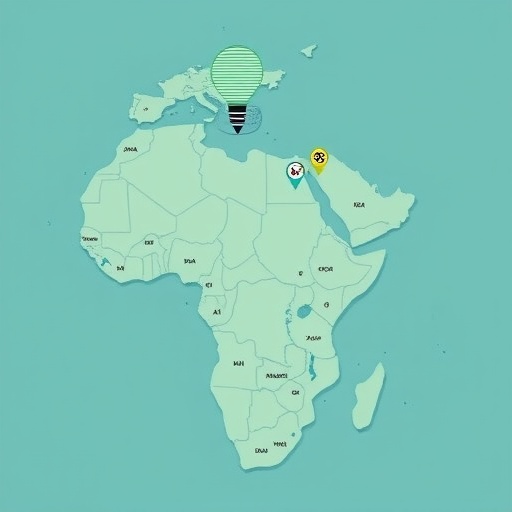
In the evolving landscape of global development, foreign direct investment (FDI) stands as a crucial catalyst for technological progress and innovation, especially in emerging economies. A groundbreaking study published in Humanities and Social Sciences Communications sheds new light on how Chinese FDI shapes the innovation capabilities of African firms, further influenced by the political dynamics within recipient countries. This research, drawing on firm-level data from the World Bank Enterprise Surveys conducted between 2018 and 2020, offers an unprecedented analysis of the interplay between foreign investment and political events in fostering industrial innovation across Africa.
One of the central revelations of the study is that Chinese FDI does not merely inject capital into African markets; rather, it acts as a conduit for technology transfer and skill augmentation, driving local firms to elevate their innovation capacity. Contrary to common apprehensions that foreign investment might lead to dependency or crowd out domestic innovation, the study demonstrates the opposite effect. African firms receiving Chinese capital significantly improve their technological capabilities, suggesting that Chinese FDI plays a constructive role in nurturing indigenous technological development in the continent.
Intriguingly, this innovation boost is not determined by foreign investment alone. The study identifies political events in host nations as vital factors that independently promote innovation while simultaneously amplifying the positive impacts of Chinese FDI. These political events range from policy reforms to diplomatic engagements, which create an enabling institutional framework that synergizes with the influx of foreign capital. This complementary relationship challenges traditional dichotomies in institutional economics which often pit market forces against political structures, underscoring instead that inclusive development hinges upon their mutual reinforcement.
The methodology employed in the study is particularly noteworthy. Utilizing data from eight African countries—Chad, Mozambique, Kenya, Morocco, Rwanda, Zambia, South Africa, and Egypt—the research team integrated comprehensive firm-level survey data with political event indicators drawn from the Global Database of Events, Language, and Tone (GDELT). This allowed for a nuanced examination of how fluctuations in political climates intersect with the inflow of Chinese FDI to influence firm innovation trajectories. Such rigorous empirical analysis transcends broad-stroke macroeconomic assessments, delivering granular insights about innovation dynamics at the operational level.
From a policy perspective, the implications of these findings are profound. African governments are encouraged to strategically attract Chinese FDI within emerging industries characterized by high innovation intensity and technological responsiveness. Sectors like information and communication technology (ICT), advanced manufacturing, and green energy are poised as prime candidates for targeted foreign investment that can yield substantive technological spillovers. Policymakers are urged to craft industrial policies and tax incentives adept at channeling foreign capital into these sectors to maximize development impact.
Moreover, the study stresses that political engagement and diplomatic cooperation form a critical scaffold supporting the productive deployment of FDI. Governments fostering robust international collaborations and research partnerships create stable institutional environments conducive to innovation. Encouraging Chinese investors to diversify collaboration modes—including joint ventures, capacity-building initiatives, and technology co-development—ensures that investment transcends financial inputs, enriching local innovation ecosystems and market access.
For business leaders in Africa, the research advocates a paradigm shift towards indigenous innovation as the cornerstone of corporate strategy. African firms are urged to embed technological development deeply within their organizational fabric, building adaptable structures and management systems aligned with the accelerating digital economy. Investments in internet-related technologies, workforce upskilling, and institutional agility emerge as key enablers for sustained innovation in the face of rapid technological transformation.
Particularly within manufacturing sectors, the study highlights the opportunity and necessity for joint initiatives with Chinese enterprises. Collaborations focused on intelligent production, automation, and local research and development activities can propel firms from resource-extractive models to innovation-led growth. This transition is pivotal for consolidating African firms’ positions in global value chains, ensuring they are not mere commodity suppliers but active leaders in technology-driven industries.
Despite its comprehensive analysis, the research does acknowledge limitations that open pathways for future inquiry. The reliance on GDELT data to quantify political events introduces challenges in capturing the qualitative nuances of these dynamics. The latitude of events ranges broadly—from cooperative diplomatic milestones to violent conflicts—each with differing impacts on innovation environments. Future research is called upon to differentiate between event types and magnitudes more accurately, potentially employing Goldstein scores that quantify event intensity to enrich interpretations.
Another data-related limitation lies in the staggered timing of World Bank Enterprise Surveys across the studied countries. Conducted over three years (2018-2020) but at different points for each nation, the dataset does not form a balanced panel, potentially affecting longitudinal comparisons. The authors express intent to expand and refine data collection to bolster the robustness and representativeness of their findings moving forward.
In sum, this innovative research enriches the discourse on the multifaceted roles of foreign investment and political institutions in shaping innovation in Africa. It reframes the narrative from viewing Chinese FDI merely as external capital inflow to recognizing it as a complex force intertwined with local political realities and institutional capacities. By embracing this intertwined dynamic, policymakers and business leaders alike can strategically harness foreign capital and political stability to bridge technology gaps and stimulate sustainable economic transformation.
As Africa stands on the cusp of a digital revolution and industrial diversification, insights from this study present a compelling roadmap for integrating global resources with local ambitions. Embracing collaborative innovation backed by coherent governance and targeted investment policies promises not only economic growth but the empowerment of African firms as vanguards of technological progress within their respective regions and on the global stage.
This research pioneers a novel lens into how the symbiosis between international investment and domestic political landscapes can be leveraged for inclusive innovation, setting a foundation for future empirical studies and policy experimentation worldwide. With technology-driven growth at the heart of global competitiveness, understanding and fostering this delicate balance will be critical in shaping resilient economies in the face of rapid geopolitical shifts and technological disruptions.
The intricate ties revealed between foreign capital flows and host country politics underscore the imperative for multilevel coordination—linking domestic governance reforms to international diplomatic engagements. Such coordination can facilitate robust innovation ecosystems that transcend mere financial attraction, embedding enduring technological capabilities and institutional strength that accelerate African countries’ leap toward knowledge-based economies.
Ultimately, this work champions a forward-looking vision where African firms, governments, and foreign investors collectively contribute to a vibrant innovation landscape—one that propels sustainable development, broader economic inclusion, and global technological leadership.
Subject of Research: The study examines the influence of Chinese foreign direct investment and political events on the innovation capacity of African firms, focusing on firm-level data in Africa from 2018 to 2020.
Article Title: Chinese FDI, political events in recipient countries, and the innovation of African firms.
Article References:
Wan, Y., Hu, Y. & Gao, Y. Chinese FDI, political events in recipient countries, and the innovation of African firms. Humanit Soc Sci Commun 12, 1885 (2025). https://doi.org/10.1057/s41599-025-06154-3
Image Credits: AI Generated


