

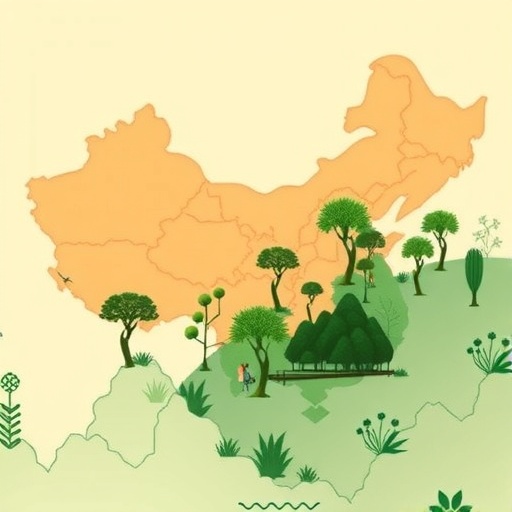
In recent years, the complex dynamics of carbon fluxes have been the center of intense scientific inquiry, especially considering their critical role in global climate regulation. A groundbreaking study led by Chen, W., Ciais, P., Yu, K., and colleagues published in Nature Communications in 2026 provides a comprehensive analysis of millennial-scale land carbon emissions in China and reveals how these emissions have been substantially offset by carbon sinks established over the last four decades. This research not only deepens our understanding of China’s terrestrial carbon balance but also reshapes the discourse on carbon management in one of the world’s most ecologically and economically significant regions.
The researchers embarked upon an ambitious modeling effort that reconciles millennial timescale emissions from land use changes with detailed carbon sink measurements dating back to the 1980s. China, bearing the legacy of extensive deforestation, agricultural expansion, and later, rapid industrialization, had long been considered a significant net source of carbon dioxide onto the atmosphere. However, this new study quantifies a compelling narrative: while millennia of anthropogenic disturbances have resulted in net emissions, these have been partially counteracted by ambitious reforestation, afforestation, and improved land management practices undertaken in recent decades.
By integrating high-resolution carbon flux data spanning over 1,000 years, the authors were able to dissect temporal changes in carbon sources and sinks with unprecedented precision. Critical to this effort was the deployment of novel process-based models that leveraged remote sensing data alongside eddy covariance measurements to capture the spatial heterogeneity and temporal variability of ecosystem responses. These models simulated carbon stocks and fluxes under varying land use and climate scenarios, offering a robust framework for attribution of observed changes in carbon dynamics.
The study reveals that from the year 1000 AD until the early twentieth century, China’s ecosystems underwent a gradual yet steady release of carbon driven primarily by deforestation, soil disturbance, and the expansion of cropland. While pre-industrial populations exerted moderate pressure on forests and grasslands, exponential population growth during the Qing Dynasty and even more so through the 20th century accelerated the loss of carbon-rich biomass. The cumulative emissions over this period were substantial, transforming vast tracts of carbon-storing ecosystems into net emitters.
Counterintuitively, from roughly the 1980s onward, the trajectory began to shift. The Chinese government’s large-scale ecological programs, including the Grain for Green initiative and other regional reforestation campaigns, alongside shifts toward less carbon-intensive agricultural practices, catalyzed a remarkable increase in carbon sequestration. Satellite-derived vegetation indices reveal greening trends across extensive regions once considered degraded or productive of high carbon emissions, signaling a significant increase in biomass accumulation and soil carbon inoculation.
Moreover, the research underscores the role of climate changes in modulating terrestrial carbon fluxes. Elevated atmospheric CO2 concentrations have enhanced photosynthetic rates, while warming and altered precipitation patterns have variably influenced ecosystem productivity and soil respiration processes. Employing sensitivity analyses, the researchers delineated the proportion of the observed carbon sink attributable to these environmental drivers separate from human land management, finding that policy-driven land use changes played a dominant role in recent decades.
The authors also address uncertainties that typically challenge carbon cycle reconstructions at such temporal depths, including incomplete historical land use records, varying soil carbon turnover rates, and limitations in proxy data for earlier centuries. Their multi-model ensemble approach, validated against independent paleoecological and historical documents, bolsters confidence in the central finding that China’s carbon sink over the last forty years has significantly mitigated centuries of carbon emissions.
This revelation carries profound implications for international climate change mitigation efforts. It illustrates the potential for targeted ecological restoration policies to offset historical carbon debts, providing a template for other nations confronting similar legacies of land degradation. Furthermore, it emphasizes the value of integrating millennial-scale perspectives into contemporary carbon accounting frameworks, which often limit themselves to recent decades, thereby potentially underestimating cumulative land use impacts and recent sink potentials.
The methodology developed here also advances the frontier of earth system science by coupling paleoenvironmental reconstruction with modern empirical data streams and mechanistic ecosystem modeling. This comprehensive integration allows for a more nuanced understanding of coupled human and natural systems and their evolving carbon dynamics, an essential component of predicting future climate trajectories and informing adaptive management strategies.
Beyond the purely scientific dimensions, the study encourages a re-evaluation of the narrative surrounding China’s contribution to global carbon budgets. While fossil fuel emissions undoubtedly remain the primary driver of anthropogenic climate change, the terrestrial biosphere’s role is both significant and dynamic. The contribution from land sinks pioneered in recent decades offers a cautionary tale about complacency but also a beacon of hope regarding the power of restoration and sustainable land stewardship.
Future research inspired by these findings will likely delve deeper into the mechanistic underpinnings of carbon stabilization in recovering ecosystems, encompassing soil microbial dynamics, mycorrhizal associations, and below-ground carbon persistence. Advances in digital soil mapping, isotopic tracing, and machine learning-driven data assimilation could further refine our ability to quantify and project terrestrial carbon budgets under varying socio-economic pathways.
Concomitantly, integrating socio-political analyses about policy implementation effectiveness, land tenure reforms, and local community engagement will be vital. The multifaceted nature of carbon fluxes demands interdisciplinary approaches that bridge ecological science, economics, and governance to ensure that the potentials identified translate into scalable, sustainable outcomes.
In sum, this landmark study offers not only a meticulous reconstruction of China’s terrestrial carbon history but also vital evidence of how human actions can reverse long-standing carbon emissions trends within relatively short time frames. Its implications resonate globally, informing both scientific understanding and policy design at a critical juncture in the fight against climate change.
The discovery that the carbon debts accrued over a millennium in a single nation can be substantially amortized by dedicated ecological restoration efforts within just four decades stands as a testament to the resilience of nature when coupled with concerted human willpower. It underscores a hopeful narrative in an often bleak climate discourse, reaffirming that strategic interventions in land management remain a cornerstone of global climate stabilization efforts.
As the world grapples with escalating climatic impacts, the importance of terrestrial carbon sinks, both existing and potential, cannot be overstated. This research, published in Nature Communications, will doubtless influence future climate policy and carbon accounting protocols, becoming a touchstone reference for scientists, policymakers, and environmental advocates alike seeking pathways toward a carbon-neutral future.
Subject of Research: Terrestrial carbon emissions and sinks in China over millennial timescales, with a focus on the offsetting effects of recent decades’ carbon sequestration.
Article Title: Millennial land carbon emissions in China offset by carbon sinks of the past four decades.
Article References: Chen, W., Ciais, P., Yu, K. et al. Millennial land carbon emissions in China offset by carbon sinks of the past four decades. Nat Commun (2026). https://doi.org/10.1038/s41467-026-70049-3
Image Credits: AI Generated


